

The difference between a skylight that transforms a room and one that creates problems comes down to one critical decision: skylight placement. The orientation, roof pitch, room position, and relationship to interior spaces all determine whether your skylight delivers beautiful, evenly distributed natural light or creates unwanted glare, excessive heat gain, and uncomfortable hot spots. Understanding the science and strategy behind optimal skylight placement helps Toronto homeowners — working with their certified VELUX installer — make decisions that maximize natural light benefits while minimizing thermal and comfort challenges. Toronto Skylight Installers provides expert skylight placement consultation as part of every installation, using our deep experience with Toronto’s latitude, sun angles, and climate conditions to position every skylight for optimal year-round performance.
How Orientation Affects Skylight Performance in Toronto
Toronto sits at 43.7°N latitude — the same latitude as Cannes, France, and Florence, Italy — but our continental climate produces dramatically different seasonal sun angles and weather patterns. Understanding how orientation affects skylight placement is the foundation of every successful installation.
| Orientation | Light Character | Heat Gain | Best For | Considerations |
|---|---|---|---|---|
| North-facing | Soft, consistent, diffuse — no direct sun | Lowest (minimal solar gain) | Studios, offices, kitchens, bathrooms | Highest heat loss in winter — use triple-pane |
| East-facing | Bright morning sun, shaded afternoon | Moderate (morning only) | Bedrooms, kitchens, breakfast nooks | Beautiful morning wake-up light but may overheat in summer mornings |
| South-facing | Strongest, brightest — direct sun most of the day | Highest (significant solar gain) | Living rooms, main gathering spaces | Requires solar blinds in summer; excellent passive solar gain in winter |
| West-facing | Intense afternoon and evening sun | High (hot afternoon sun) | Entertainment rooms, spaces used evenings | Most likely to overheat — use solar blinds and low-SHGC glazing |
How Roof Pitch Affects Skylight Performance
Roof pitch directly affects how much sunlight enters through the skylight at different times of year. In Toronto, the optimal pitch for year-round balanced light is approximately equal to the latitude (43°) — but most Toronto residential roofs have pitches between 4:12 (18°) and 8:12 (34°), which is lower than the ideal. Understanding this relationship helps optimize skylight placement for your specific roof.
| Roof Pitch | Angle | Winter Performance | Summer Performance | Common Toronto Home Types |
|---|---|---|---|---|
| 4:12 (low slope) | 18° | Captures less low-angle winter sun | Captures more overhead summer sun — higher heat gain | Ranch-style, low-profile homes, some 2-storey |
| 6:12 (moderate slope) | 27° | Good winter sun capture | Moderate summer exposure | Most common in Toronto 2-storey homes |
| 8:12 (moderate-steep) | 34° | Very good winter capture — close to latitude angle | Reduced summer exposure | Tudor, Victorian, steep gable homes |
| 10:12+ (steep) | 40°+ | Excellent winter sun — nearly optimal angle for Toronto | Minimal summer heat gain | Victorian, Gothic, custom designs |
Room-by-Room Skylight Placement Guide
Kitchen
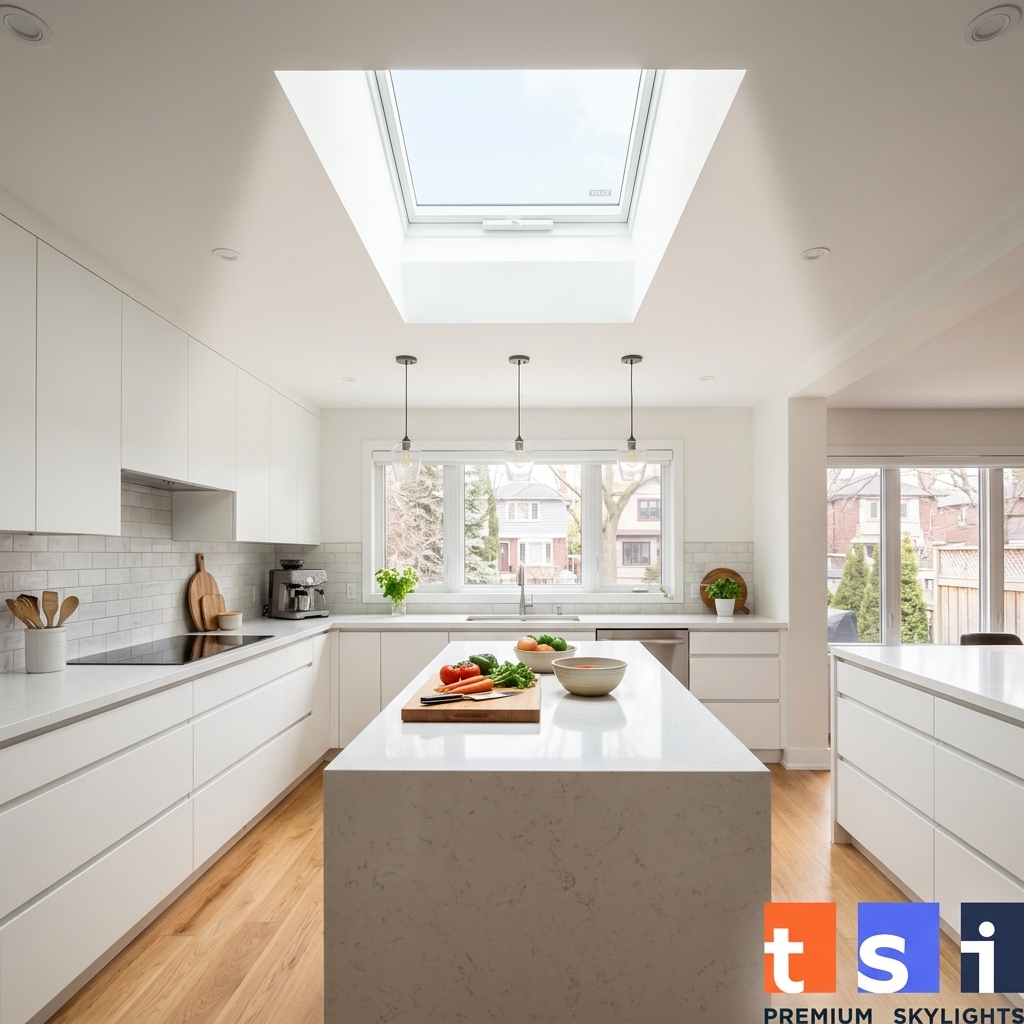
Position the skylight directly above the primary work surface — typically the kitchen island or counter. This delivers task-appropriate natural light exactly where food preparation occurs. North-facing or east-facing skylight placement is ideal for kitchens because the light is softer and does not create harsh glare on reflective countertop surfaces. Avoid south-facing or west-facing placement over kitchen work areas — the intense direct sun creates glare, overheats the cooking area, and accelerates food spoilage for items left on the counter. Toronto Skylight Installers recommends operable skylights in kitchens to exhaust cooking heat and moisture.
Living Room
South-facing skylight placement is ideal for living rooms — it delivers the strongest natural light during the day and provides beneficial passive solar heating in winter. Position the skylight away from the TV viewing area to prevent screen glare. The centre of the room or offset toward the seating area provides the most dramatic and useful light distribution. Pair with VELUX light-filtering blinds for summer heat control.
Bedroom
East-facing skylight placement provides a beautiful natural wake-up light but must be paired with room-darkening blinds for sleeping. Position the skylight above the bed or offset toward the foot of the bed — never directly above the pillow area. North-facing placement provides soft, constant light without the dramatic sun movement that disrupts sleep schedules.
Bathroom
North-facing or east-facing skylight placement provides soft, flattering light for grooming. Position above the vanity or in the shower/tub area for maximum impact. Operable skylights in bathrooms provide essential moisture ventilation — removing steam directly at the ceiling level where moisture concentrates. Sun tunnels are excellent for interior bathrooms where direct roof access is limited by upper floors.
Stairwell and Hallway
These transitional spaces benefit enormously from overhead natural light. Skylight placement at the top of a stairwell creates a dramatic light column that illuminates the entire staircase. A skylight in a long hallway breaks up the tunnel effect and makes the space feel wider and more inviting. Fixed skylights are typically sufficient for these spaces — operable models are unnecessary since ventilation is not a priority.
Light Shaft Design and Its Impact on Placement
For skylights installed in rooms below an attic (most 2-storey Toronto homes), the light shaft — the vertical or angled channel between the roof-level skylight and the ceiling-level opening — significantly affects how light is distributed in the room.
- Straight shaft: The ceiling opening is the same size as the skylight opening. Light enters as a defined beam. Simple and cost-effective to build but produces the smallest light spread
- Splayed shaft: The ceiling opening is wider than the skylight opening — the drywall shaft is angled outward. This spreads light more broadly across the room and is the most popular configuration. A full splay (all four sides angled) creates a soft, diffuse light that fills the room without creating a defined sunbeam
- Flared shaft: One or more sides of the shaft are angled toward the south or toward the primary use area. This directs more light toward a specific part of the room — useful for skylight placement over a kitchen island or work area
Common Skylight Placement Mistakes to Avoid
- Placing skylights in a valley: Roof valleys collect water and debris — a skylight positioned in or near a valley is significantly more prone to leaks and maintenance issues. Always position skylights on clear roof planes
- Too many skylights on one slope: Over-glazing a single roof slope weakens the roof structure and can create excessive light and heat in one area while leaving adjacent rooms dark. Distribute skylights across slopes for balanced light
- Ignoring the room below: The skylight opening on the roof must align with a practical ceiling opening in the room below — avoiding beams, ductwork, and plumbing. Toronto Skylight Installers surveys both the attic space and the room below before recommending placement
- West-facing skylights without blinds: West-facing skylights receive intense afternoon sun in summer — without solar blinds, they can raise room temperature by 5-10°C above comfortable levels
Skylight Placement and Toronto’s Seasonal Sun Angles
Toronto’s sun angle changes dramatically between seasons — and understanding this is essential for optimal skylight placement. In June (summer solstice), the noon sun angle is approximately 70° above the horizon — nearly overhead. In December (winter solstice), the noon sun drops to approximately 23° above the horizon — a dramatic 47° difference that fundamentally changes how light enters through roof-mounted skylights.
This seasonal variation has important implications for skylight placement on different roof pitches. On a low-pitch roof (4:12 / 18°), a south-facing skylight receives intense, nearly perpendicular summer sun — creating maximum heat gain and glare. In winter, the same skylight receives the low-angle sun at a steep angle through the glass, reducing light transmission and passive solar benefit. On a steep-pitch roof (10:12 / 40°), the summer sun hits the skylight at a lower angle of incidence (reducing heat gain), while the winter sun enters more directly — providing better passive solar heating when it is most needed. This is why steeper south-facing roof slopes generally provide better year-round skylight performance in Toronto.
For Toronto homeowners who cannot choose their roof pitch (it is already built), skylight accessories compensate for suboptimal orientation. South-facing skylights on low-pitch roofs benefit from solar-powered blinds that automatically deploy during peak summer sun hours and retract during winter to maximize passive solar gain. North-facing skylights on any pitch benefit from triple-pane glazing to minimize heat loss through the glass — since north-facing skylights receive minimal direct solar warming year-round, they are net heat loss surfaces in Toronto’s winter climate. Toronto Skylight Installers incorporates seasonal sun angle analysis into every skylight placement recommendation, using our knowledge of Toronto’s latitude and climate to position skylights for optimal year-round performance.
Professional Skylight Placement Assessment
Toronto Skylight Installers provides complimentary skylight placement assessments for Toronto and GTA homeowners. During the assessment, our certified VELUX installer evaluates your roof from both exterior and interior perspectives — identifying optimal skylight locations based on roof orientation, pitch, structural framing, existing mechanical systems in the attic (ductwork, plumbing, wiring), and the lighting needs of the room below. We use solar path analysis to predict exactly how light will enter through the skylight at different times of day and different seasons — ensuring the skylight placement delivers the light quality you want year-round without creating problems. The assessment includes a detailed recommendation with product specifications, orientation rationale, estimated light performance, and a complete installed price quote. There is no obligation — our goal is to help you make an informed decision about whether and where skylights will enhance your Toronto home. Many homeowners discover during the assessment that their original placement idea can be improved with minor positioning changes that dramatically enhance the light quality and thermal performance of the installation.
Which direction should a skylight face in Toronto?
Where is the best place to put a skylight in a kitchen?
Does roof pitch affect skylight performance?
What is a splayed skylight shaft?
Can I install a skylight anywhere on my roof?
How many skylights should I install?
Get Expert Skylight Placement — Call Toronto Skylight Installers
Toronto Skylight Installers provides expert skylight placement consultation and installation across Toronto and the GTA. As certified VELUX dealers, we use our deep knowledge of Toronto’s latitude, sun angles, and climate to position every skylight for optimal year-round performance.
Call (416) 365-7557 or request a free skylight placement consultation.
Toronto Skylight Installers — Toronto’s certified VELUX dealer for skylight installation, replacement, repair, and residential products across the GTA.