

Understanding skylight snow load Toronto requirements is one of the most overlooked parts of installing a roof window in the GTA, yet it determines whether your skylight survives 15 winters or leaks after the first hard February. When a metre of wet snow piles onto a low-slope roof and an ice dam forms at the eaves, the forces acting on a skylight curb and its flashing are far higher than most homeowners imagine. This 2026 code guide explains exactly how snow accumulation, drifting, and ice damming affect skylights on Toronto roofs, what the Ontario Building Code now requires, and how proper installation protects your home through the harshest months of the year.
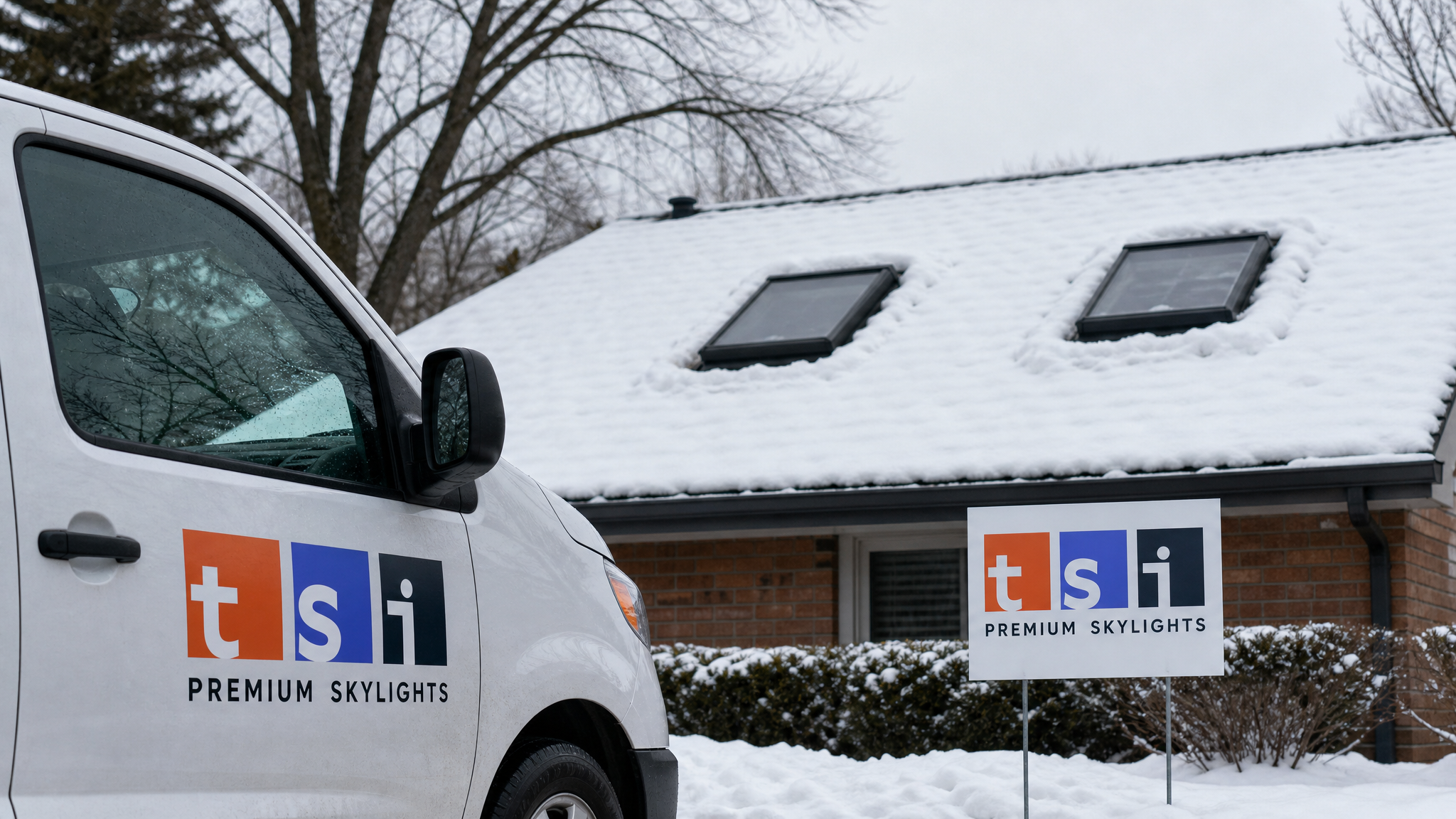
Why Skylight Snow Load in Toronto Matters More Than You Think
Snow is heavier than it looks. The skylight snow load Toronto homeowners must plan for is driven by the ground snow values the Ontario Building Code assigns to the city, combined with how that snow drifts and accumulates around roof projections. Fresh, fluffy snow weighs roughly 1.0 to 1.5 kilonewtons per cubic metre, but the saturated, compacted snow that sits on a roof in late winter can reach 4.0 kilonewtons per cubic metre or more. When that load concentrates around a skylight curb, the frame, the glass, and especially the flashing must be engineered to handle it.
Toronto sits in a climate zone where the building code specifies a ground snow load (Ss) of about 1.1 to 1.2 kPa, plus a rain-on-snow surcharge (Sr) of roughly 0.4 kPa. Those base numbers are then multiplied by shape, exposure, and accumulation factors that can double or triple the effective load on a specific part of the roof. Skylights, dormers, and parapets create exactly the kind of obstructions where snow drifts deepest. A correctly engineered skylight, installed by a team that understands these forces, will carry the load without deflection, water intrusion, or seal failure. A poorly mounted one becomes the weak point of the entire roof. This is why working with a specialist such as Toronto Skylight Installers matters: the unit, the curb height, and the flashing all have to be matched to the local load.
How the 2026 Ontario Building Code Treats Skylight Snow Loads
The Ontario Building Code, which references the structural provisions of the National Building Code of Canada, treats a skylight as part of the roof assembly, meaning it must be designed for the same specified snow loads as the surrounding structure. For 2026, designers in Toronto continue to apply the climatic data tables that set Ss and Sr for the region, then layer on the accumulation and slope factors from the structural commentary.
The key concept is the specified snow load (S), calculated as S = Is x Ss x (Cb x Cw x Cs x Ca) + Is x Sr. The accumulation factor (Ca) is where skylights demand attention, because snow sliding off upper roof surfaces or drifting against a raised curb can create localised loads well above the flat-roof baseline. On a flat or low-slope roof, the slope factor (Cs) is 1.0, meaning no relief from gravity shedding, so flat-roof skylights carry the full weight.
| Code Parameter | Toronto 2026 Value | What It Means for Skylights |
|---|---|---|
| Ground snow load (Ss) | ~1.1-1.2 kPa | Baseline roof snow weight before factors |
| Rain-on-snow (Sr) | ~0.4 kPa | Added load from rain saturating snowpack |
| Importance factor (Is) | 1.0 (normal homes) | 1.15 for assembly/critical buildings |
| Accumulation factor (Ca) | 1.0 to 2.25+ | Higher near curbs, valleys, and walls |
| Slope factor (Cs) | 0.0 to 1.0 | Steeper roofs shed snow; flat roofs do not |
For most GTA homes classified as normal importance, the importance factor is 1.0. But if a skylight sits below a taller roof section, downhill of a chimney, or within a roof valley, the local accumulation factor climbs sharply. A professional skylight installation accounts for these zones during planning, not after the snow arrives.
Ice Dams: The Hidden Threat to Toronto Skylights
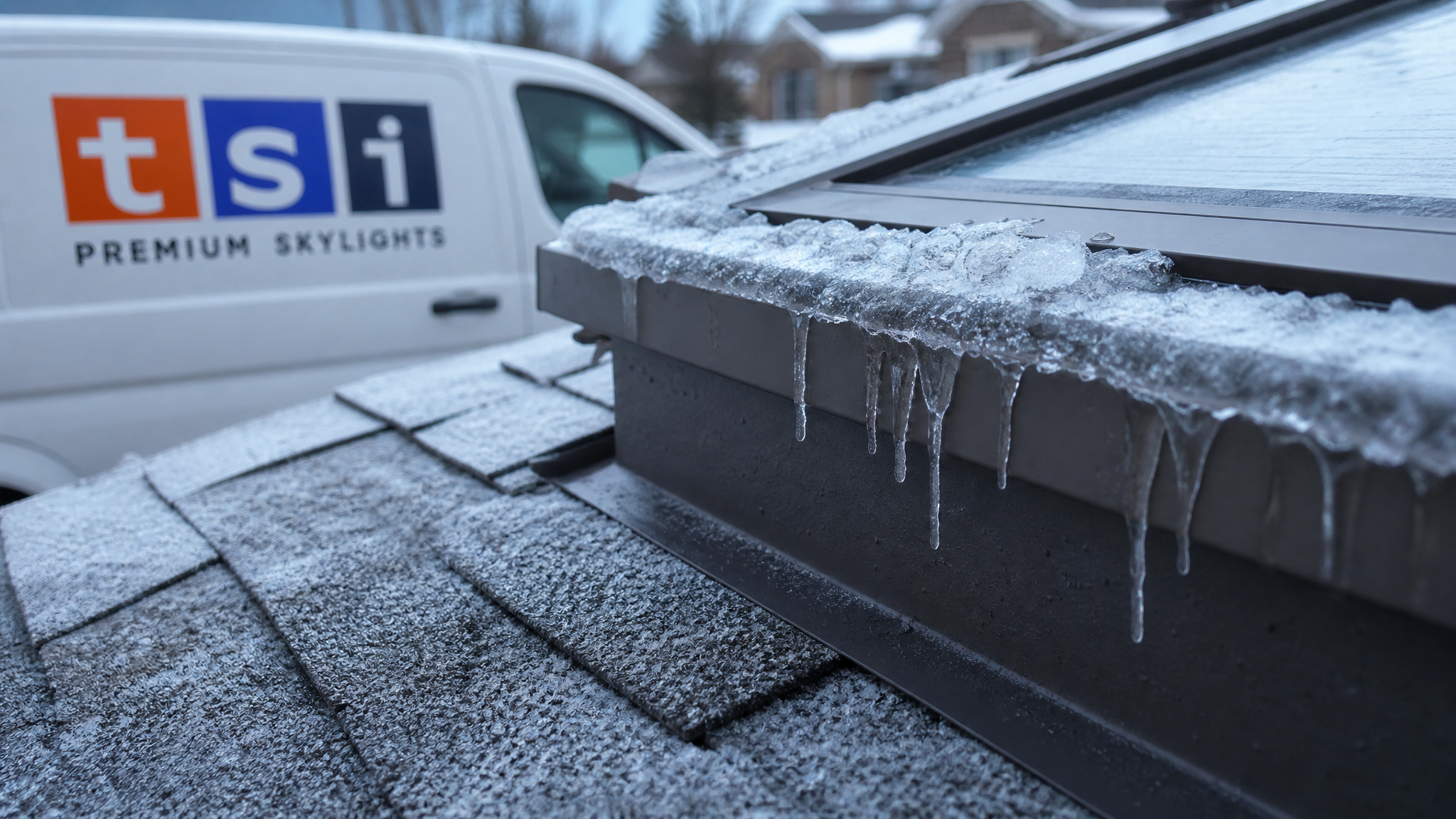
Snow load is a structural concern, but ice dams are a moisture concern, and they are arguably the more common cause of skylight failure in Toronto. An ice dam forms when heat escaping through the roof melts the bottom layer of snow, that meltwater runs down to the cold eaves or to a cold skylight curb, and there it refreezes. Over days, a ridge of ice builds and traps a pool of standing water behind it.
Because a skylight interrupts the smooth plane of the roof, it becomes a natural collection point. Meltwater migrating downslope hits the upper edge of the skylight, where it can pond and freeze. If the flashing is incorrectly lapped or the curb is too low, that trapped water finds its way under the shingles and into the curb assembly. The result is staining, rot, mould, and the dreaded interior drip that homeowners often mistake for a leaking seal.
Critically, most skylight “leaks” reported during a Toronto thaw are not the glass seal failing at all. They are ice-dam-driven water intrusion at the flashing. That distinction matters because it changes the fix entirely, and it is why a proper skylight repair begins with diagnosing the flashing and insulation, not just replacing a gasket.
| Ice Dam Risk Factor | Low Risk | High Risk |
|---|---|---|
| Attic insulation | R-50 to R-60, even coverage | R-20 or less, gaps near skylight |
| Curb height above roof | 150 mm (6 in) or more | Under 75 mm or curb-mounted flush |
| Ice-and-water membrane | Wraps full curb + 600 mm out | Felt only, no peel-and-stick |
| Attic ventilation | Balanced soffit-to-ridge | Blocked soffits, no intake |
| Skylight age | Under 15 years, sealed glass | 20+ years, single glazed |
How Roof Slope and Skylight Type Change the Load Equation
The angle of your roof dramatically changes how snow behaves around a skylight. On a steep-slope roof (over about 30 degrees), snow tends to slide off, reducing the retained load on the deck panel itself but increasing the danger of snow sliding onto a lower skylight or onto people below. On a low-slope or flat roof, snow stays put, accumulates, and saturates, putting the full design load directly on the unit.
This is why product selection is inseparable from snow performance. A flat-roof skylight is engineered with a raised curb and a domed or stepped profile precisely to shed water and resist ponding under heavy, wet snow. A pitched-roof deck-mounted unit relies on gravity drainage and a continuous flashing kit. Choosing the wrong product for your roof geometry is one of the most expensive mistakes a homeowner can make.
| Skylight Type | Best Roof Slope | Snow/Ice Behaviour | Typical GTA Installed Cost (2026) |
|---|---|---|---|
| Fixed deck-mounted | 15-60 degrees | Sheds well, needs good flashing | $1,800 – $3,200 |
| Solar fresh-air venting | 15-55 degrees | Auto-closes in rain; good drainage | $3,200 – $5,500 |
| Flat-roof domed/curb | 0-15 degrees | Resists ponding; high curb critical | $2,500 – $4,800 |
| Sun tunnel | 15-60 degrees | Small footprint, minimal drift | $900 – $2,200 |
| Centre-pivot roof window | 15-55 degrees | Sheds well; flashing kit essential | $2,000 – $3,800 |
For venting skylights, a solar-powered fresh-air skylight includes a rain sensor that automatically closes the unit, an underrated feature during the freeze-thaw cycles common to a Toronto winter. For tight or interior spaces, a sun tunnel skylight presents the smallest roof footprint and therefore the least snow obstruction.
Installation Details That Protect Against Snow and Ice
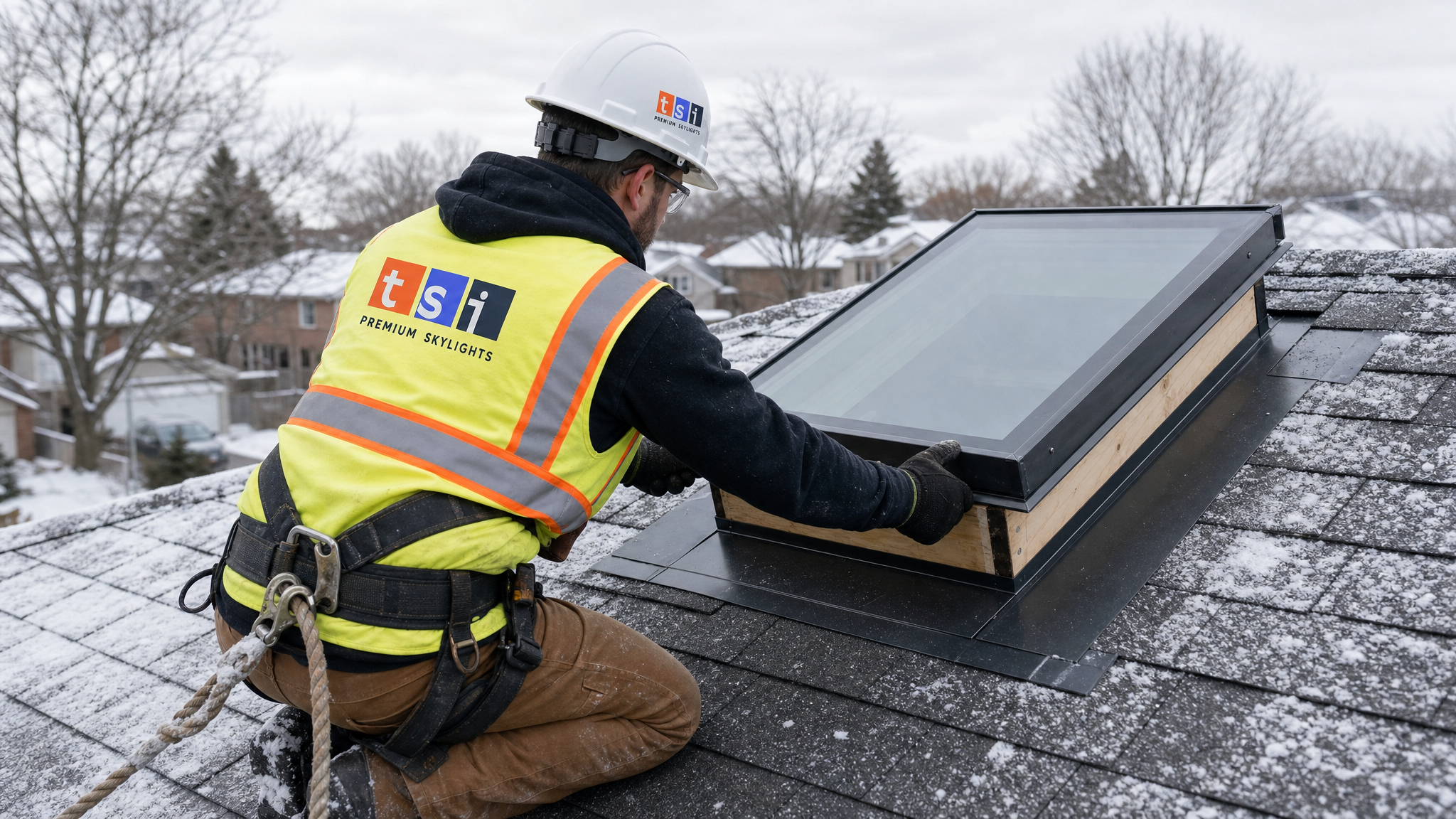
The difference between a skylight that survives 20 Toronto winters and one that fails in three comes down to installation craft. Snow load and ice dam resistance are built in at the curb, the membrane, and the flashing, in that order. Cutting corners on any of the three guarantees future water intrusion no matter how premium the glass unit is.
The most important detail is the curb height. A curb that rises at least 150 mm above the finished roof surface keeps the glass and weep channels well above the depth that ponding meltwater and ice can reach. The second detail is a continuous ice-and-water shield membrane that wraps the entire curb and extends at least 600 mm onto the roof deck in every direction, creating a self-sealing barrier under the shingles. The third is the step flashing and counter-flashing, lapped so that water always travels over, never under, the next piece downslope.
| Installation Element | Spec for Toronto Winters | Failure if Skipped |
|---|---|---|
| Curb height | 150 mm min. above roofline | Meltwater overtops, leaks inside |
| Ice-and-water membrane | Full curb wrap + 600 mm field | Ice dam water reaches deck, rot |
| Head flashing | Diverts upslope flow around curb | Snowmelt funnels into top corner |
| Insulated light shaft | R-24+ with vapour barrier | Heat loss melts snow, feeds ice dam |
| Factory flashing kit | Matched to roof type and pitch | Improvised flashing voids warranty |
A genuine, model-matched skylight flashing kit is non-negotiable. Generic or shop-bent flashing is the single most common reason older Toronto skylights leak during a thaw. When an existing unit is past its service life or was installed without these protections, a full skylight replacement with modern curb and flashing detailing is far more cost-effective than chasing leaks every spring.
Winter Maintenance and Emergency Response for Toronto Skylights
Even a perfectly installed skylight benefits from seasonal attention. Before winter, clear leaves and debris from around the curb so meltwater drains freely. Confirm your attic insulation is intact and evenly distributed around the light shaft, because warm spots melt snow unevenly and feed ice dams. After heavy storms, gently rake snow off accessible low-slope roofs to reduce both structural load and the volume of meltwater available to refreeze.
If you notice interior staining, dripping, or a visible ice ridge forming above a skylight during a January thaw, treat it as urgent. Trapped water expands as it refreezes and can crack seals and lift flashing overnight. Do not climb an icy roof yourself. Instead, arrange professional emergency skylight repairs so the source is found and sealed before it spreads into drywall and framing.
For commercial and multi-unit buildings, the stakes are higher because flat roofs hold more snow and serve more occupants. A commercial skylight requires engineered load documentation and a drainage strategy that accounts for both snow accumulation and the rain-on-snow surcharge.
Skylight Snow Load Toronto: Costs, Timelines, and What to Budget
Planning around skylight snow load Toronto realities means budgeting not just for the unit but for the curb, membrane, flashing, and any insulation upgrades that prevent ice dams. A new energy-efficient skylight installed to current code typically pays for itself in daylighting, comfort, and avoided water-damage repairs. The table below outlines realistic 2026 GTA figures so you can plan with confidence.
| Project Scope | Typical 2026 GTA Cost | Timeline |
|---|---|---|
| Single fixed skylight, pitched roof | $1,800 – $3,200 | 1 day |
| Venting/solar skylight upgrade | $3,200 – $5,500 | 1 day |
| Flat-roof skylight with new curb | $2,500 – $4,800 | 1-2 days |
| Replacement + flashing + membrane | $2,400 – $4,500 | 1 day |
| Insulation/ice-dam remediation add-on | $600 – $1,800 | 0.5-1 day |
A new skylight installation in a previously solid roof is straightforward, while a replacement that corrects past snow and ice failures may involve curb rebuilding and deck repair. Either way, the investment in correct detailing is small compared with the cost of repairing water-damaged ceilings, insulation, and framing year after year.
How much snow load can a skylight in Toronto handle?
What causes skylights to leak during a Toronto winter thaw?
Does the 2026 Ontario Building Code have special rules for skylights?
How high should a skylight curb be for Toronto snow conditions?
Can I prevent ice dams around an existing skylight?
Is a flat-roof skylight riskier in heavy snow?
Solve Your Skylight Snow Load Toronto Concerns This Winter
Don’t wait for the first thaw to discover whether your skylight was installed for Toronto’s climate. The team at Toronto Skylight Installers specialises in code-compliant curbs, factory flashing kits, and ice-dam-resistant detailing engineered for GTA winters, so your skylight delivers daylight without water worries.
Call us today at (416) 365-7557 or book a free skylight consultation to have your roof and snow-load conditions assessed by certified VELUX-trained professionals.
Toronto Skylight Installers proudly serves homeowners and businesses across Toronto and the GTA with expert skylight installation, replacement, and repair built to withstand every season.