

Homeowners shopping for skylights in York Region are usually trying to solve one of two problems: a dark interior that no amount of pot lighting can fix, or an aging unit that has started to leak, fog between the panes, or drip condensation onto the ceiling below. Both are common across Markham, Vaughan, Richmond Hill, Aurora and Newmarket, and both come down to the same short list of decisions: which type of unit, which roof it is going into, which flashing system, and who does the work.
This guide covers what installing skylights in York Region actually involves in 2026, what the work costs, how Ontario Building Code and municipal permits apply, and how the region’s mix of housing affects the job. The goal is simple: give you enough practical detail that you can judge a quote properly instead of comparing two numbers on two pieces of paper.
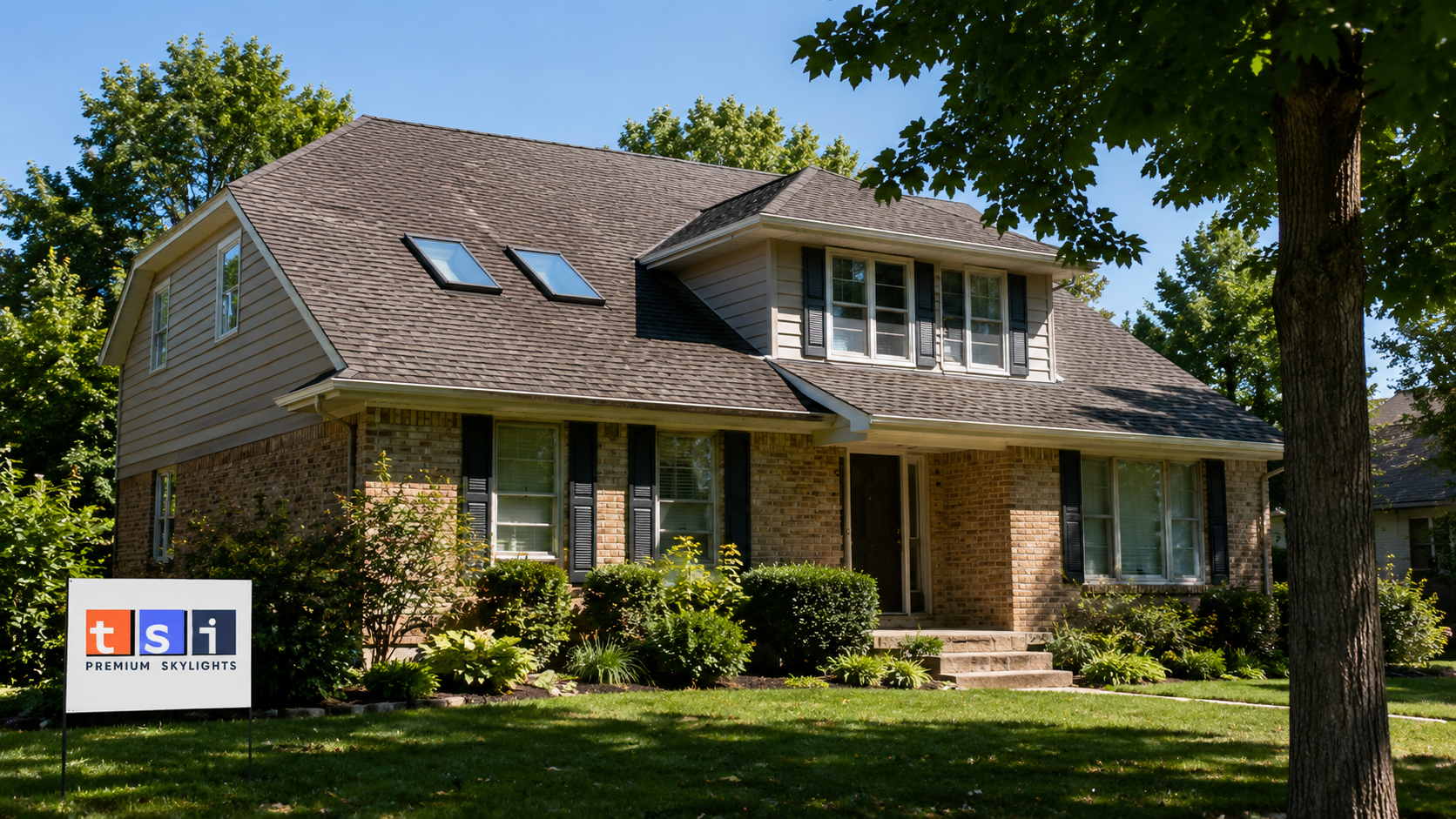
What Makes Skylights in York Region a Distinct Installation Job
The technical fundamentals of skylight work do not change from one municipality to the next, but the housing stock does, and that is what drives cost and complexity. Skylights in York Region get installed into a wider spread of roof and ceiling assemblies than you would find in a single older Toronto neighbourhood. On any given week the work can move from a 1960s side split with a shallow attic to a 2015 subdivision home with an engineered truss roof and a two storey open foyer.
Three factors matter most. The first is roof pitch. Most sloped roofs across the region sit between 4:12 and 9:12, which is well inside the operating range of standard deck-mounted units. Steeper pitches on newer executive homes make staging and fall protection more involved, which adds labour hours rather than material cost.
The second is the ceiling assembly, and it is the biggest single cost variable for skylights in York Region. A skylight in a cathedral ceiling is a relatively direct opening. A skylight in a flat ceiling with an attic above it needs a light shaft framed, insulated, vapour sealed and finished, and that shaft can easily be more work than the skylight itself. The third factor is attic ventilation and insulation quality, because a poorly ventilated attic is the single most common reason a correctly installed skylight still sweats in January.
Anyone quoting skylights in York Region should be looking at all three before giving you a price. A quote produced from photographs alone, without someone in the attic, is a guess.
York Region Housing Character and How It Affects Placement
The region’s building stock spans roughly seven decades, and each era brings its own considerations for skylights in York Region.
Postwar bungalows and side splits. These homes typically have shallow attics, smaller rafter spacing and original roof framing that was never designed around a large opening. They benefit enormously from daylight because the floor plans are compartmentalized, but they usually need a framed light shaft. Sun tunnels are often the smarter choice in a bungalow hallway or bathroom where a full skylight would mean a long, awkward shaft.
Older brick two storey homes. Common in the region’s established town centres, these often have steeper roofs and finished attic spaces or converted third floors. Placement here is usually constrained by existing framing and by where the roof plane actually faces.
Newer subdivision homes. Homes built from the late 1980s onward generally use engineered roof trusses. Trusses cannot be cut or modified without an engineered detail, so skylight width is limited to the clear space between truss chords, commonly around 22 to 24 inches. This is the single most misunderstood constraint homeowners run into. It is not the installer being difficult; it is a structural rule.
Estate lots and custom builds. Larger homes on wider lots often have complex roof geometry, multiple dormers and vaulted interior volumes. These projects tend to use larger or multiple units, and they are where electric venting and solar powered venting models earn their cost. They are also the projects where skylights in York Region are specified at the design stage rather than added later.
If you want a broader overview of the coverage area, our page on York Region skylight installation and repair services outlines what we handle across each municipality, and the detailed skylight installation service page walks through the full process step by step.
Choosing the Right Skylight Type for a York Region Home
Product selection should follow the room, not the catalogue. Here is how the main categories of skylights in York Region break down in practice.
Fixed skylights
A fixed skylight does not open. It is the most economical option, the least likely to develop a mechanical fault, and the right answer for stairwells, hallways, living rooms and any space where you want light rather than airflow.
Venting skylights
Manual venting units use a crank or pole and work well where the unit is reachable. Electric and solar powered models are the practical choice in cathedral ceilings and second storey spaces. A solar powered fresh air skylight needs no wiring run, which usually makes it cheaper to install than an electric unit even though the unit itself costs more. Venting units belong in kitchens, bathrooms and laundry rooms where moisture needs somewhere to go.
Sun tunnels
A sun tunnel uses a reflective tube to carry daylight from the roof into a small interior space. In bungalows and older side splits with long dark corridors, closets and windowless bathrooms, a sun tunnel delivers most of the benefit at a fraction of the cost and disruption of a framed shaft.
Flat roof units
Rear additions, garage conversions and modern builds with low slope sections need a flat roof skylight on a properly built curb. Curb height matters: the curb must sit high enough above the finished membrane to keep standing water and snow melt away from the seal.
What Skylights in York Region Cost in 2026
Pricing varies with unit type, glazing package, roof access and whether a light shaft is required. The ranges below reflect typical supplied and installed pricing across the Greater Toronto Area in 2026, including flashing kit, labour and cleanup, before HST.
| Skylight type | Supplied and installed range | Best suited to | Typical service life |
|---|---|---|---|
| Sun tunnel (250 to 350 mm) | $1,100 to $1,900 | Hallways, closets, small bathrooms | 25 to 30 years |
| Fixed deck-mounted | $2,000 to $3,400 | Stairwells, living areas, offices | 20 to 30 years |
| Manual venting | $2,500 to $4,000 | Reachable ceilings, bathrooms | 20 to 30 years |
| Solar powered venting | $3,200 to $5,200 | Cathedral ceilings, kitchens | 20 to 30 years |
| Electric venting (wired) | $3,600 to $5,800 | High ceilings with existing circuit access | 20 to 30 years |
| Flat roof curb-mounted | $3,000 to $6,000 | Additions, low slope sections | 20 to 25 years |
Several add-ons move the number. A framed and finished light shaft through an attic typically adds $900 to $2,500 depending on length and finish level. Blinds, whether manual, solar or hardwired, add roughly $350 to $900 per unit. Upgrading to laminated glass with a low emissivity coating and argon fill is usually worth the modest premium, and it is standard practice on skylights in York Region because winters here are genuinely cold. If the surrounding roof section is at the end of its life, replacing shingles at the same time is far cheaper than doing it twice.
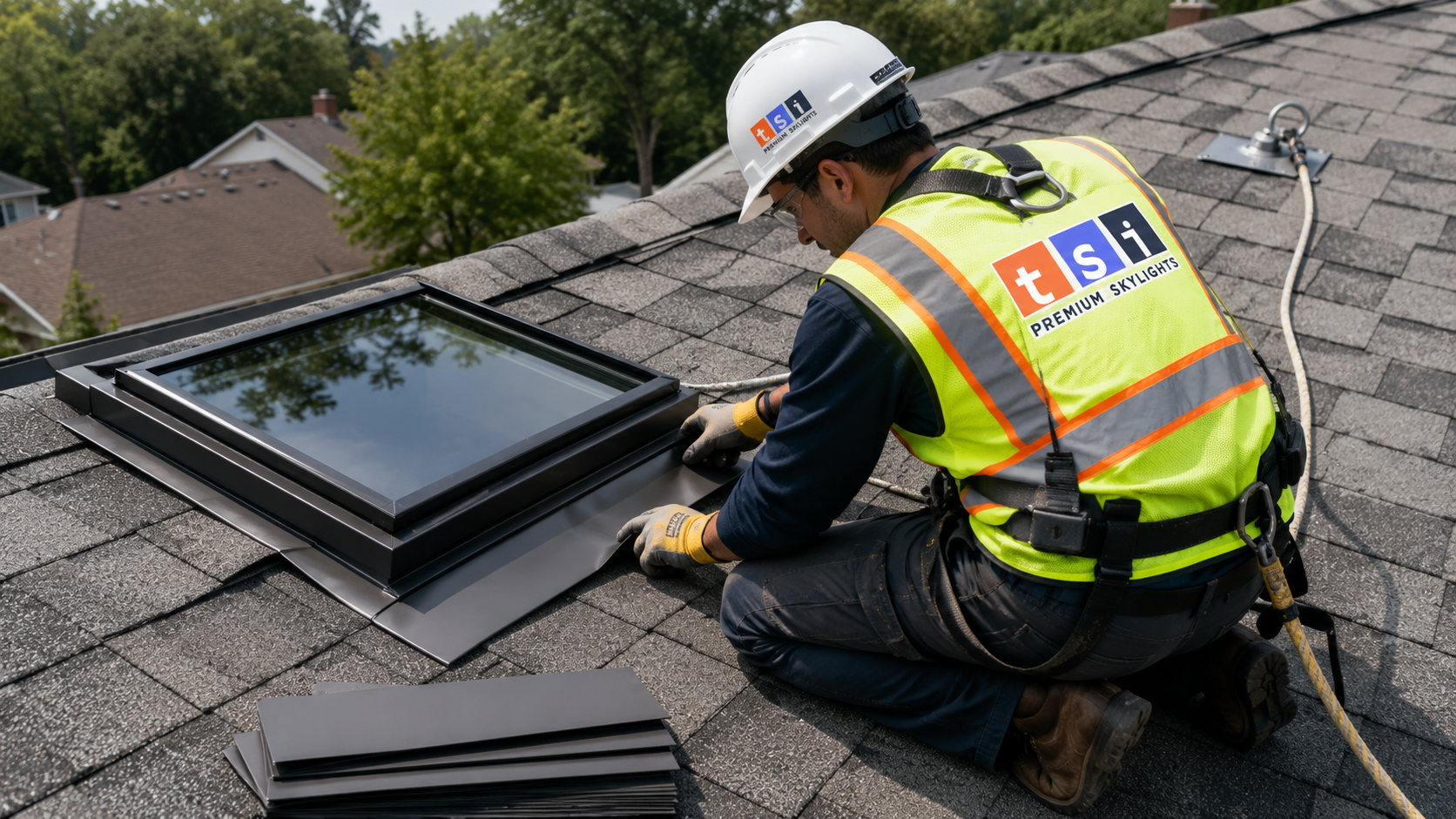
Repair or Replace: Reading the Symptoms Correctly
A large share of the service calls we take for skylights in York Region are diagnostic rather than replacement jobs. Not every problem needs a new unit, and not every problem can be sealed. The distinction usually comes down to whether the fault is in the glazing unit itself or in the surrounding roof interface.
| Symptom | Most likely cause | Usual course of action | Typical cost range |
|---|---|---|---|
| Fog or haze between glass panes | Failed seal in the insulated glazing unit | Replace the unit; the seal cannot be restored | $2,000 to $4,500 |
| Water staining at the head or sides of the shaft | Flashing failure or degraded step flashing | Reflash, often with surrounding shingle work | $650 to $1,800 |
| Droplets on the interior glass on cold mornings | Condensation from indoor humidity and weak attic ventilation | Ventilation and humidity correction, not replacement | $300 to $1,200 |
| Venting unit will not open or close | Motor, control or chain fault | Component repair or motor replacement | $400 to $1,100 |
| Cracked or spalled exterior glass | Impact damage or thermal stress | Sash or full unit replacement | $1,400 to $4,000 |
| Draft and cold spot around the frame | Missing or compressed shaft insulation | Reinsulate and air seal the shaft | $500 to $1,500 |
Condensation deserves a note of its own because it is misdiagnosed constantly. If moisture appears on the interior surface of the glass, the skylight is not leaking; it is doing what cold glass does when indoor air carries too much moisture. The fix is a combination of humidity control, exhaust fan use and, very often, correcting attic intake and exhaust ventilation. Replacing a perfectly good skylight will not solve it. Our skylight repair service starts with an actual diagnosis rather than an assumption, and a straight skylight replacement is recommended only where the unit itself has genuinely reached the end of its life.
As a general rule, a unit over twenty years old with a failed seal is worth replacing rather than patching. Modern glazing packages are meaningfully better at controlling heat loss and summer solar gain, and current flashing kits are engineered as a system with the frame rather than fabricated on site.
Permits, Ontario Building Code and Energy Requirements
Permits for skylights in York Region are set provincially and administered by each municipality, so the paperwork differs slightly between Markham, Vaughan, Richmond Hill, Aurora, Newmarket and the northern townships, but the principles are consistent.
Like for like replacement of an existing skylight in the same opening, with no change to structure, generally does not require a building permit. It is still work that must be done to code.
A new opening cut into a roof normally does require a building permit, because you are altering the structure. Where rafters or truss members are involved, the municipality may require a drawing or a letter from a professional engineer confirming the header and support details.
Under the Ontario Building Code, skylights in York Region are treated as part of the building envelope and must meet minimum thermal performance for the climate zone. In practice this means a double or triple glazed unit with a low emissivity coating and an inert gas fill. Units in wet areas and in locations where glass is overhead typically require laminated or tempered glazing. Any reputable installer supplies units that already satisfy these requirements; if a quote is unusually cheap, glazing specification is the first place to look.
Fall protection requirements under Ontario’s occupational health and safety regulations apply to every roof this work happens on. Any crew working above three metres must be tied off. If a crew shows up without harnesses and anchors, that is a liability problem for you as the property owner, not just for them.
What the Installation Process Actually Looks Like
A straightforward replacement is a one day job. A new opening with a framed shaft and interior finishing typically spans two to four days including drywall drying time. Here is a realistic sequence for most skylights in York Region.
| Stage | What happens | Typical duration | Homeowner involvement |
|---|---|---|---|
| Site assessment | Roof, attic and ceiling inspected; placement and unit type confirmed | 45 to 90 minutes | Access to attic and rooms below |
| Quote and permit | Written scope issued; permit filed where a new opening is involved | 3 to 15 business days | Approval and permit sign off |
| Opening and framing | Roof opened, header framed, curb or deck prepared | Half a day to one day | Clear the room below |
| Unit set and flashed | Skylight set, flashing kit installed course by course, roof closed | 2 to 5 hours | None |
| Shaft and interior finish | Shaft framed, insulated, vapour sealed, drywalled and taped | 1 to 2 days | Paint decision |
| Final inspection | Water test, operation check, cleanup and site walkthrough | 1 hour | Walkthrough with the crew |
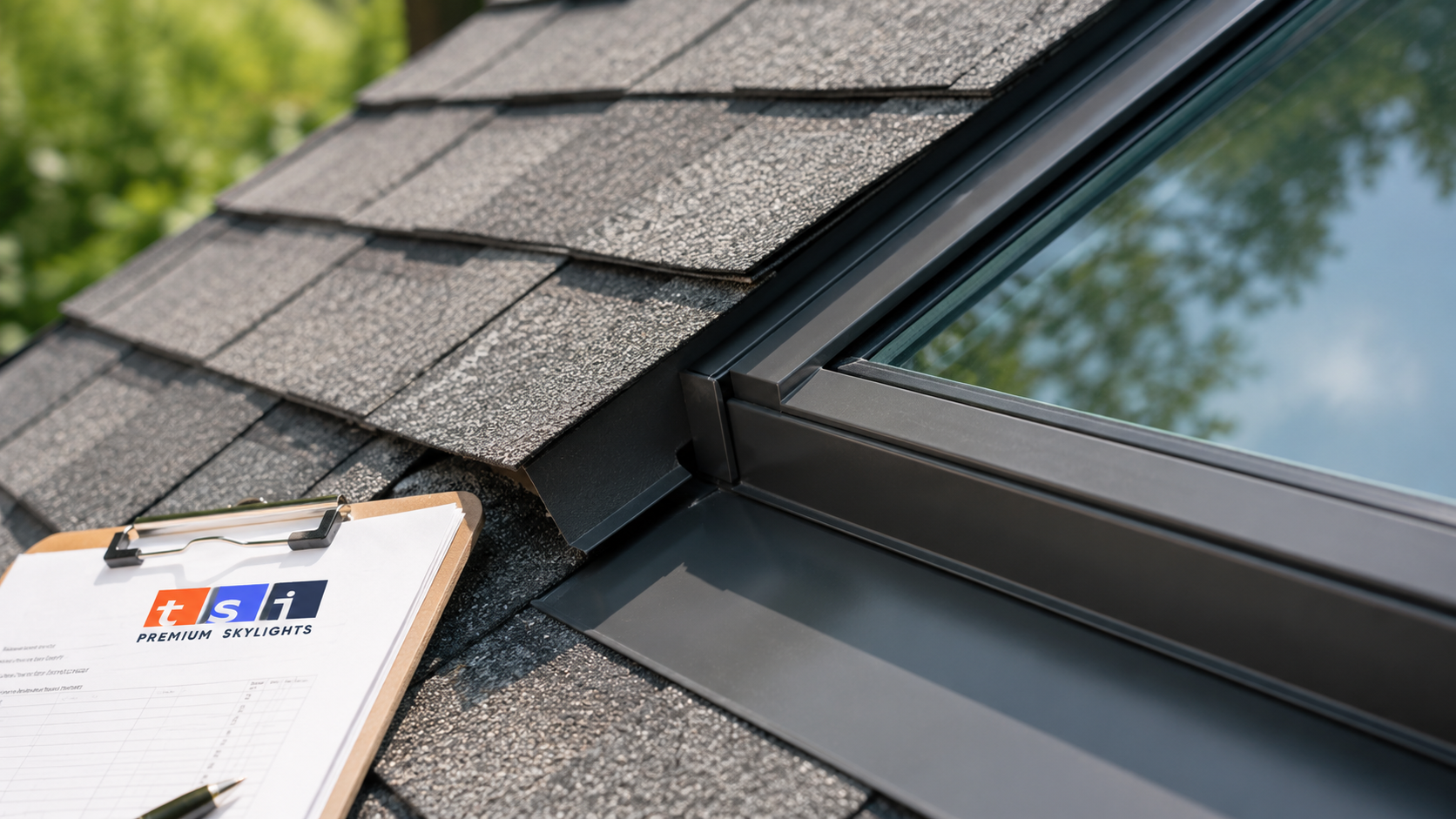
Two details separate durable work from work that leaks in year three. The first is that flashing must be woven into the roofing course by course, never surface sealed with caulking as a substitute. Caulking is a supplement, not a waterproofing method. The second is that the light shaft has to be treated as part of the insulated envelope: insulated to the same standard as the attic and air sealed on the warm side. A shaft that is drywalled without proper air sealing will produce condensation regardless of how well the skylight itself was installed.
Seasonal Maintenance and Getting the Most From the Investment
Skylights in York Region are low maintenance, not no maintenance. A short seasonal routine prevents most of the problems that turn into service calls.
- Clear leaves and debris from the head of the unit each autumn, since a dam of wet debris above the flashing forces water sideways.
- Check the exterior seals and gaskets visually once a year, ideally at the same time as gutter cleaning.
- Run bathroom and kitchen exhaust fans properly during the heating season and keep indoor relative humidity in a reasonable range, roughly 30 to 40 percent in deep winter.
- Keep attic soffit intake vents clear of blown insulation, which is a frequent cause of the moisture problems people blame on the skylight.
- Operate venting units a few times each season so motors and chains do not seize from disuse.
- After heavy ice storms, look for ice damming above the unit; a persistent dam is a ventilation and insulation symptom worth addressing.
Owners who follow this routine typically get the full rated service life out of a unit, and often more. Neglected units fail early at the flashing and at the seal, both of which are expensive to correct after water has reached the drywall. Treat skylights in York Region the way you would treat eavestroughs: a small amount of seasonal attention avoids a large repair.
Choosing an Installer for Skylights in York Region
The market for skylights in York Region includes general roofers, general contractors and specialists. All three can do good work, but the questions you should ask are the same.
Ask whether the company installs the manufacturer’s engineered flashing kit for your specific roof covering, since that single detail decides how long skylights in York Region stay watertight. Ask who frames and finishes the shaft, since a roofer who subcontracts interior work adds a coordination risk. Ask for the WSIB clearance certificate and proof of liability insurance, and confirm the crew uses fall arrest equipment. Ask what the workmanship warranty covers and for how long, separately from the manufacturer’s product warranty, which is typically ten years on the unit and twenty on the glass seal.
Finally, ask for the permit position in writing. A contractor who tells you a new roof opening never needs a permit is either uninformed or planning to skip it, and the consequence lands on your property file, not theirs. Homeowners in Markham, Vaughan, Richmond Hill, Aurora and Newmarket can confirm current requirements directly with their municipal building department before work begins.
How much do skylights in York Region cost to install in 2026?
Do I need a building permit to add a skylight?
Why is water dripping from my skylight in winter?
How long do skylights in York Region last?
Can a skylight be installed in a home with roof trusses?
Should I replace my skylight when I replace my roof?
Book Your Free Assessment for Skylights in York Region
Whether you are adding daylight to a dark bungalow hallway, replacing a fogged twenty year old unit, or planning skylights in York Region into a larger renovation, the right starting point is an on site assessment that looks at the roof, the attic and the ceiling below. Toronto Skylight Installers is based in the Toronto area and serves homeowners throughout York Region with installation, replacement and repair, using manufacturer engineered flashing systems and full interior finishing.
Call us today at (416) 365-7557 or request a free consultation. We will assess the roof, confirm what the opening will allow, explain the permit position honestly and give you a written quote for skylights in York Region with no pressure attached.
Toronto Skylight Installers proudly serves York Region, including Markham, Vaughan, Richmond Hill, Aurora and Newmarket, along with communities across the Greater Toronto Area.