

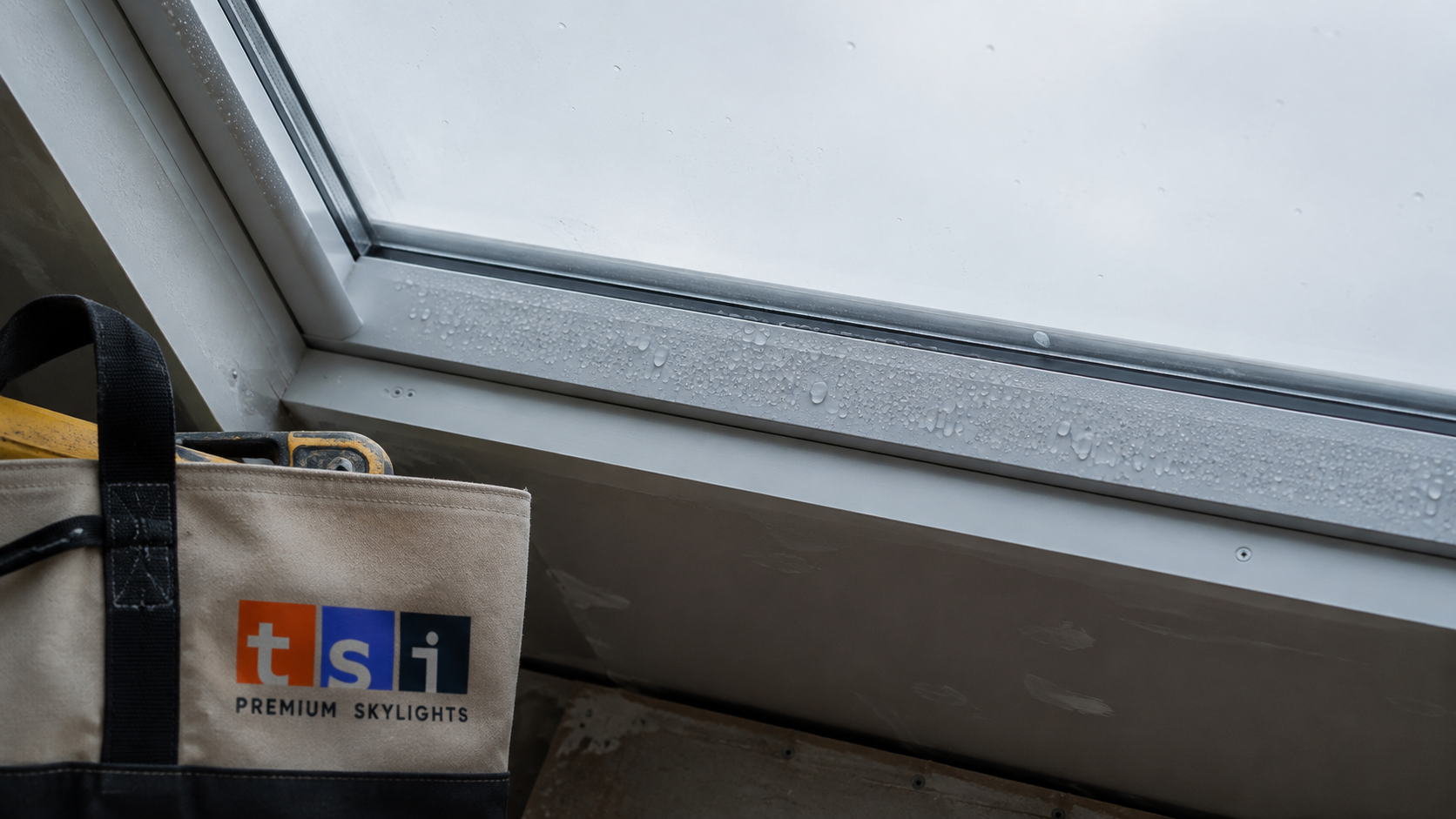
The single most useful thing a homeowner can learn about skylight repair North York is how to tell a leak from condensation, because the two look identical from inside the house and require completely different work. A leak means water is getting past the flashing or the frame, and the fix is on the roof. Condensation means warm indoor moisture is meeting a cold surface, and the fix is inside the attic and the light shaft. Every autumn, as indoor humidity rises and overnight temperatures drop, we are called to a great many North York homes where the ceiling is wet and the roof is entirely sound.
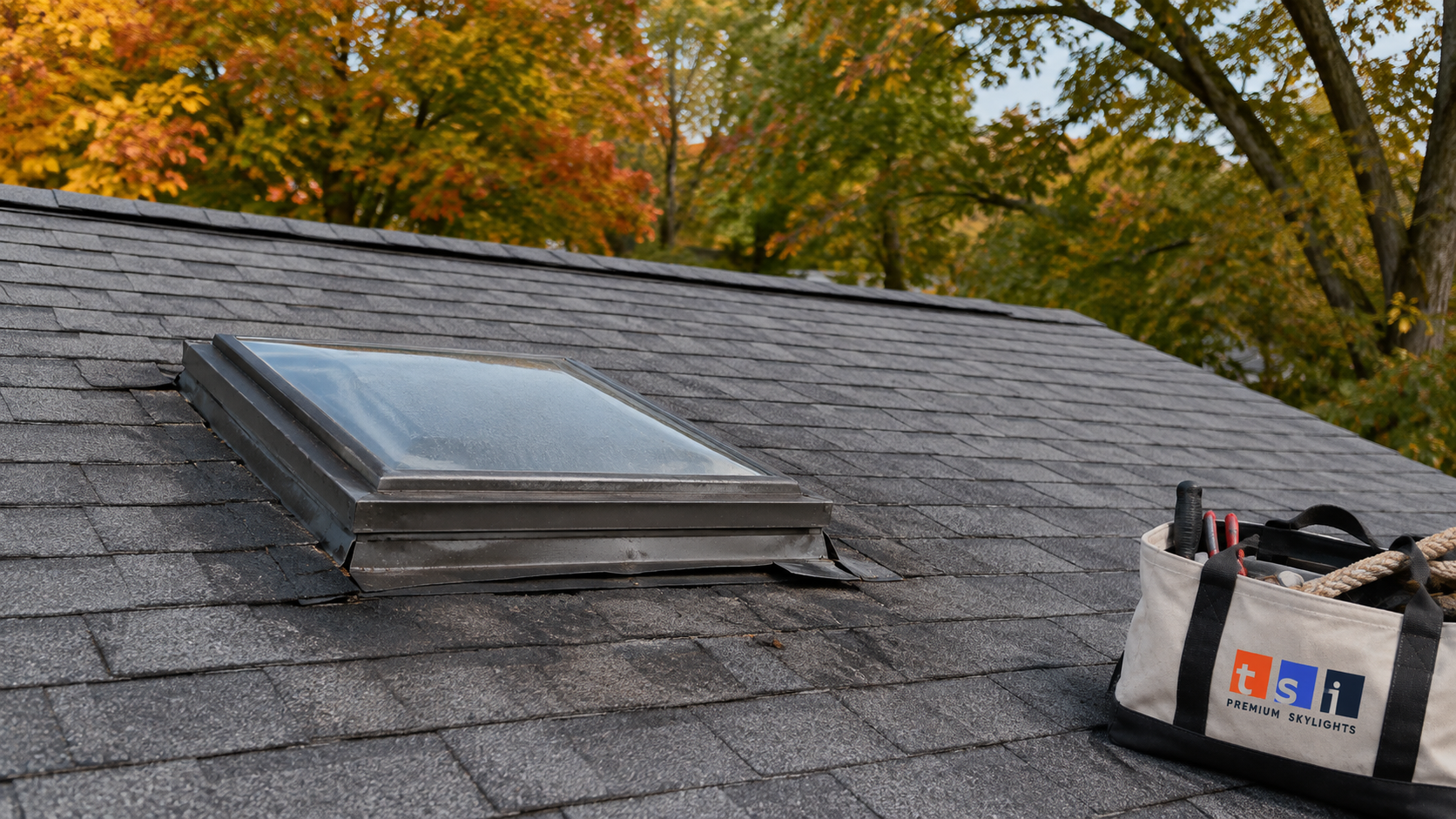
Skylight Repair North York: Leak Or Condensation?
The differences are consistent enough to be diagnostic. Work through these before anyone climbs a ladder.
| Observation | Points to a leak | Points to condensation |
|---|---|---|
| Timing | During or shortly after rainfall or snowmelt | Cold mornings, cold snaps, regardless of rain |
| Location | Often one corner or one side, sometimes running down a wall | Evenly around the interior frame or all four shaft edges |
| Appearance | Running water, staining that spreads outward, sometimes discoloured | Small even beads or a film of moisture, usually clear |
| Quantity | Can be substantial in heavy rain | Usually small, wipes away and returns |
| Seasonality | Worst in autumn rain and spring thaw | Worst in the coldest, driest outdoor weather |
| Response to indoor humidity | None | Reduces when a bath fan runs or humidity is lowered |
A practical test: run the bathroom and kitchen exhaust fans consistently for a few days during a cold, dry spell. If the moisture around the skylight diminishes noticeably, you are dealing with condensation. If it is unchanged and it returns with rain rather than cold, you have a water path and the roof needs attention.
There is a third possibility worth knowing about. Water can enter somewhere else entirely, travel along a rafter or along the top of the shaft, and appear at the skylight simply because that is the first place it can escape. This is why a competent diagnosis includes an attic inspection with a light, tracing staining back to its origin, rather than assuming the skylight is guilty because it is the nearest opening.
Why Autumn Humidity Changes The Picture In North York
Condensation problems are seasonal for a specific physical reason. Through summer, indoor and outdoor temperatures are close enough that no surface in the house is cold enough to reach the dew point. As soon as overnight temperatures fall into single digits, the underside of a skylight and the framing inside its shaft become the coldest surfaces in the house.
At the same time, indoor humidity rises. Windows close, heating starts, showers and cooking stop being vented by open windows, and in many homes a humidifier comes on. The result is warmer, wetter indoor air meeting colder surfaces, and moisture appears exactly where the insulation is weakest.
North York’s housing stock spreads this across two distinct situations. In older postwar bungalows the attic is shallow and often under insulated, with soffit vents packed with blown insulation, so the whole attic runs warm and humid and every cold surface collects moisture. In newer rebuilt homes with vaulted ceilings there is no attic at all, so the only barrier between warm interior air and the cold deck is the insulation and vapour control at the opening perimeter. Both produce the same wet ceiling by different routes.
The Genuine Causes Of Skylight Leaks
- Failed or improperly installed step flashing. The most common true cause. Step flashing must be woven course by course, each piece under the shingle above and over the one below. Where it was installed as a continuous strip or replaced with sealant, water will eventually find a path.
- Head flashing that stops water rather than diverting it. Water arriving from upslope must be carried out onto the shingle plane either side of the unit. A head detail relying on caulk fails within a few years.
- A deteriorated timber curb. Site built curbs, especially untreated ones, go soft at the corners after two decades of minor water ingress. Once the curb is soft, nothing fastened to it stays watertight.
- Frame or seal failure in the unit itself. Corroded aluminium mitres and perished gaskets let water in through the unit rather than around it.
- Ice damming above the skylight. Where attic heat loss melts snow which then refreezes at a cold eave or at the skylight head, water backs up under the shingles. The real fix is attic insulation and ventilation, not roofing.
- Debris accumulation at the head. Leaves and needles collecting above a skylight hold water against the flashing far longer than a clean roof would. This is genuinely worth clearing each autumn.
Note that four of those six are workmanship or maintenance issues rather than product failures. A modern unit installed with its matched flashing kit, on a sound deck, very rarely leaks through the unit itself.
How A Proper Diagnosis Is Carried Out
An inspection that consists of looking at the ceiling and applying a bead of sealant on the roof is not a diagnosis. A proper one has four parts.
- Interior examination. Where exactly is the moisture, what shape is the staining, and does it correspond to the shaft edges or to one corner?
- Attic inspection. With a light, tracing any staining on rafters and sheathing back upslope to its origin, and assessing insulation coverage, vapour barrier condition and whether soffit vents are clear.
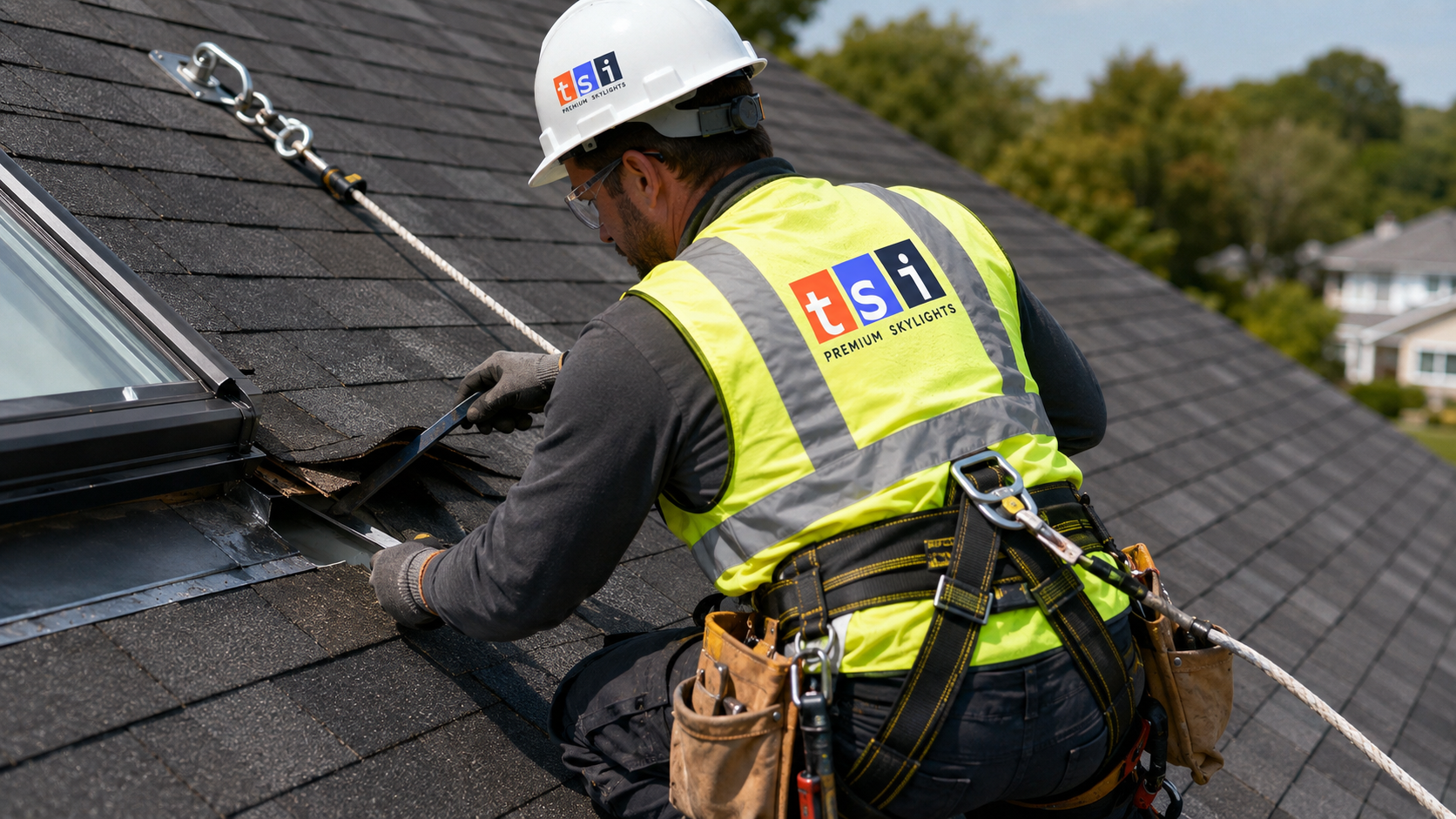
- Roof inspection. Lifting shingle courses adjacent to the unit to see the actual condition and installation of the step flashing beneath, rather than judging from the surface. Checking the head detail, the curb if there is one, and the deck for softness.
- Water testing where necessary. Controlled application of water, starting low and working upslope, with an observer inside, to establish the entry point rather than guess at it.
That process usually takes an hour or two and it is the difference between one repair and three. Our full local scope is on the North York skylight services page, and the detail of diagnostic and remedial work on our skylight repairs service page.
What Skylight Repairs Cost In North York In 2026
| Repair | 2026 range | Typical duration |
|---|---|---|
| Diagnostic inspection with attic assessment | $180 to $400 | 1 to 2 hours |
| Refit or replace step flashing on one side | $450 to $1,100 | Half day |
| Full reflash, all four sides, unit retained | $900 to $2,000 | Half to 1 day |
| Rebuild a deteriorated timber curb | $500 to $1,100 | Half day |
| Replace deteriorated deck boards around the opening | $300 to $900 | Half day |
| Insulate and vapour seal an existing light shaft | $700 to $1,800 | 1 to 2 days including finishing |
| Clear and restore blocked soffit venting | $300 to $800 | Half day |
| Replace venting hardware, where parts available | $350 to $900 | Half day |
The economics have a clear threshold. Once a repair approaches roughly half the cost of a replacement, and the unit is over twenty years old, replacement is the better decision, because the labour of opening the roof is the same either way and a new unit carries a new warranty.
Repairing The Flashing Properly
When the diagnosis is a genuine leak, the repair is almost always a flashing repair, and there is a right way and a fast way to do it.
The right way begins with removing the affected shingle courses so the flashing is fully exposed rather than partially visible. Old step flashing pieces are taken out, not bent back and reused, because metal that has worked through twenty years of thermal cycling has already fatigued at the folds. The deck beneath is inspected while it is open, and any soft boards replaced. Self adhered ice and water membrane is applied around the opening and lapped correctly with the surrounding underlayment, so that water arriving from above always travels over the membrane rather than behind it.
New step flashing then goes in course by course, each piece tucked under the shingle above it and lapping over the one below, all the way up both sides of the unit. The head flashing goes in last, under the shingles upslope, shaped so water is carried out onto the shingle plane on either side rather than dammed against the frame. The shingle courses are then cut in and reinstated so the roof reads as continuous.
The fast way is to apply sealant along the visible joint and leave. It stops the drip for a season or two while the deck underneath continues to get wet, and it makes the eventual proper repair more expensive because there is now rot to deal with as well. If a quote for a leaking skylight does not describe lifting shingle courses, it is not describing a repair.
One partial exception is worth knowing. If the unit itself is modern and sound and only one side of the flashing has been disturbed, for example by a past shingle repair or wind damage, reflashing that one side is a legitimate and economical fix. That judgement can only be made once the shingles are lifted and the rest of the assembly has been seen.
Fixing Condensation Properly
If the diagnosis is condensation, the repair is inside, and it has three components.
Insulate the shaft. The shaft walls must be insulated to current Ontario Building Code levels so their interior surfaces stay close to room temperature rather than dropping below the dew point. Many older shafts were drywalled directly onto bare framing.
Seal the vapour barrier. A continuous barrier on the warm interior side, sealed at every seam and penetration, prevents household moisture from ever reaching cold framing. This is the step most often skipped, and it is the one that actually resolves the problem.
Fix the attic. Attic insulation must be returned tightly against the outside of the shaft with no bypass gap, and soffit venting must be clear so the attic runs cold and dry rather than warm and humid.
Reducing indoor humidity helps as a supporting measure. Running bath and kitchen exhaust fans for twenty minutes after use, and turning a whole house humidifier down through the coldest weeks, both lower the dew point enough to make a marginal situation comfortable. But these are supplements. The building work is the fix.
Maintenance That Prevents Most Repairs
| Task | Frequency | Why it matters |
|---|---|---|
| Clear leaves and debris from above the unit | Twice a year, autumn and spring | Standing debris holds water against the flashing |
| Visual check of flashing and sealant condition | Annually | Catches lifted flashing before water finds it |
| Check attic for staining after heavy rain | Annually | Finds slow leaks long before the ceiling shows them |
| Confirm soffit vents are clear of insulation | Every few years | Prevents warm humid attic conditions |
| Operate venting hardware fully | Twice a year | Keeps mechanisms from seizing and failing to seat |
Autumn is the natural time for most of these. Clearing debris before sustained rain, and confirming the attic is dry and ventilated before the heating season, prevents the great majority of the problems we are called out for in January.
How do I know whether I need skylight repair North York or just better ventilation?
Can a skylight leak be sealed with caulking?
What does a skylight leak inspection cost?
Why is my skylight wet only in winter?
When is repair no longer worth it?
Could water be entering somewhere other than the skylight?
Book A Skylight Repair North York Diagnosis This Autumn
A wet ceiling under a skylight is worth diagnosing properly rather than sealing hopefully, because the wrong fix costs money and leaves the cause in place. Toronto Skylight Installers is based in the Toronto area and works throughout North York, inspecting the interior, the attic and the flashing itself before recommending anything.
Call us today at (416) 365-7557 or request a free consultation before the autumn rain and the heating season arrive together.
Toronto Skylight Installers serves North York and the wider GTA, from Downsview and Willowdale through Don Mills, Bayview Village and the communities north of the city.