

If your roof is due for new shingles, the skylights deserve a decision before the crew arrives, not on the morning of tear-off. Replacing skylights during a roof replacement is usually the most economical and watertight way to handle them, because the flashing that seals a skylight to the roof is woven into the same layers the roofers are replacing. Leave an old unit in place under a new roof, and you are often paying to disturb it again within a few years.
This guide explains why the timing works, how to judge whether your existing units are worth keeping, how skylight installers and roofers divide the work, and what upgrades are easiest while the roof is open.
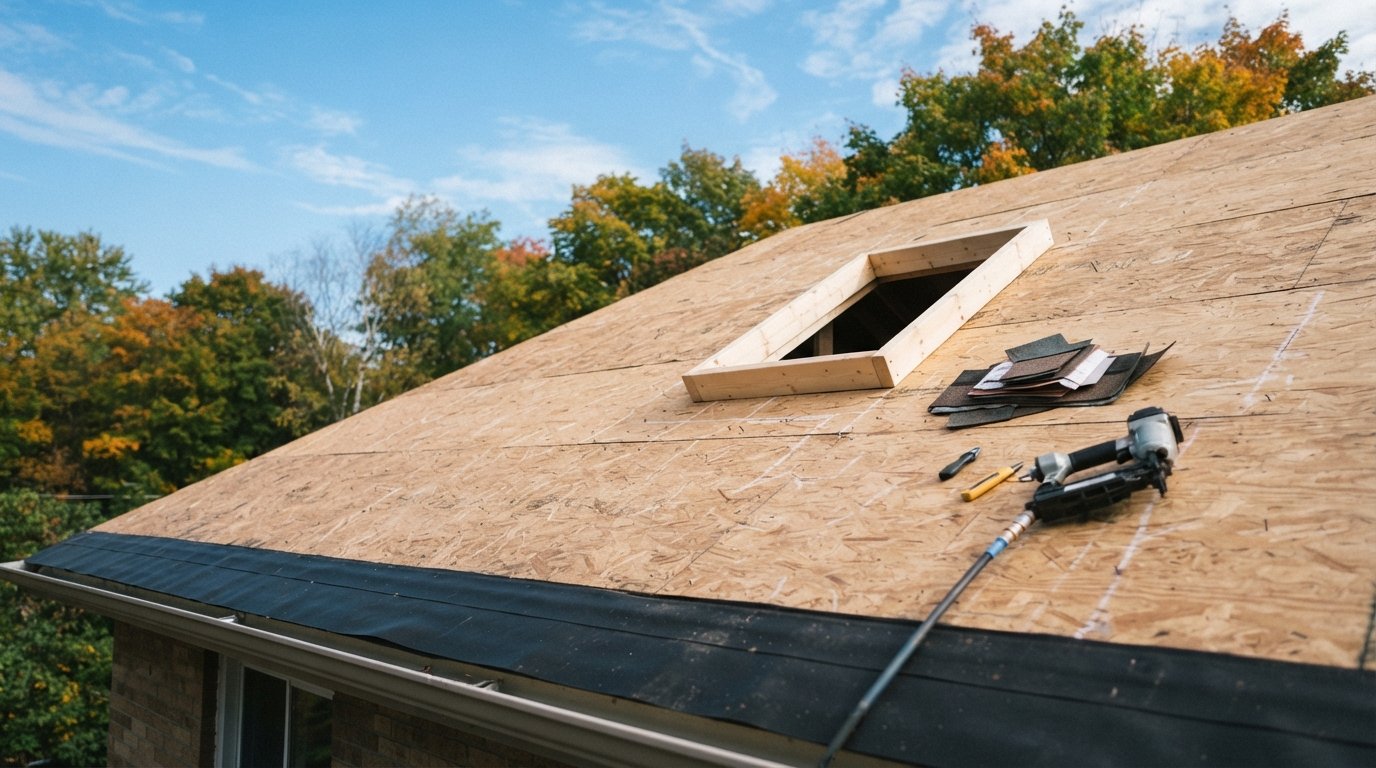
Why Skylights During A Roof Replacement Make Sense
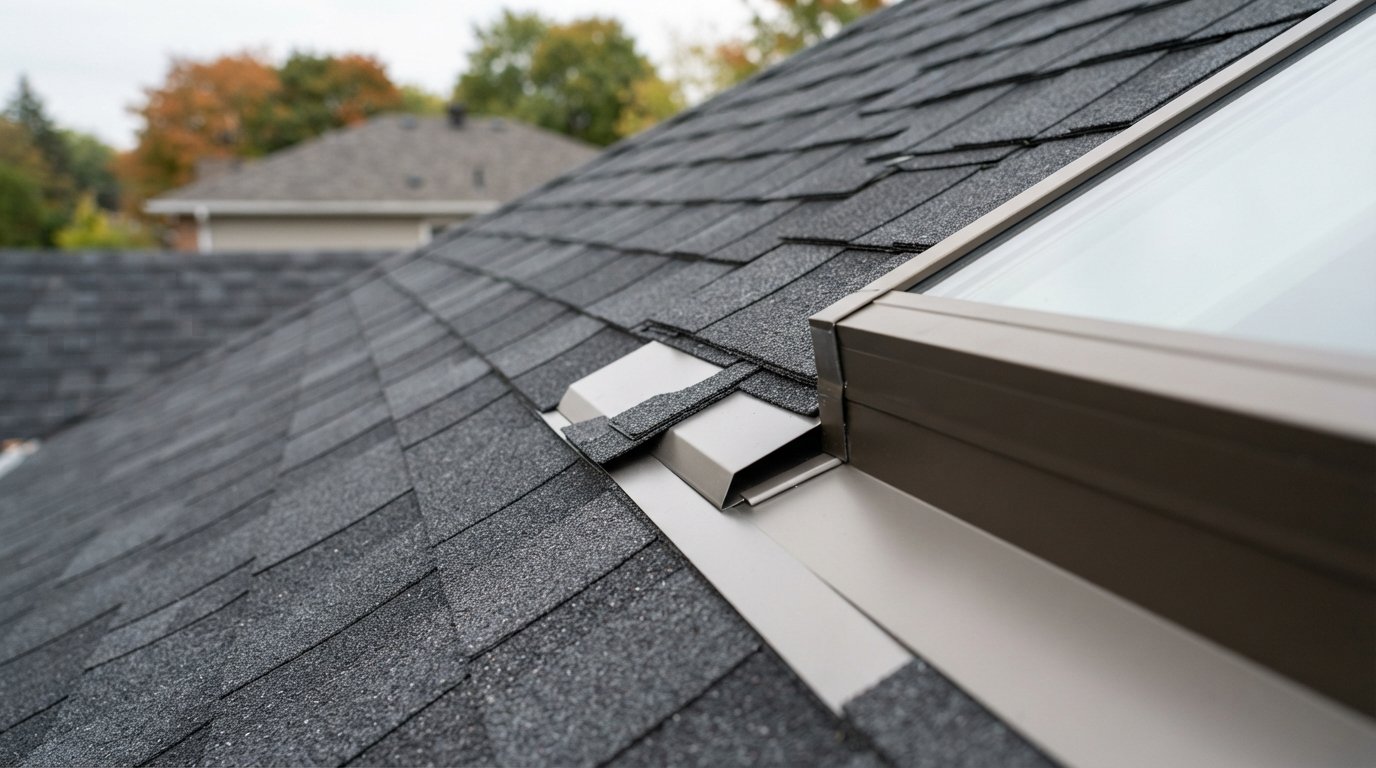
The main reason to handle skylights during a roof replacement is the flashing. A skylight on a shingle roof is sealed by a set of parts that interlock with the roofing: an underlayment collar sealed to the deck, step flashing pieces woven in with each shingle course along the sides, a head flashing at the top and an apron at the bottom. Those parts are only as good as how they lap with the underlayment and shingles around them.
When the roofers tear off, most of that assembly is disturbed anyway. Old step flashing is bent, nailed and often corroded; reusing it with new shingles is one of the most common causes of skylight leaks we are called to investigate on newer roofs. Manufacturers design their flashing kits to work with a specific frame, and installing a fresh kit with a new unit means every layer is new and lapped in the right order.
There are practical reasons too:
- Access is already set up. Ladders, fall protection and a disposal bin are on site. Adding skylight work is far less disruptive than a separate project later.
- The deck is exposed. Soft sheathing or rotted framing around the opening can be seen and fixed properly.
- The lifespans line up. Skylights and asphalt shingle roofs often have broadly similar service lives, so a unit installed with this roof can be expected to reach the next roof replacement in reasonable shape.
- No patching new shingles. Replacing a skylight a few years after reroofing means cutting into brand-new roofing and matching shingles, which rarely looks as good.
For a full description of how we remove and replace existing units, see our skylight replacement service for pitched and flat roofs.
Should Your Existing Skylights Be Replaced?
Not every skylight needs replacing when a roof does. A unit that is only a few years old, has never leaked and came with a flashing kit designed for re-roofing may be re-flashed and kept. But in practice, most skylights we see during reroofing are at least as old as the roof itself, and that changes the math.
As a working rule, if a skylight is roughly 15 years old or more, or has any history of leaking, fogging or condensation damage, replacing skylights during a roof replacement is usually the better choice. The cost of a new unit is partly offset by the labour already involved in removing and re-flashing the old one.
| Condition of existing skylight | Usual recommendation | Reason |
|---|---|---|
| Under about 10 years old, no leaks, manufacturer flashing kit available | Keep and install a new flashing kit | Unit has life left; new flashing ties into new roofing |
| Roughly 15 years or older, no visible problems | Usually replace | Seals and glass are ageing; next chance is the next roof |
| Fog between panes or cracked glass | Replace | Seal failure; fixing only the glass leaves old flashing and frame |
| History of leaks or stained shaft | Replace and inspect framing | Hidden rot around the opening is likely |
| Old acrylic dome or site-built curb | Replace, possibly convert to deck-mounted | Poor insulation and dated flashing details |
| Skylight no longer wanted | Remove and deck over | Easiest time to frame, sheath and roof the opening |
If you are unsure what to do with your skylights during a roof replacement, ask for an inspection before the roofing contract is signed. It is much easier to adjust the plan and order units in advance than to decide on the roof with the deck open and weather coming.
Who Does What: Coordinating Installers And Roofers
This is where projects most often go wrong. Handling skylights during a roof replacement means two sets of work that have to interlock, and if nobody owns the skylight flashing, it tends to be done by whoever is standing closest with a tube of sealant.
There are two common arrangements:
The roofer handles everything
Some roofing contractors install skylights themselves. That can work well if they are experienced with the specific product and follow the manufacturer’s instructions, including the underlayment collar and the full flashing kit. Ask how many skylights they install and whether they use the manufacturer’s kit or site-bent flashing.
A skylight installer works alongside the roofer
In this arrangement, the skylight installer removes the old units, repairs framing, sets the new units and installs the underlayment collar and flashing kit components, while the roofers do the rest of the roof. It needs scheduling: the skylight work has to happen after tear-off but before shingles go on around the units, and step flashing must be installed course by course as the shingles go up. That usually means either the skylight installer returns for the flashing stage, or the roofers install the kit’s step flashing following the skylight installer’s layout.
| Stage | Typical task | Who usually does it |
|---|---|---|
| Before the job | Assess skylights, choose units, order products | Skylight installer with homeowner |
| Tear-off | Strip shingles and old underlayment | Roofer |
| Old unit removal | Remove skylights, check framing and deck | Skylight installer |
| Framing and set | Repair or resize opening, fasten new unit | Skylight installer |
| Underlayment and collar | Ice and water membrane, underlayment, skylight collar | Roofer and skylight installer, in agreed order |
| Flashing and shingles | Apron, step flashing course by course, head flashing | Agreed in advance; must be one clearly responsible party |
| Interior | Shaft repair, insulation, drywall and paint | Skylight installer or finishing trade |
Whichever arrangement you choose, get the answer to one question in writing: who is responsible if the skylight flashing leaks? Roofing workmanship warranties and skylight manufacturer warranties are separate documents with separate conditions. Some manufacturer warranties depend on the unit being installed with the matching flashing kit, and some roofing warranties exclude skylights or flashing installed by others. Read the current documents for both.
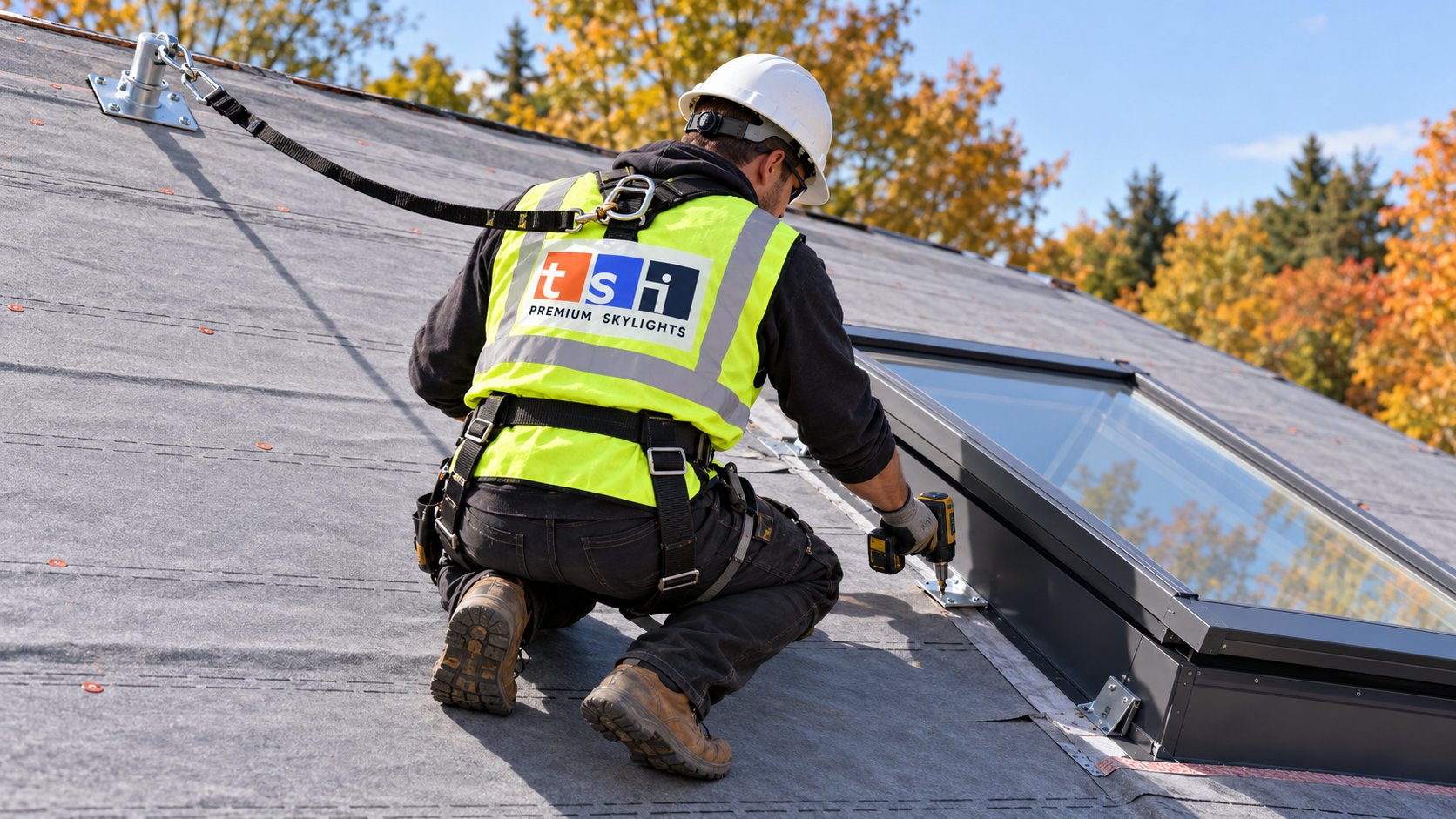
How The Day Actually Runs
On a typical single-day shingle job with one or two skylights, a well-coordinated sequence looks like this:
- Interior protection goes down under each skylight before any work starts, because debris falls into the shaft during removal.
- Tear-off exposes the deck. The roofers work around the skylight openings.
- Old units come out. The installer removes each skylight and the old flashing, and inspects the framing and deck at the opening.
- Repairs and framing. Soft sheathing is replaced, and the opening is squared or resized as planned.
- New units are set and fastened with the manufacturer’s brackets, checked for square and level.
- Membrane and collar. Ice and water protection and underlayment are installed, and the skylight’s own underlayment collar is sealed to the deck and frame, lapped correctly with the roof underlayment.
- Shingling and flashing. Roofers shingle up to the skylight, the apron goes on, step flashing is woven in with each course, and the head flashing and cladding complete the unit.
- Interior finishing follows: shaft insulation, air sealing, drywall and paint.
If the weather turns, an opening cannot sit exposed overnight. Good crews only remove a skylight they can reset and seal the same day, or they protect the opening properly. Ask how that will be handled on your job.
Upgrades While The Roof Is Open
A roof replacement is the easiest time to change anything about your skylights, because the deck and framing are exposed and the roofing is new around whatever you choose. Common upgrades include:
- Resizing. Enlarging or reducing an opening involves framing changes that are much simpler with the roofing off. Structural changes can require a permit, so confirm with your municipality.
- Fixed to venting. Switching to a venting skylight adds fresh air to kitchens, bathrooms and upper floors. A solar-powered fresh air skylight avoids new wiring through finished ceilings.
- Adding a new skylight. A new opening costs less to add when the shingles are already off. Check attic framing and interior layout first.
- Adding a sun tunnel. Tubular units suit closets, interior bathrooms and hallways under truss roofs. See our sun tunnel skylights for options.
- Removing an unwanted skylight. If a unit has caused trouble and you do not need it, the opening can be framed, sheathed and roofed over, with the ceiling patched inside.
- Better glass. Current units commonly offer low-emissivity coatings, gas fill and laminated inner panes that outperform older glazing.
| Option while reroofing | Main benefit | Typical cost range (estimate) |
|---|---|---|
| Same-size replacement, fixed unit | New flashing and glass matched to new roof | Often around $1,500 to $3,500 per unit, varies with size and access |
| Same-size replacement, venting unit | Adds ventilation | Often around $2,200 to $4,500 per unit |
| Resize or add a new framed skylight | Better light layout | Often around $3,000 to $6,000 or more, depending on framing and finishing |
| Add a tubular skylight | Light for small interior spaces | Often around $900 to $2,000 |
| Remove and deck over | Eliminates a problem opening | Often several hundred to about $1,500 with interior patching |
These are broad estimates that depend on house, roof pitch, access, unit choice and interior work. Get a written quote for your specific roof.
Flat Roofs And Curb-Mounted Units
Everything above assumes a pitched shingle roof, but the same logic applies on flat and low-slope roofs, with different details. On a flat roof, skylights usually sit on a curb, and the roofing membrane is carried up the curb sides as base flashing. When the membrane is replaced, the curb flashing is replaced with it, so handling skylights during a roof replacement on a flat roof means deciding whether the curb itself is sound, tall enough and insulated.
Older flat roofs often have short, uninsulated wood curbs under acrylic domes. Those curbs are commonly rebuilt during reroofing, sometimes taller than before, because new insulation and membrane raise the roof surface and a curb that was barely adequate becomes too low. Curb-mounted glass units from our flat roof skylights range are designed to sit on a properly built curb.
Mistakes We See After Reroofing
Many of the leak calls we get on roofs that are only a year or two old trace back to decisions made about skylights during a roof replacement. The usual culprits:
- Old flashing reused with new shingles, often with sealant added to cover gaps.
- Underlayment cut short at the skylight instead of lapped up the frame or sealed to a collar.
- Step flashing replaced by a continuous strip of metal along the side, which lets water run behind the shingles.
- Head flashing tucked in wrong, so water from above runs under it rather than over it.
- An old unit kept that fogged or leaked a year later, forcing a cut into new shingles.
None of these are exotic. They happen when nobody takes clear responsibility for the skylights and the job is treated as roofing with obstacles in the way.
Planning Timeline
A little lead time makes replacing skylights during a roof replacement much smoother. Book a skylight assessment as soon as you have a roofing date, ideally several weeks ahead, because some units and sizes need to be ordered. Early autumn is a popular window for reroofing across the GTA, and skylight products for a September or October roof should be confirmed early. If you are in the western GTA, our Peel Region skylight installation, replacement and repair team can coordinate directly with your roofer.
Before tear-off day, confirm the following with both contractors:
- Which units are being replaced, kept, added or removed.
- That products and flashing kits are on site, and in the right sizes.
- Who installs each flashing component, and in what order.
- How openings are protected if the weather changes.
- Who repairs the shaft and ceiling inside, and when.
- Which warranties cover what, and who to call if a leak appears.
Reroofing And Skylight Questions
Should I replace my skylights when I replace my roof?
Can a roofer reuse my old skylight flashing?
Who should install the skylight flashing?
Does replacing a skylight add time to the roofing job?
Can I add a new skylight during reroofing?
Can I remove a skylight during a roof replacement?
Plan Your Skylights During A Roof Replacement
If a new roof is on your calendar, now is the time to decide what happens to the skylights. Toronto Skylight Installers can assess your existing units, recommend which to keep, replace, add or remove, and coordinate the flashing with your roofer so every layer is done right.
Call us today at (416) 365-7557 or request a free estimate.
Serving homeowners in Peel Region and across the wider GTA with skylight installation, replacement and repair.