

On a flat commercial roof, a skylight looks like part of the landscape: a low dome or a glass panel that crews walk past every time they service a rooftop unit. That familiarity is exactly the problem. Unguarded skylights are a well-known cause of serious falls on commercial and industrial roofs, because most of them are not designed to carry a person’s weight. Skylight guards, in the form of screens or railings, turn that hidden hole into a protected opening.
This guide is for property managers, building owners and facility teams. It explains why workers fall through skylights, how screens and railing systems compare, what Ontario workplace fall protection rules expect in general terms, how guards are retrofitted onto existing domes and how to plan safe access for maintenance crews.
Why Skylight Guards Matter On Commercial Roofs
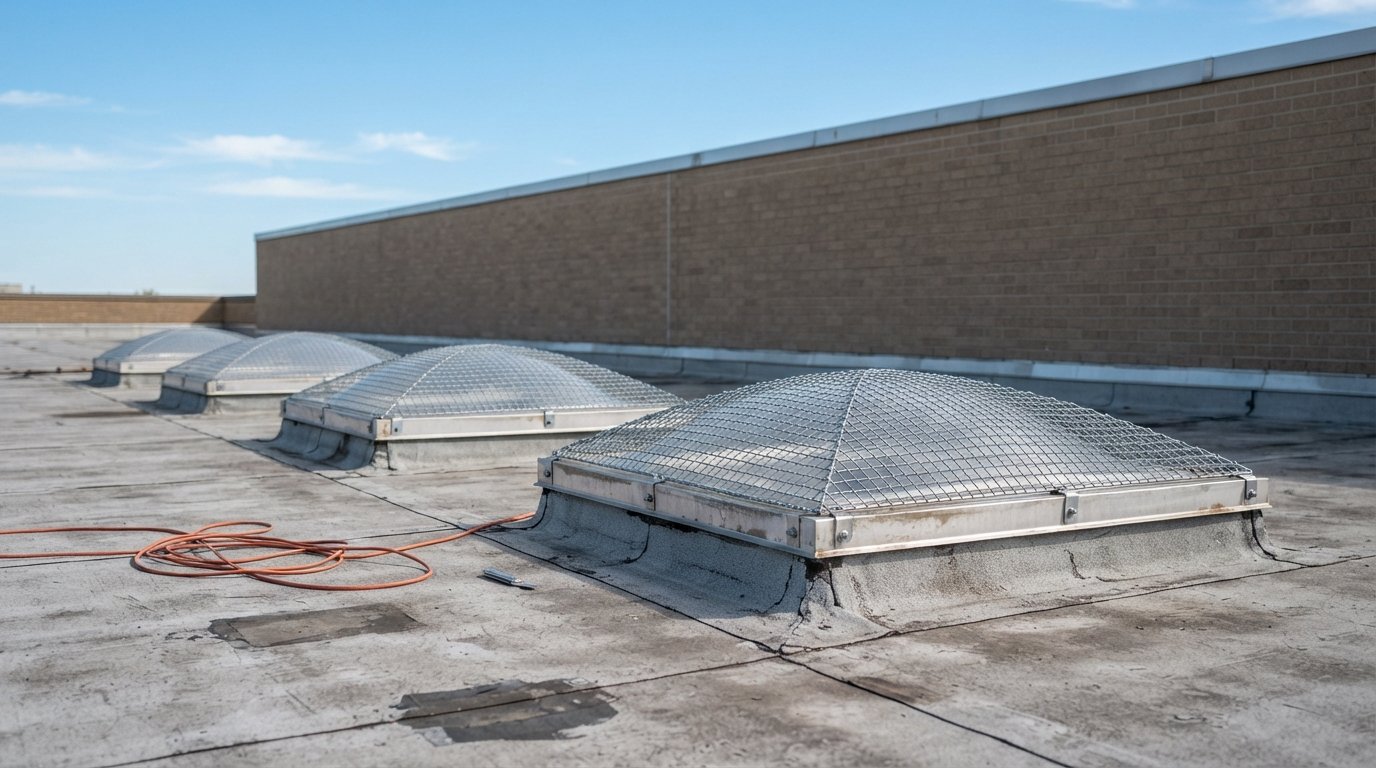
Skylight guards exist because a skylight is an opening in the roof, even when it is covered by a dome or glass. A typical plastic dome is built to keep weather out, not to stop a falling adult. Glass units are stronger, but unless a product is specifically rated for loads, you should not assume it will hold anyone. For fall protection purposes, the safe assumption is that an unguarded skylight is a hole.
On commercial roofs the risk is concentrated because people are up there regularly: HVAC technicians, roofers, electricians, inspectors, snow-clearing crews and cleaners. Their attention is on the equipment in front of them, not the dome behind them. Guards are a simple engineering control that works whether or not anyone remembers the skylight is there.
If you are reviewing or replacing units on a building, our commercial skylights range and commercial skylight domes can be specified with guarding in mind from the start.
How Workers End Up Falling Through Skylights
The pattern behind skylight falls is remarkably consistent. It is rarely someone deliberately stepping on a dome. More often it is one of these:
- Sitting or leaning. A dome at knee height looks like a convenient seat during a break or while reading a gauge.
- Stepping backward. A worker backs away from a unit while carrying material or pulling a hose and steps onto a skylight they never looked at.
- Tripping. A trip over a pipe, cable or curb sends someone sideways onto a nearby dome.
- Hidden under snow. After a snowfall, low skylights disappear under a uniform white surface. Snow-clearing crews are at particular risk.
- Weakened plastic. Old acrylic domes become brittle with age and ultraviolet exposure. A dome that once flexed may now shatter.
- Painted or covered domes. Skylights that have been painted over, tarped or covered with debris no longer look like openings.
| Hazard situation | Why it catches people out | Control that addresses it |
|---|---|---|
| Dome used as a seat or lean point | Looks solid, sits at a convenient height | Screen over the dome or railing around it |
| Backing up while working | Attention is on the task, not the roof layout | Guards plus clear, marked travel paths |
| Snow-covered skylights | Opening becomes invisible | Permanent guards; railings stay visible above snow |
| Brittle, aged domes | Material fails with little warning | Guards now, dome replacement on a schedule |
| Work close to a skylight edge | Tools and materials pulled toward the opening | Railing system or temporary cover during the work |
| Unfamiliar contractors | No knowledge of roof layout | Roof access briefing, map and signage at the hatch |
Screens Versus Railing Systems
There are two main families of skylight guards. Both are proven approaches, and the right choice depends on the roof, the skylight type and how the roof is used.
Skylight screens
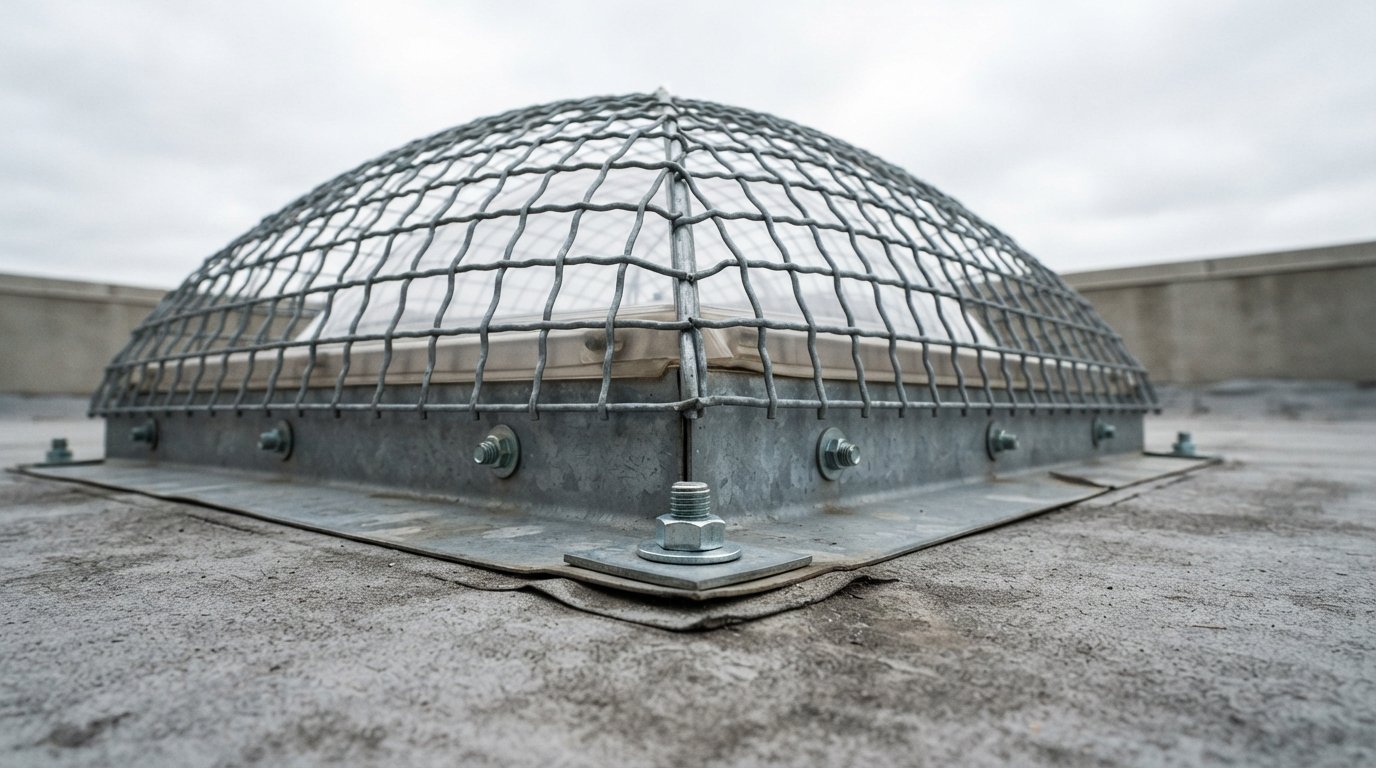
A screen is a steel or aluminum mesh or grating fastened over the skylight, usually attached to the curb. It covers the opening directly, so if someone falls onto it, they land on the screen. Screens are low profile, add little visual clutter, and let most of the light through, though mesh does cast some shadow. They are generally the more economical choice for roofs with many skylights. Manufacturers design screens to resist specified loads; ask for the tested load rating and installation requirements for any product you are considering.
Railing systems
A railing system surrounds the skylight with a guardrail, keeping people away from the opening entirely. Railings are highly visible, stay above snow and suit skylights that are regularly approached during work. Some systems attach to the skylight curb, others are free-standing with weighted bases or fastened to the roof structure. Railings take more roof area and can obstruct snow removal and equipment movement.
| Factor | Screens | Railing systems |
|---|---|---|
| How it protects | Covers the opening; a person lands on the screen | Keeps people away from the opening |
| Visibility | Low profile, can be hidden by snow | High visibility, stays above typical snow |
| Light loss | Some shading from mesh | None through the skylight |
| Roof space | Fits the curb footprint | Needs clearance around the skylight |
| Snow clearing | Easier to work around | Can obstruct plows and shovels |
| Dome access for replacement | Screen must be removed or hinged | Dome usually accessible within the railing |
| Relative cost | Generally lower per skylight | Generally higher per skylight |
On many buildings, a mix works best: screens on skylights in open areas that few people approach, and railings around skylights next to equipment where workers spend time.
What Ontario’s Fall Protection Rules Expect, In General
Ontario’s Occupational Health and Safety Act and its regulations place duties on employers, constructors and building owners to protect workers from falls. In general terms, workers exposed to a fall hazard, including an opening in a roof, must be protected. Guarding the opening with a guardrail or a secure cover is a recognized way of doing that, and it is generally preferred over relying on personal fall arrest equipment alone, because it protects everyone without depending on each worker’s harness being used correctly.
Workers using fall protection equipment on construction projects in Ontario also need approved working at heights training. That applies to many contractors who come onto commercial roofs.
We are deliberately not quoting section numbers here. The specific requirements depend on the type of workplace, the work being done and the regulation that applies, and they are updated from time to time. Building owners and employers should confirm current requirements with the province’s labour ministry, their health and safety consultant, or a qualified professional, and should keep records of the fall protection measures in place on each roof.
Retrofitting Guards On Existing Domes
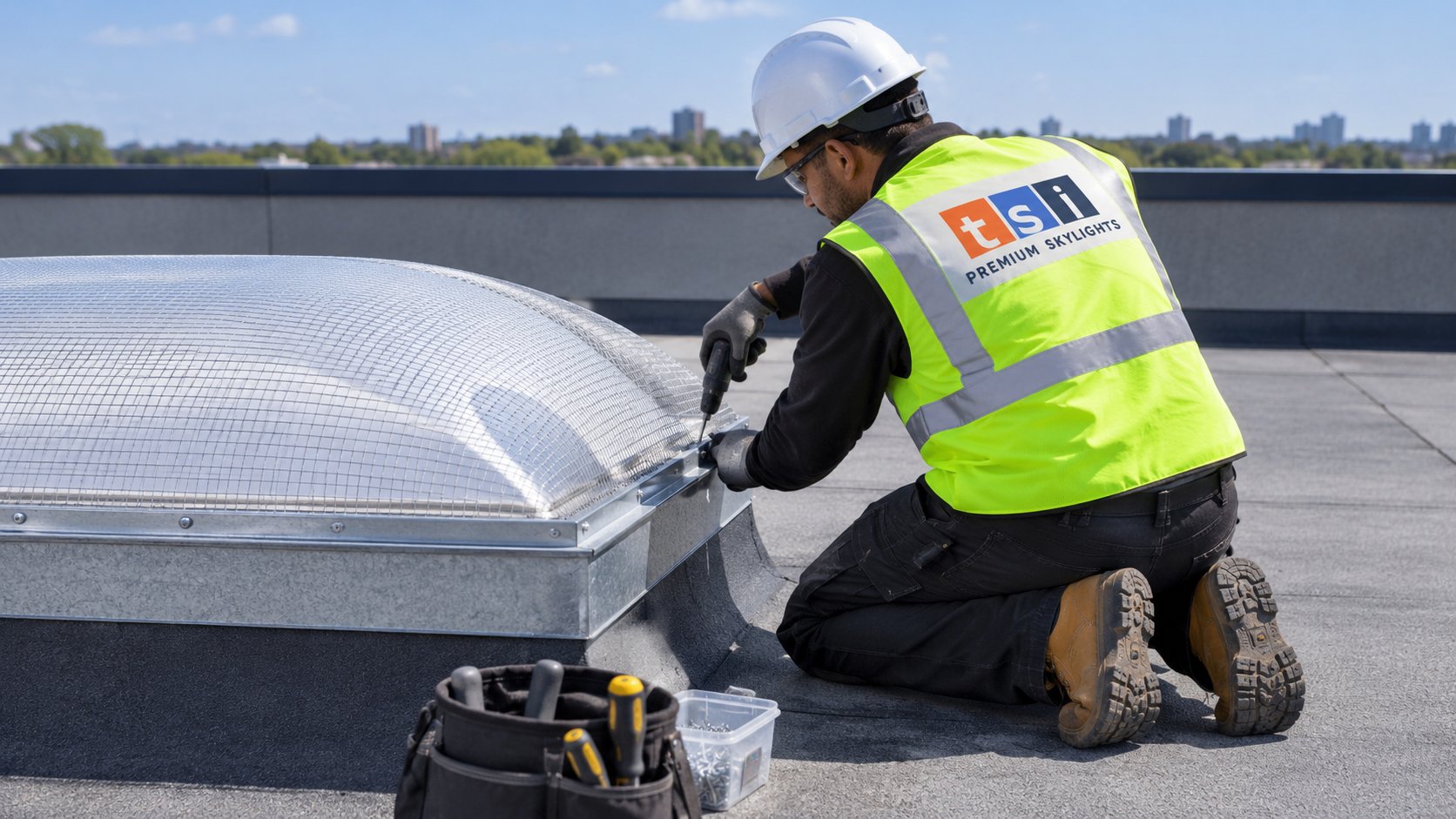
Most commercial buildings already have skylights, often decades-old domes. Retrofitting skylight guards onto them is common, but it needs a little care:
- Survey every skylight. Record size, curb height, curb material, dome condition and location relative to equipment and roof edges.
- Check curb condition. Screens usually fasten to the curb, so a rotted or damaged curb cannot anchor a guard. Curb repairs may be needed first.
- Assess dome condition. A brittle, yellowed or crazed dome is a candidate for replacement. It often makes sense to replace the dome and install guards in the same visit.
- Choose screens or railings per skylight, based on location, traffic and snow patterns.
- Measure precisely. Screens must fit the curb snugly without stressing the dome or its frame, and railings need correct clearance.
- Install without compromising the roof. Fasteners go into the curb or structure following the product instructions. Any penetration through the roofing membrane must be sealed according to the membrane manufacturer’s details.
- Document and brief. Update the roof plan, note guard locations, and brief anyone who accesses the roof.
Retrofit timing matters. Early autumn is a practical window because roofs are dry, temperatures suit sealants, and guards are in place before snow hides the skylights. We do this work across the GTA, including through our Durham Region skylight installation, replacement and repair team.
On cost, projects vary widely with the number of skylights, their size, curb condition and whether screens or railings are chosen. Get a written quote after a roof survey rather than relying on a per-unit figure.
Building Guarding Into New Or Replacement Skylights
Retrofits solve the problem on existing roofs, but the cleanest result comes when skylight guards are planned as part of a new installation or a dome replacement program. At that point you can choose the curb, the skylight and the guard as one system instead of fitting a screen to whatever happens to be there.
Points worth raising at the specification stage:
- Curb design. A curb built with guard attachment in mind, with solid blocking or a metal curb suited to the screen’s fasteners, gives a stronger connection than a screen screwed into an old wood curb.
- Guard type per location. Mark each skylight on the roof plan and decide screen or railing based on nearby equipment, walkways and snow drifting, rather than applying one approach everywhere.
- Load-rated products. Some skylight systems and screens are tested and documented for specific loads. Ask for that documentation rather than relying on descriptions such as heavy duty.
- Access for dome maintenance. Hinged or easily removable screens make future dome cleaning and replacement simpler, provided the removal is controlled and the opening is protected while the screen is off.
- Glazing choice. Replacing brittle single-layer domes with current multi-wall domes or insulated glass units improves weather performance and energy use at the same time as the guards go on.
Building owners with a large number of older domes often phase the work: guards first on every skylight to deal with the immediate fall hazard, then dome replacement over several seasons, reusing or refitting the guards as each unit is changed. That approach removes the urgent risk quickly while spreading the capital cost.
Planning Maintenance Crews’ Access
Skylight guards are one part of a safe roof. How people get onto and move across the roof matters too:
- Controlled access. Keep roof hatches and access doors locked, and log who goes up.
- Roof map at the access point. A simple plan showing skylights, equipment and hazards helps contractors who have never been on the roof.
- Defined walkways. Walkway pads or marked paths between the hatch and equipment keep people on predictable routes, away from skylights.
- Clear zones. Do not store materials or place new equipment right next to skylights.
- Snow plans. Snow-clearing crews should know skylight locations before a storm, not after.
- Safe access for skylight work. When a dome needs replacing or cleaning, the guard may have to be removed. That work needs its own fall protection plan, such as temporary covers or a railing, so the opening is never left unprotected.
Keeping Guards In Service
Once installed, skylight guards need occasional attention, just like the skylights they protect. Add them to your regular roof inspection:
- Check fasteners and connections to the curb or structure.
- Look for corrosion, bent mesh, broken welds or damaged railing components.
- Confirm guards were reinstalled after any skylight maintenance.
- Clear leaves and debris that collect on screens, especially in autumn, since they reduce light and hold moisture against the dome.
- Replace aged domes on a schedule; a guard protects people, but a failing dome still lets in water.
| What to check | Suggested timing | What a problem looks like |
|---|---|---|
| Guard present and secured on every skylight | Every roof visit and after any skylight work | Missing screen, loose railing section, guard leaning against a curb |
| Fasteners and anchor points | At scheduled roof inspections, often spring and autumn | Loose bolts, pulled screws, cracked curb around fasteners |
| Corrosion and welds | At scheduled roof inspections | Rust streaks, broken welds, thinning wire |
| Debris on screens | Autumn and after storms | Leaves and branches blocking light and trapping moisture |
| Dome condition under the guard | Annually | Yellowing, crazing, cracks or failed seals |
| Roof map and access briefing | Whenever the roof layout changes | New equipment or skylights not shown on the plan |
A guard that has been removed for work and never refitted is worse than none, because everyone assumes the skylight is protected.
Skylight Guards FAQ
Are skylight guards required on commercial roofs in Ontario?
Can a skylight dome hold a person’s weight?
Are screens or railings better?
Can guards be added to existing skylights?
Do screens reduce the light from a skylight?
Who is responsible for skylight fall protection?
Arrange A Skylight Guards Survey
If your commercial roof has unguarded skylights, a survey of each unit, its curb and its surroundings is the first step toward a safer roof. Toronto Skylight Installers can assess existing domes, recommend screens or railings for each location and replace ageing domes at the same time.
Call us today at (416) 365-7557 or request a free estimate.
Serving property owners in Durham Region and across the wider GTA with skylight installation, replacement and repair.