

A VELUX skylight not closing is one of the more stressful calls we get in autumn, usually because rain is forecast and the sash is hanging open over a bedroom or kitchen. The good news is that most cases come down to a handful of causes: a rain sensor that is dirty or shielded, a solar battery struggling on short, overcast days, a remote that has lost its link to the skylight, or something physically in the way. Real motor or chain failures happen, but they are not the first thing to suspect.
This guide walks through the causes of a VELUX skylight not closing in the order a technician would check them, explains how solar and electric models differ, and points out where VELUX’s own instructions should take over for model-specific steps.
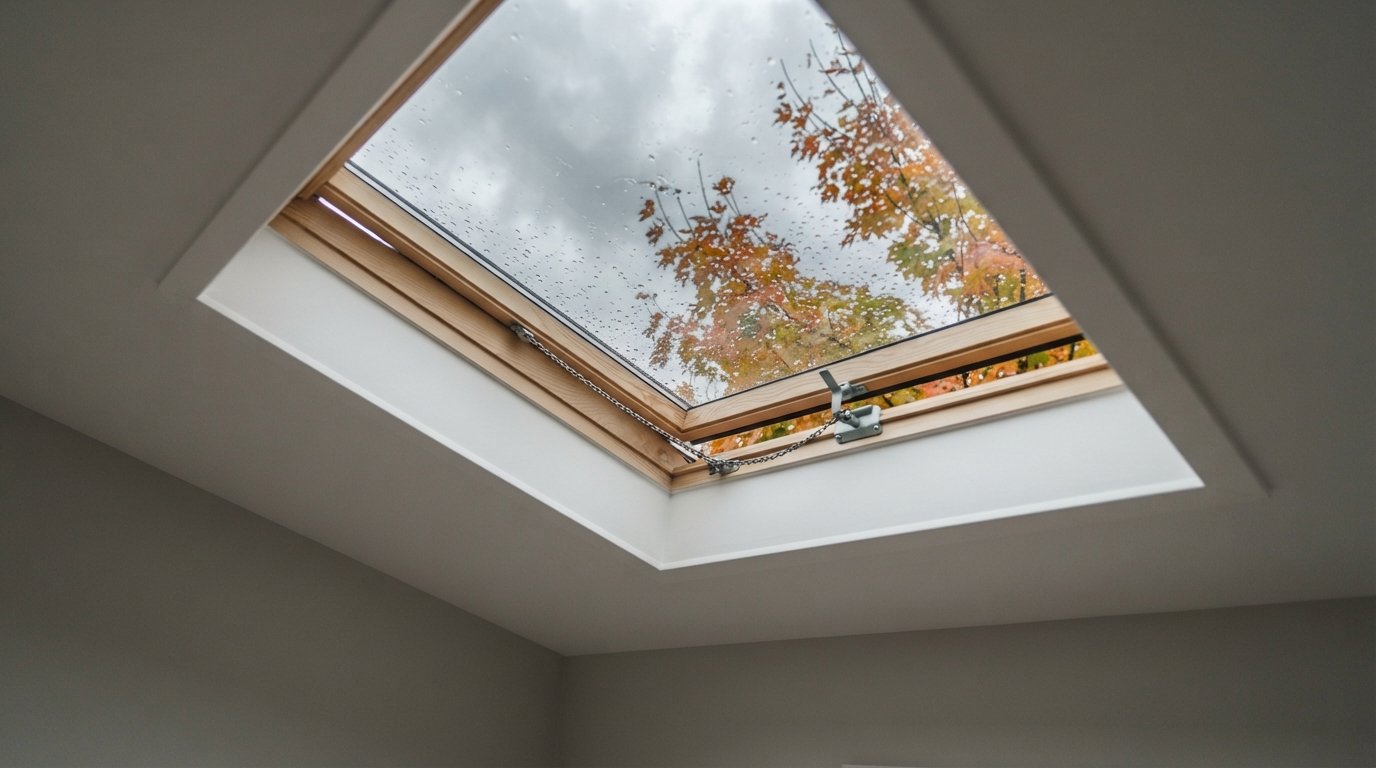
Why a VELUX skylight not closing is usually a simple fault
VELUX’s venting skylights come in three broad types. Manual units open with a crank handle or a rod. Electric units, such as the deck-mounted VSE and curb-mounted VCE, are wired to your home’s power and run a concealed motor. Solar units, such as the VSS and VCS, charge a battery from a small solar panel on the frame and need no wiring. Both powered types use a remote and include a rain sensor intended to close the skylight when rain starts.
Because the system is a motor, a battery or power supply, a radio link and a sensor working together, a fault in any one of them looks the same from below: the skylight will not move. A careful diagnosis isolates each piece in turn, which is exactly how our skylight repairs team approaches a service call. Many owners solve the problem themselves at the first or second step.
One useful piece of logic: VELUX states that its solar units close themselves before the battery is fully drained. So a solar skylight stuck wide open is less likely to be a flat battery and more likely to involve the remote, the switch, a jam or a mechanical fault. A solar skylight that stays shut and refuses to open, by contrast, very often is a charge issue.
First, keep the weather out
If you find your VELUX skylight not closing with rain on the way, deal with the weather before troubleshooting. Do not climb onto the roof to push it shut; pitched roofs are dangerous when wet and covered in leaves, and forcing a sash against a chain operator can damage it.
- Try the remote from directly below. Indoor range is limited, and walls, metal and distance all reduce it. Stand under the skylight with the remote pointed toward it before deciding the remote has failed.
- Check for a power switch on the unit. VELUX’s Canadian FAQ for solar models advises checking that the power switch on the skylight is in the on position.
- Use the manual release if needed. VELUX documents a way to close a powered unit by hand. For solar models, its Canadian FAQ describes disconnecting the chain at the window sash; for electric models, VELUX describes a release procedure that uses an Allen wrench, with details that differ between production years. Follow the steps for your exact model rather than improvising, and work from a stable ladder inside.
- Protect the room. If the skylight cannot be closed safely, move furniture and electronics, lay down towels, and call for help. That is what emergency skylight repairs are for.
Rain sensor problems
The rain sensor sits on the exterior of the skylight frame. VELUX’s manual for its older electric control pad explains that the skylight starts closing within roughly half a minute of the sensor getting wet and can take up to about a minute to close completely, so some water can still enter during a sudden downpour. On those electric units, the sensor also has a small heating element so that dew, fog or very fine drizzle does not trigger it unnecessarily.
When the sensor fails to close the skylight
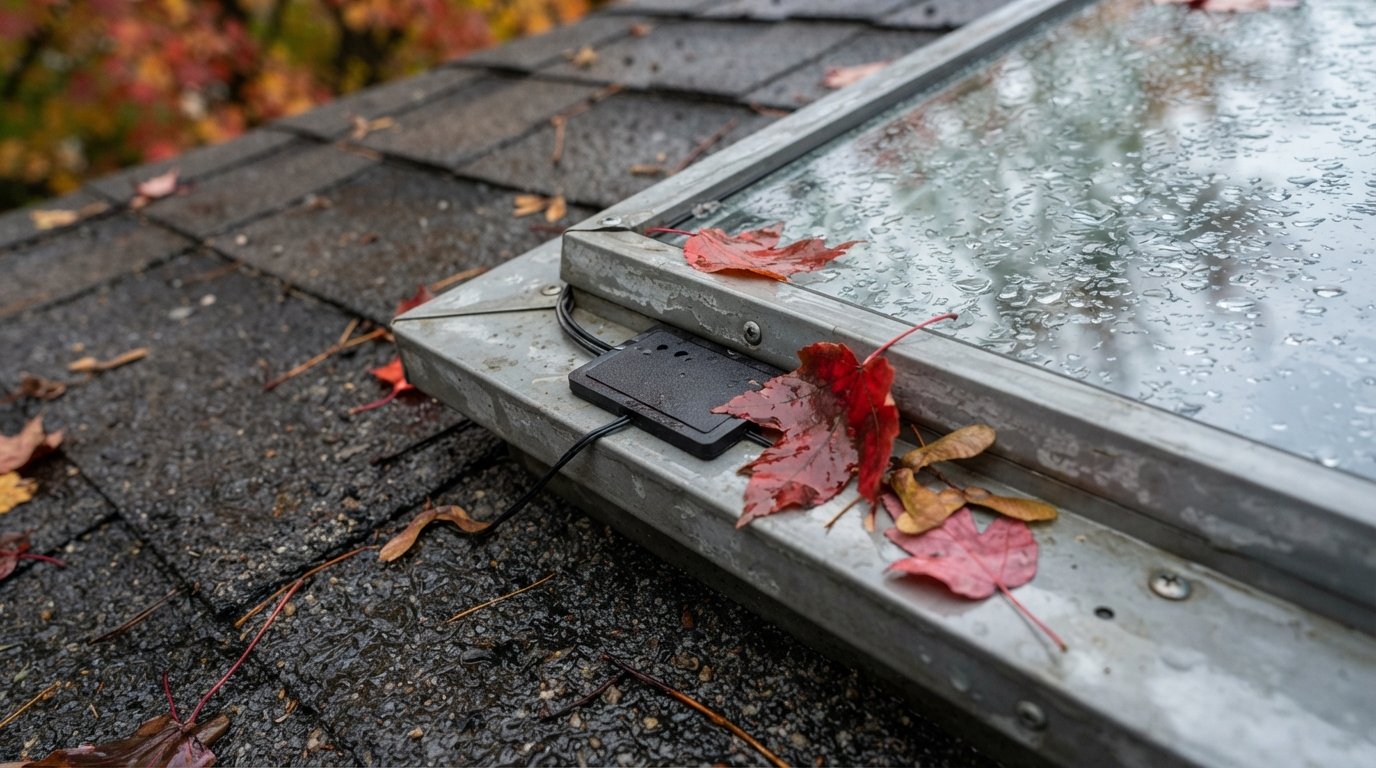
When a shower arrives and you find a VELUX skylight not closing on its own, the sensor may not have registered the water. VELUX’s FAQ notes that on steeper roof pitches the open sash can shield the sensor, and the fix is to relocate the sensor, for which VELUX supplies an extension wire. Other causes include a sensor covered by leaves, maple keys or bird droppings, a sensor on a roof slope sheltered by a taller wall or dormer, and a sensor that has been disabled. VELUX’s controls also allow the sensor to be overridden for a limited period so the skylight can stay open in light rain. If someone in the house used that setting, the skylight may not respond to rain until it resets.
When the sensor keeps the skylight shut
The opposite problem is just as common in autumn. A sensor that is still wet after rain, or one sitting under a drip from a branch or an eave above, keeps telling the skylight that it is raining. The unit closes, or refuses to open, until the surface dries. On cool, damp autumn days with little sun, that can take longer than you expect. If a skylight seems to close on its own on dry days, look for leaves, grime or a drip source over the sensor.
Cleaning the sensor is a roof-side job. For skylights within reach of a flat roof deck or a roof access window it may be straightforward; on a pitched roof, it is work for someone with fall protection.
| What you see | Likely cause | First check |
|---|---|---|
| Solar skylight stays shut and will not open | Low battery after dull days, or a wet rain sensor | Wait for a few hours of daylight and a dry sensor, then retry |
| Skylight stayed open during rain | Sensor shielded by the sash, covered, or temporarily disabled | Ask whether anyone disabled the sensor; check for leaves on it |
| Skylight closes by itself on dry days | Sensor wet from a drip, or dirty | Look for an overhanging branch or eave drip above the sensor |
| Nothing responds to the remote | Remote batteries, range, registration or a switched-off unit | Fresh remote batteries, stand below, check the unit’s power switch |
| Sash starts to move, then stops | Obstruction, debris in the frame, ice, or a misfitted screen | Inspect from inside for anything touching the sash or chain |
| Motor hums or clicks but the sash does not move | Chain or operator fault | Stop operating it and call a technician |
Solar batteries on short autumn days
A solar venting skylight charges a concealed battery from its panel. VELUX says the unit can operate with a minimal amount of sunlight and will still charge from indirect light, and that the battery holds its charge to open at night. What changes in autumn is the balance between charging and use. Days are shorter, the sun is lower, clouds are more frequent and the panel may be partly covered by leaves or shaded by trees that were less of a problem when the sun was high.
If the skylight was opened and closed often in late summer and then sees a run of grey days, the battery may drop low. As noted above, VELUX designs the operator to close the skylight before the battery is fully drained, and it then waits until it has recharged. That is why a low battery rarely explains a VELUX skylight not closing; it is far more often the reason one will not open. Practically, that means a solar skylight that will not open on a dull October afternoon may simply need a day or two of better light. Clearing leaves off the panel, which again is a roof-side task, helps.
Batteries do age. VELUX’s Canadian FAQ says the battery is covered for 5 years and gives a life expectancy of 10 to 12 years, and notes that replacing the battery means ordering a new operator, which includes it. If your solar unit is older and struggles even after sunny spells, an ageing battery is a reasonable suspect. For current coverage terms on your unit, check VELUX’s warranty documents.
| Issue | Solar models | Electric models |
|---|---|---|
| Power source | Battery charged by a frame-mounted solar panel | Wired to the home’s electrical system |
| Typical cause of no movement | Low charge after dull days, ageing battery, leaves on the panel | Tripped breaker, wiring fault or power interruption |
| Behaviour when power runs low | Closes itself before the battery is drained, then waits to recharge | Stops wherever it is if power is lost |
| Rain sensor | Built in, closes the skylight when rain is detected | Standard on VSE and VCE models |
| Who handles power faults | Skylight technician, operator replacement through VELUX parts | Licensed electrical contractor for wiring; skylight technician for the operator |
Remotes, control pads and pairing
The remote becomes the next suspect when the skylight ignores every button press, not just the close command. VELUX describes registration as the link between the skylight and the remote control, and powered units ship with remotes already paired. That link can be lost after a power interruption, a battery change in some controls, adding a new product, or someone pressing reset.
Start simple. Replace or recharge the remote’s batteries as its manual directs, and if you have more than one control, test each. Check that you are selecting the right product in the remote’s menu, especially in houses with several skylights and shades. Then follow VELUX’s registration steps for your specific control. Procedures differ between generations: the user manual for the older KLR 100 control pad, for example, has you briefly cut power to the products and then register them within a short time window, while newer remotes use their own sequence. Because the steps are model-specific, use the manual for the exact remote you own, which you can find through VELUX’s support pages.
Skylight shades often share the same remote. If the shade works and the skylight does not, the remote itself is probably fine and the fault lies with the skylight’s registration, power or operator.
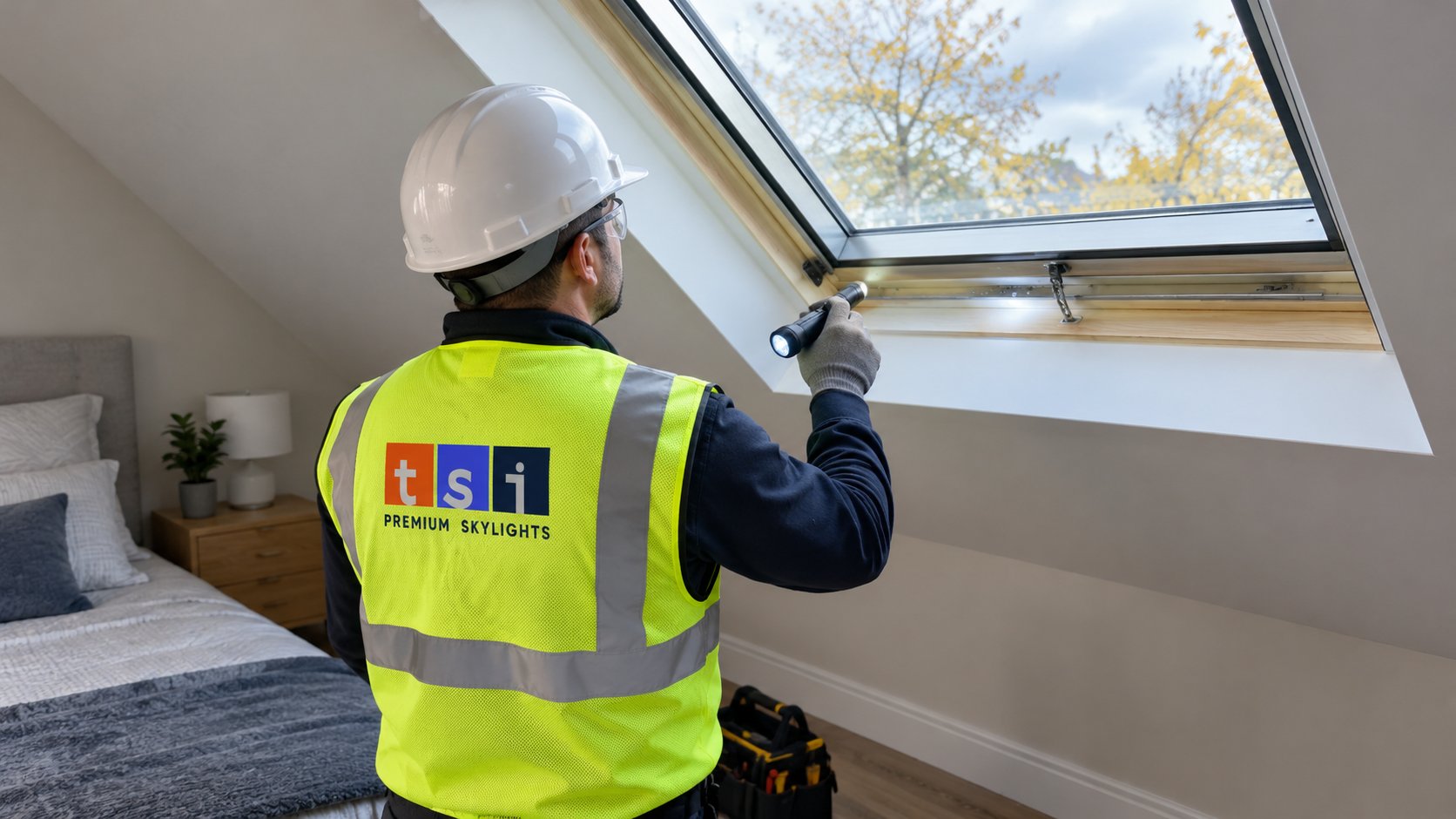
Obstructions, screens and the sash itself
A VELUX skylight not closing all the way, where the sash starts moving and then stops or reverses, usually has something resisting it. Common autumn culprits are twigs, maple keys and wet leaves lodged between the sash and frame, and sometimes a wasp nest built over the summer. Inside, an insect screen or shade that has been removed and refitted out of position can rub against the operator or chain. Look carefully, but do not force anything.
Later in the season, ice becomes a factor. VELUX’s control pad manual warns that snow or ice can block operation and damage the skylight, which is why it makes sense to close venting skylights fully and leave them closed during freezing weather. A sash that is out of square, perhaps because the frame or framing has shifted, can also bind enough that the operator stops. That is a structural or installation issue rather than a control fault.
Motor, chain and wiring faults
When the power supply, the remote and the sensor all check out and you still have a VELUX skylight not closing, attention turns to the operator. Signs include a motor that hums or clicks without moving the chain, a chain that extends unevenly or looks bent, grinding noises, or a sash that moves only part way every time. VELUX’s older manual notes that there are no user-serviceable parts inside the operator, and replacement parts are ordered using information from the data plate on the skylight, so note the model and size code before you call anyone.
For electric units, a tripped breaker or a wiring fault is a separate category. Wiring on the house side of the skylight is electrical work for a licensed electrical contractor, and any new or altered wiring falls under Ontario’s Electrical Safety Authority rules. Do not open junction boxes or operator housings yourself.
When to call a technician
Call for service when the skylight is open and cannot be closed safely by hand, when the operator hums, grinds or stalls, when a solar unit fails even after several bright days, or when the sensor or panel needs attention on a pitched roof. It also makes sense to book a visit if the unit is old enough that a full replacement might be better value than a new operator. Older venting skylights with fogged glass or worn seals sometimes justify upgrading to a new solar-powered fresh air skylight rather than repairing one component.
Whether you are in the city or one of the homeowners we help through skylight installation, replacement and repair across Halton Region, a technician will usually check the sensor and panel, test registration with a known-good remote, inspect the chain and operator, and confirm the frame is square. Repairs vary widely, so ask for a clear explanation of what failed and what replacing it involves before approving work.
| Situation | Reasonable to try from inside | Call a technician when |
|---|---|---|
| Remote does nothing | New remote batteries, test from below, check the unit’s power switch, follow the registration steps in your manual | Registration fails repeatedly or the shade responds but the skylight never does |
| Solar unit will not open | Wait for a few brighter days and a dry sensor | It still fails after sunny spells, or the unit is old enough that the battery may be failing |
| Sensor or solar panel covered in leaves | Nothing, unless it is safely reachable from a flat roof deck or roof access window | The skylight is on a pitched roof that needs fall protection |
| Sash stuck open with rain coming | VELUX’s manual release steps for your model, from a stable ladder inside | The release does not work or the sash will not seat when closed |
| Hum, click or grinding with no movement | Stop operating it and note the model and size code from the data plate | Straight away; the operator or chain needs assessment |
Frequently asked questions
Why does my solar skylight stay closed on cloudy days?
What should I check first if the skylight will not respond at all?
Why did my skylight stay open when it rained?
Can I close a powered skylight by hand?
How long does a solar skylight battery last?
Is it worth repairing an older venting skylight?
Get help with a VELUX skylight not closing
If the basic checks have not solved it, or the sash is stuck open with rain coming, Toronto Skylight Installers can diagnose the sensor, battery, remote and operator and explain your repair or replacement options clearly. Call us today at (416) 365-7557 or request a free estimate.
Keeping venting skylights working for homeowners across Halton Region and the wider GTA.