

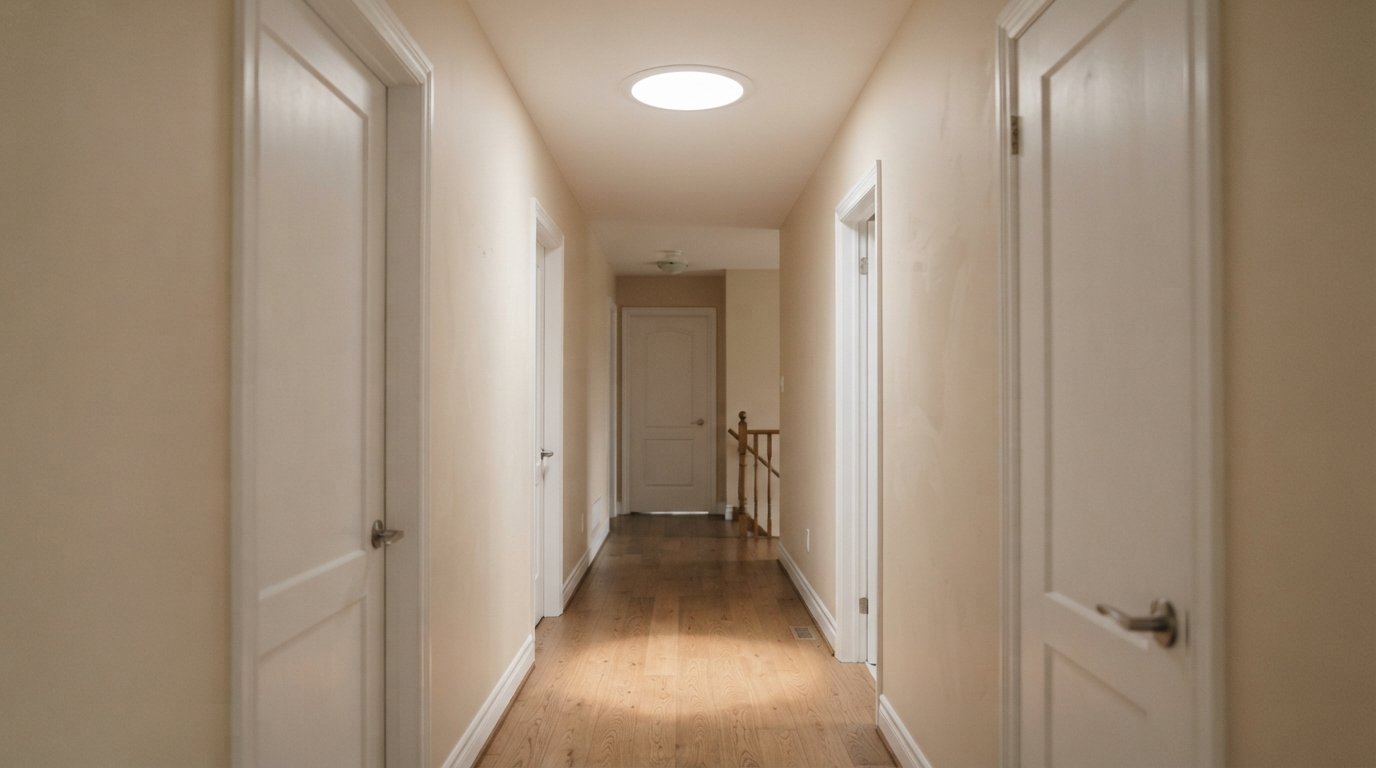
An artificial skylight is a ceiling light fixture designed to look like a window to the sky: a backlit panel, sometimes printed with clouds, sometimes engineered to glow blue and bright as if there were open air above. A sun tunnel is the opposite approach, a small dome on the roof and a reflective tube that carries real daylight down to a diffuser in the ceiling. Both are popular answers to the same problem, a windowless bathroom, hallway, closet or basement room, and as autumn days shorten that problem becomes harder to ignore.
They are not interchangeable. One delivers genuine daylight but needs a path to the roof; the other works anywhere there is power but is still electric light. This guide explains what each can and cannot do and how to decide which suits your room.
What an artificial skylight is, and what it is not
The term covers a wide range of products. At the simple end, a fake skylight is an LED panel with a translucent face, sometimes printed with a sky or tree-canopy image, mounted in a recessed ceiling frame that imitates a skylight well. Many fit standard drop-ceiling grids or replace an existing ceiling fixture. Some add tunable colour temperature, so the light can shift from cool white in the morning to warm white in the evening.
At the high end, a few specialized fixtures use optical techniques to imitate the depth of a sky and the way sunlight seems to come from far away, producing a convincing effect of blue sky with a beam of “sun”. These are architectural products with prices to match, and they need careful installation and space above the ceiling.
What none of these products offers is daylight. It is an electric light fixture, however well designed. It uses power whenever it is on, it does not change with the weather or the seasons unless programmed to, it provides no view and no ventilation, and its brightness is limited to what an indoor fixture can reasonably produce. Daylight outdoors, even on an overcast autumn day, is far brighter than typical indoor lighting, which is a large part of why real daylight feels different. To be clear about our own role: we install real skylights and sun tunnels; we do not sell faux skylight panels, and an electrician or lighting supplier is the right contact for those.
How a sun tunnel brings real daylight down
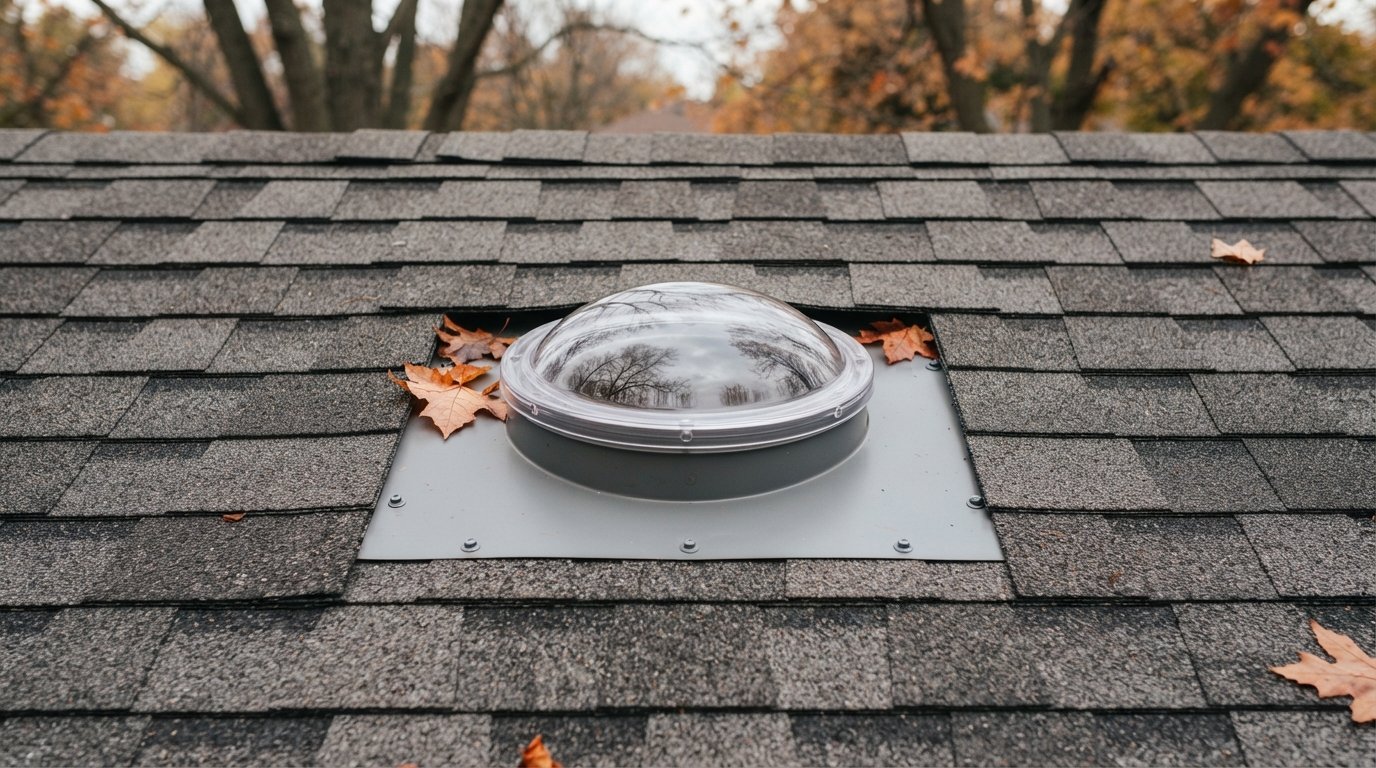
A sun tunnel, also called a tubular skylight, has three parts: a clear dome or flat glass top on the roof with its own flashing, a tube lined with highly reflective material, and a diffuser in the ceiling that spreads the light. Because the opening is small, it fits between rafters or trusses with little or no framing change, and the ceiling cut-out is roughly the size of a large round light fixture. Our sun tunnel skylights page covers the models we install.
The light it delivers changes through the day and with the weather. On a bright day a well-placed tunnel can light a small bathroom or hallway so well that people forget to switch lights on; on a dark, rainy autumn afternoon it gives a soft, grey glow. At night it gives nothing on its own. Some models accept an electric light kit fitted inside the tube, so a single ceiling opening works as a daylight source by day and a light fixture after dark; check the manufacturer’s current accessory list for your model.
| Factor | Artificial skylight (LED panel) | Sun tunnel |
|---|---|---|
| Light source | Electric LEDs | Real daylight from the sky |
| Works at night | Yes | Only with an added light kit |
| Changes with weather and time of day | Only if programmed | Naturally, with the sky |
| Energy use | Uses electricity whenever on | None for daylight; small amount for any light kit |
| Needs a path to the roof | No | Yes, through an attic or roof space |
| Works under occupied floors | Yes | Generally no |
| Roof penetration and flashing | None | Yes, a small flashed opening |
| Installed by | Licensed electrical contractor | Skylight installer |
Real daylight vs simulated light
For many rooms, the honest question is how much the difference matters to you. Real daylight has a quality that is hard to imitate: it varies, it is intensely bright compared with indoor light, and its colour shifts through the day. People commonly describe rooms lit by sun tunnels as feeling “connected to outside”, partly because a passing cloud dims the room and the light warms toward evening.
A good artificial skylight can produce pleasant, even, glare-free light and a convincing look, and tunable models can follow a daily cycle. For a basement family room or a windowless office, that can be a real improvement over a plain ceiling fixture. But it will never be brighter than the fixture’s rated output, it will not respond to the weather outside, and on a sunny day it will look dimmer than a real opening to the sky would.
If you want the room to feel lit by the outdoors, only daylight does that. If you want consistent, controllable light that looks like a skylight, especially where daylight cannot reach, a well-chosen faux panel is a reasonable choice.
Energy use and running costs
A sun tunnel uses no electricity for daylight. Over a year, a tunnel in a hallway or bathroom where lights would otherwise be switched on for much of the day can noticeably reduce how often those lights run. The trade-off is a small roof penetration that has to be flashed and maintained, and a small amount of heat transfer through the tube, which is why tubes passing through cold attics are insulated or use the manufacturer’s energy kit.
A faux panel draws power like any LED fixture of its size. Modern LED panels are efficient, so running costs for an ordinary panel are modest, but a fake skylight left on all day in a basement still uses energy every hour it is lit. Larger architectural sky fixtures can draw considerably more. If running costs matter, compare the rated wattage of the fixture you are considering and think about how many hours a day it will actually be on.
Where a sun tunnel can and cannot reach
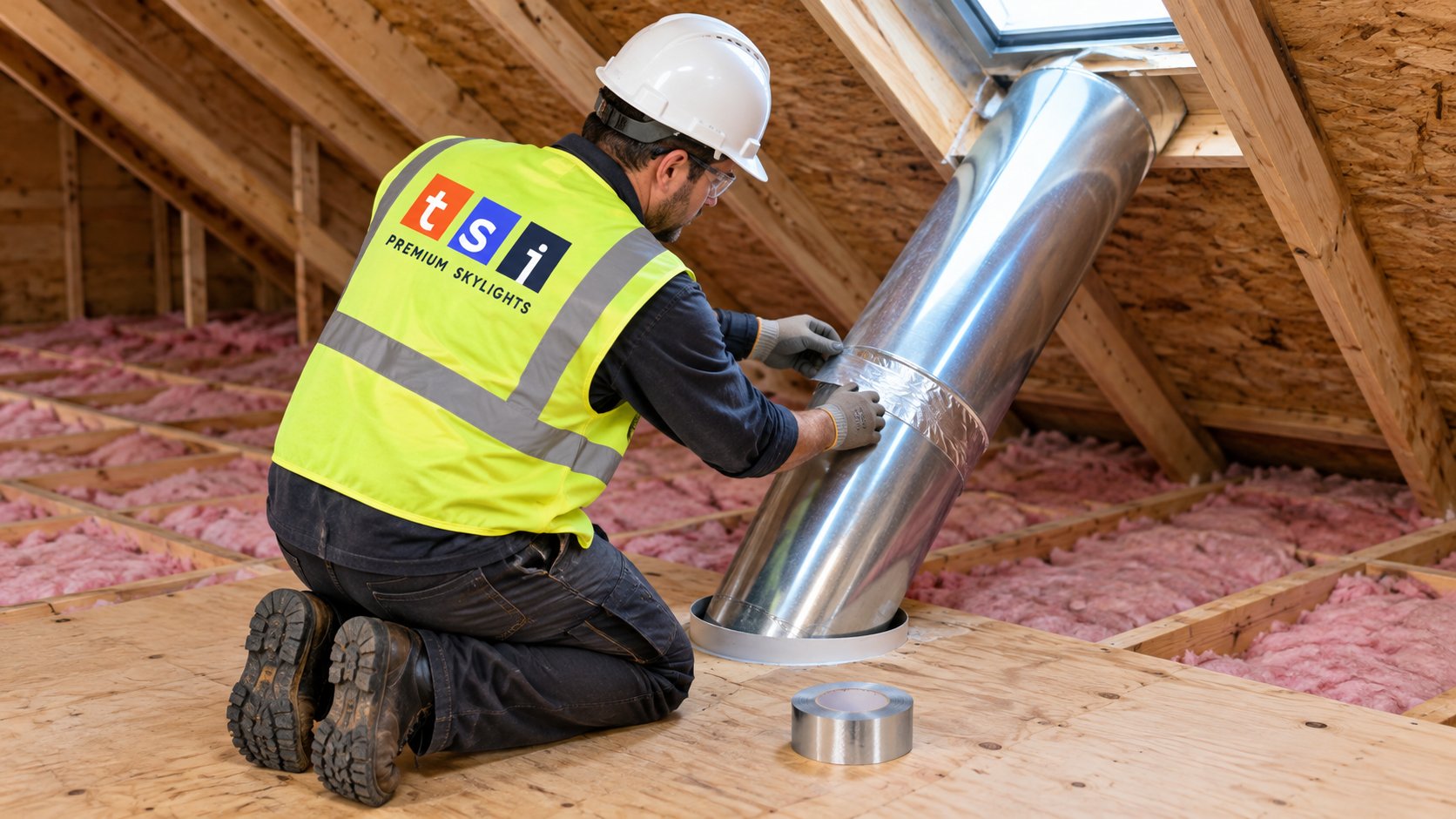
A sun tunnel needs a reasonably direct route from the roof to the ceiling. That usually means a room on the top floor of a house with an attic above, or a room under a flat or low-slope roof. Tube length and type matter. VELUX publishes recommended maximum lengths that rise with tube diameter: its rigid tubes are rated for long runs, roughly 20 feet or more depending on size, while its flexible tubes are recommended only for short runs of about 8 to 12 feet. Check the current instructions for the exact model. Rigid tubes with fewer elbows deliver more light; each bend and each extra foot of flexible tube costs some brightness.
Where a sun tunnel generally cannot reach:
- Rooms with occupied floors above. A main-floor powder room in a two-storey house usually has a bedroom or bathroom above it, and running a tube through that space is rarely practical. Occasionally a tube can pass through a closet above, but this is the exception.
- Basements. The distance and the floors in between rule out a tube in almost every house.
- Condominium apartments and most units below the top floor. There is no roof access, and the roof is not yours to cut.
- Rooms under complicated roofs. Mechanical equipment, ducts or framing in the way can force so many bends that the light becomes too weak to be worthwhile.
These are exactly the places where an artificial skylight earns its keep. If a room has floors above it, a faux panel is often the only way to get a skylight-like effect at all.
| Room | Usually the better fit | Why |
|---|---|---|
| Top-floor interior bathroom with attic above | Sun tunnel | Short, direct route to the roof and real daylight |
| Upstairs hallway or walk-in closet | Sun tunnel | Small opening, fits between framing members |
| Main-floor powder room with a bedroom above | Artificial skylight | No practical route for a tube |
| Basement family room or office | Artificial skylight | Several floors between the room and the roof |
| Condominium apartment interior room | Artificial skylight | No roof access |
| Top-floor room that also needs night light | Sun tunnel with a light kit | Daylight by day and electric light at night through one opening |
Getting the most from either option
Sun tunnel placement and sizing
Where the dome sits on the roof matters. A position that sees open sky for most of the day, away from chimneys, taller walls and dense evergreens, gives the most light. Deciduous trees are less of a problem than they look in summer: once the leaves drop in autumn, a shaded dome often sees more sky through the darker months. VELUX offers several rooftop versions for different situations, including a low-profile one designed to blend with the roofline, a pitched version intended to gather light well from different roof directions, and a curb-mount version for flat or low slopes.
Diameter is the other lever. As a rough guide, the smallest tubes suit closets and small powder rooms, mid sizes suit bathrooms and hallways, and the largest suit bigger rooms or longer runs. The diffuser choice changes how the light spreads, from a plain frosted lens to patterned options that throw light more widely. Your installer should explain the trade-offs for your room rather than defaulting to one size.
Making an artificial skylight convincing
If a faux panel is the answer, a few details decide whether it reads as a skylight or as a large light fixture. A recessed frame with a shallow well looks far more like a real opening than a flat panel on the ceiling. Size it in proportion to the room, and place it where a real skylight would logically sit, typically centred over a corridor or a seating area. Choose a diffuser that hides individual LEDs, put it on a dimmer, and match the colour temperature to the time of day, cooler during the day and warmer in the evening, if the fixture allows it.
Installation, permits and what to ask
A sun tunnel installation is a roof job: the installer cuts a small opening, sets and flashes the dome, runs and seals the tube through the attic, and fits the ceiling diffuser. Most are completed in a day. Because the opening normally fits between framing members, structural changes are rarely needed, but the tube must be sealed at the ceiling and insulated through a cold attic to prevent condensation. Permit requirements vary, so check with your municipality.
Installing a faux panel is electrical work. In Ontario, adding or changing a fixture is generally covered by the Electrical Safety Authority’s rules, which usually means a notification of work and, if you hire someone, a Licensed Electrical Contractor. If the fixture goes into a ceiling below an attic, the electrician should also maintain the air and vapour barrier and insulation around it, just as a skylight installer would with a tube.
Whichever you choose, and whether you are in Toronto or looking for skylight installation, replacement and repair across Durham Region, ask a few practical questions first: how much light the option will deliver on a dull winter day, what happens at night, where the tube or fixture will run, and how it will be sealed against moisture.
Cost comparison
Costs vary widely by product and house. The ranges below are rough estimates in Canadian dollars for typical residential situations, and a site visit or quote is needed for a real number.
| Option | What is usually included | Typical installed range (estimate) |
|---|---|---|
| Sun tunnel, short rigid run | Dome, flashing, tube, diffuser, installation | Often roughly $900 to $2,000 |
| Sun tunnel with an electric light kit | As above, plus kit and electrical connection | Often roughly $1,200 to $2,600 |
| Basic LED artificial skylight panel | Panel and frame, electrician’s installation | Often roughly $400 to $1,500 |
| Tunable or premium faux skylight fixture | Fixture, controls, recess framing, electrician | Often roughly $1,500 to $5,000 or more |
| Architectural sky-simulating fixture | Specialized fixture, design and installation | Can run well into five figures |
Frequently asked questions
Does an LED faux skylight provide real daylight?
Can a sun tunnel light a room on the main floor?
Which uses less energy?
Do you sell or install faux skylight panels?
How far can a sun tunnel run?
Can I combine daylight and night lighting?
Choosing a sun tunnel or an artificial skylight
If your room has a route to the roof, real daylight is usually worth having. Toronto Skylight Installers can check whether a sun tunnel will reach, how much light it is likely to deliver and how it will be sealed, and tell you honestly when an artificial skylight from an electrician is the better path. Call us today at (416) 365-7557 or request a free estimate.
Bringing real daylight to interior rooms across Durham Region and the wider GTA.