

Commercial buildings consume more electricity for artificial lighting than any other single energy category — and in many cases, that lighting runs all day in spaces that could be illuminated naturally from above. Commercial skylight installation toronto projects are increasingly driven by building owners and property managers who recognize that natural daylighting is not just an aesthetic upgrade — it is a measurable investment that reduces operating costs, improves employee productivity, enhances retail sales performance, and contributes to green building certification. This guide covers the complete landscape of commercial skylight solutions for Toronto businesses, including product options, cost analysis, energy savings, code requirements, and the installation process for offices, warehouses, retail spaces, and institutional buildings.
Why Commercial Skylights Make Business Sense
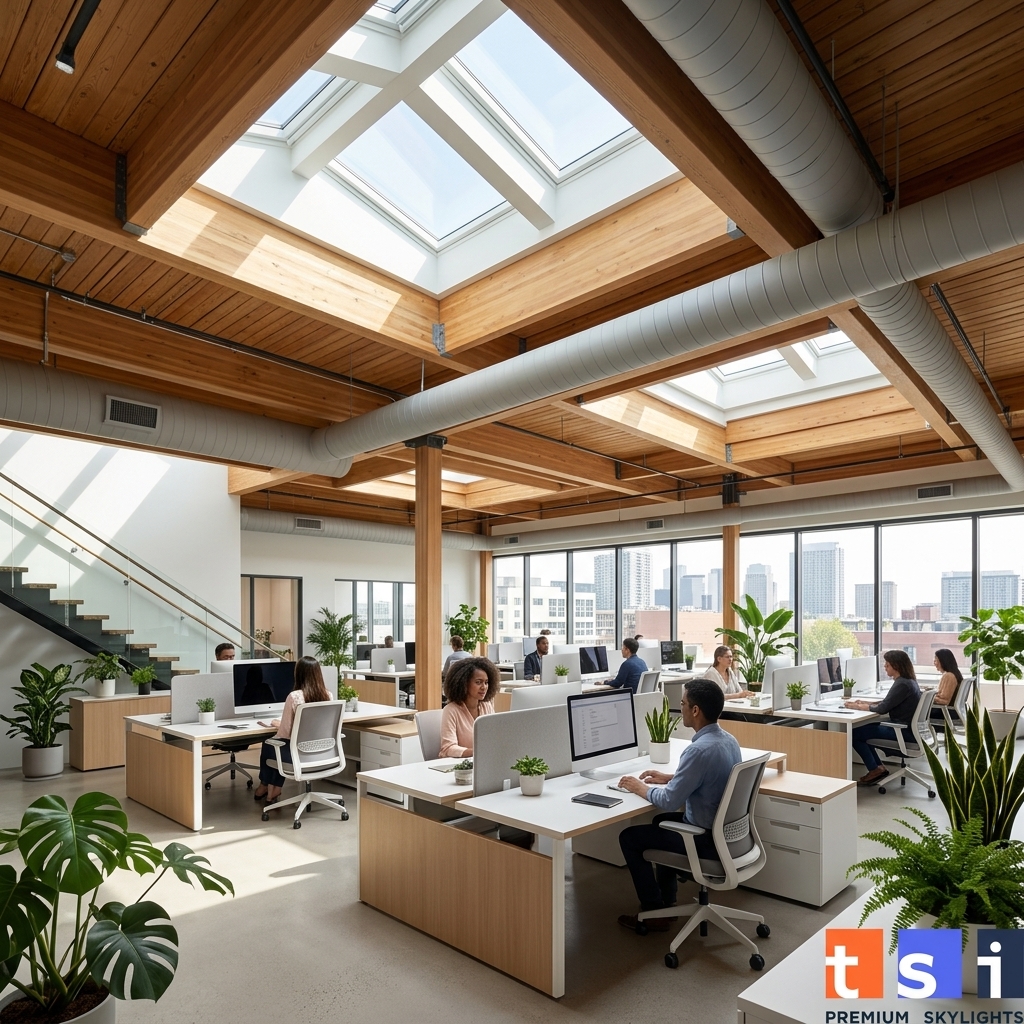
Employee Productivity and Wellbeing
Peer-reviewed research consistently demonstrates that employees working in naturally lit environments report higher job satisfaction, better mood, fewer headaches, reduced eye strain, and lower rates of absenteeism compared to employees in artificially lit offices. A landmark study by the Heschong Mahone Group found that workers in offices with the best daylighting performed 10 to 25 percent better on cognitive tasks than those in the least daylit environments. For a Toronto office with 50 employees earning an average of $60,000 annually, even a 5 percent productivity improvement represents $150,000 per year in equivalent labour value — far exceeding the one-time cost of skylight installation.
Retail Sales Performance
In retail environments, the impact of natural light is equally dramatic. Multiple studies have documented that retail stores with skylights experience 15 to 40 percent higher sales per square foot compared to identical stores without overhead natural light. The mechanism is straightforward: natural light renders colours more accurately, creates a more pleasant shopping environment, and keeps customers in the store longer — all of which translate directly to increased transaction volume and average order value.
Energy Cost Reduction
| Building Type | Typical Lighting Energy Reduction | Annual Savings per 10,000 sq ft |
|---|---|---|
| Office | 30-50% | $3,000 – $8,000 |
| Warehouse | 40-70% | $5,000 – $15,000 |
| Retail | 25-45% | $2,500 – $7,000 |
| Manufacturing | 35-60% | $4,000 – $12,000 |
| School / Institutional | 30-55% | $3,500 – $10,000 |
Commercial Skylight Types for Toronto Buildings
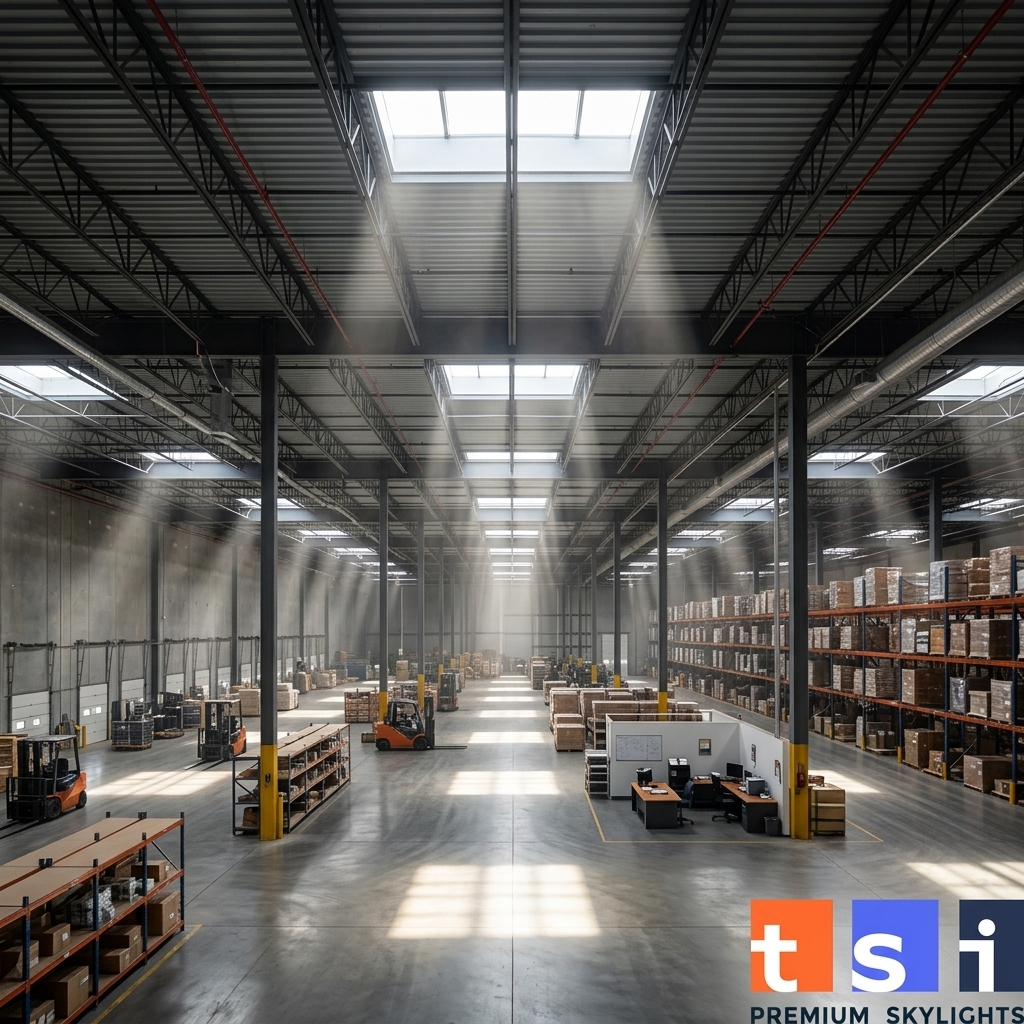
Flat Roof Skylights
Most commercial buildings in Toronto have flat or low-slope roofs, making flat roof skylights the primary product category for commercial applications. VELUX commercial flat roof skylights feature a curb-mounted design that sits on a raised frame above the roof membrane, with a domed or flat glass top that sheds water and prevents ponding. These units are available in fixed (light only) and venting (light plus ventilation) configurations, in sizes from 2 x 2 feet to 4 x 8 feet per unit. Multiple units can be ganged together in rows or grids to create large continuous daylighting zones across expansive commercial roof areas.
Ridge Skylights and Continuous Skylights
For warehouse, manufacturing, and large retail buildings with peaked or ridged roof structures, continuous ridge skylights provide maximum daylighting coverage along the entire length of the roof ridge. These systems consist of multiple skylight panels joined in a continuous strip, providing even, shadow-free illumination across the full width of the building below. Ridge skylights are the most efficient commercial daylighting solution for large open-plan spaces because they distribute light uniformly rather than creating bright spots directly below individual skylights.
Unit Skylights and Modular Systems
| Skylight Type | Best Application | Size Range | Cost per Unit Installed |
|---|---|---|---|
| Flat roof curb-mount (fixed) | Offices, retail, institutional | 2×2 to 4×8 ft | $2,000 – $6,000 |
| Flat roof curb-mount (venting) | Kitchens, workshops, occupied spaces | 2×2 to 4×4 ft | $3,000 – $8,000 |
| Continuous ridge skylight | Warehouses, manufacturing | Custom length, 2-6 ft wide | $150 – $400 per linear foot |
| Pyramid skylight | Lobbies, atriums, feature spaces | 4×4 to 10×10 ft | $5,000 – $25,000 |
| Barrel vault skylight | Corridors, walkways, entrances | Custom length, 3-8 ft wide | $200 – $500 per linear foot |
Commercial Skylight Installation Process
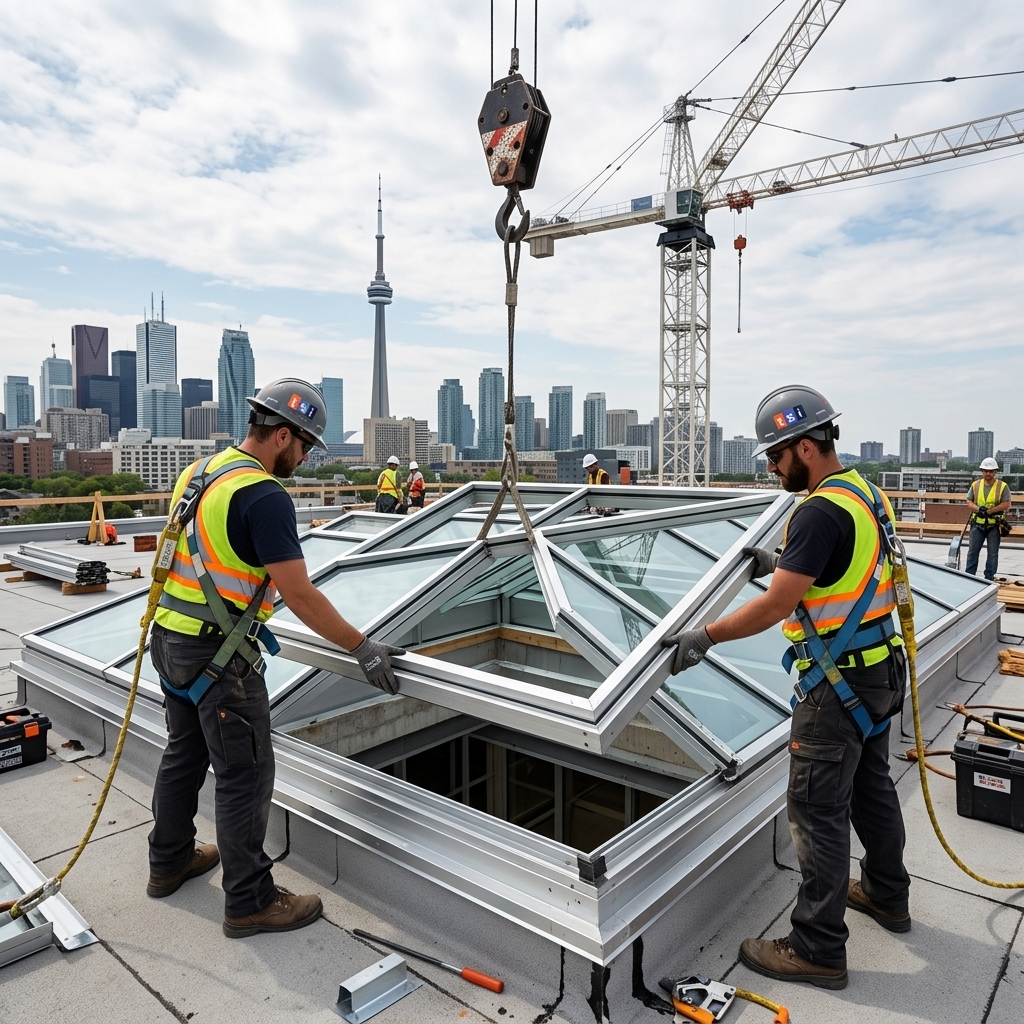
Commercial skylight installation differs significantly from residential work in scale, complexity, and coordination requirements. The process begins with a comprehensive site assessment including roof structural analysis, existing membrane evaluation, and daylighting design to determine optimal skylight placement for maximum light distribution with minimum glare. Toronto Skylight Installers works with building engineers and architects to ensure that the skylight design integrates properly with the existing roof structure, HVAC systems, fire suppression systems, and electrical infrastructure.
Key Differences from Residential Installation
- Structural engineering: Commercial roof openings often require engineered steel headers and reinforced curb framing designed by a structural engineer to maintain roof load capacity
- Membrane integration: Commercial flat roofs use continuous membrane systems (TPO, EPDM, modified bitumen) that require specific waterproofing details at every skylight penetration to maintain warranty coverage
- Fire code compliance: Ontario Fire Code sets requirements for skylight glazing in commercial buildings, including fire-rated glass in certain applications and minimum setbacks from property lines
- Permits and inspections: Commercial skylight installations require building permits from the City of Toronto and typically involve structural, building envelope, and electrical inspections
- Working at height: Commercial roofs require comprehensive fall protection systems — Toronto Skylight Installers maintains full WHMIS and Working at Heights certifications for all commercial installation crews
Daylighting Design: Optimizing Natural Light Distribution
Effective commercial daylighting is not simply about cutting holes in the roof — it requires careful design to distribute natural light evenly across the occupied floor area while minimizing glare, hot spots, and excessive solar heat gain. The skylight-to-floor-area ratio (SFR) is the primary design metric, typically targeting 3 to 5 percent for offices and retail, and 4 to 8 percent for warehouses and industrial spaces. Proper spacing between skylights ensures overlapping light cones that create uniform illumination without dark zones between fixtures. For Toronto’s latitude (43.65 degrees N), skylight placement must also account for the low winter sun angle that can create direct beam penetration and glare issues in south-facing skylights — diffusing glazing or automated blinds mitigate this effectively.
Commercial Skylight Maintenance and Lifecycle
Commercial skylights require periodic maintenance to maintain optimal light transmission and waterproof integrity over their 25-30 year typical lifespan. Toronto Skylight Installers provides commercial maintenance programs that include biannual inspections (spring and autumn), glass cleaning from the roof side using safe access equipment, gasket and sealant assessment with proactive replacement before failure occurs, and drainage system clearing to prevent water ponding around skylight curbs. Regular professional maintenance extends the functional lifespan of commercial skylights significantly and prevents the costly water damage that results from deferred maintenance — a single commercial skylight leak can damage thousands of dollars worth of inventory, equipment, or finished interior surfaces below.
Industry-Specific Applications in the GTA
| Industry | Application | Primary Benefit | ROI Timeline |
|---|---|---|---|
| Restaurant / Hospitality | Dining area daylighting | Enhanced ambiance, higher customer satisfaction scores | 3-5 years |
| Healthcare / Dental | Treatment room natural light | Patient comfort, accurate colour rendering for procedures | 4-6 years |
| Auto Dealership | Showroom daylighting | True colour rendering of vehicle finishes, reduced electricity | 2-4 years |
| Gym / Fitness Centre | Open workout area lighting | Energy savings, improved member experience and retention | 3-5 years |
| Grocery / Food Retail | Sales floor daylighting | Natural light on produce increases perceived freshness and sales | 2-3 years |
| Daycare / Education | Classroom and play area lighting | Improved learning outcomes, regulatory compliance for natural light | 4-6 years |
Retrofit vs New Construction: Commercial Considerations
Installing skylights in an existing commercial building (retrofit) involves additional considerations compared to new construction. Retrofit projects require careful evaluation of the existing roof structure to confirm it can support the additional load and opening without compromising structural integrity — this typically involves a structural engineer assessment. The existing roof membrane warranty must also be considered, as cutting into the membrane for skylight installation may void coverage in the affected area unless the membrane manufacturer approves the penetration detail. In new construction, skylights are integrated into the structural design from the beginning, allowing optimal placement and structural coordination without these retrofit complications. Toronto Skylight Installers has extensive experience with both scenarios and provides the engineering coordination needed to execute retrofit installations without compromising existing building systems or warranties.
Green Building Certification and LEED Credits
Commercial skylights contribute directly to LEED (Leadership in Energy and Environmental Design) certification — the most widely recognized green building standard for commercial properties in Canada. Skylights can earn credits in multiple LEED categories including Energy and Atmosphere (reduced lighting energy), Indoor Environmental Quality (daylighting and views), and Innovation (advanced daylighting controls). For Toronto commercial property owners pursuing LEED certification, a well-designed skylight daylighting system is one of the most cost-effective credit strategies available — providing tangible operational savings alongside certification credits that enhance property value, tenant attraction, and corporate sustainability reporting.
How much do commercial skylights cost in Toronto?
How much energy do commercial skylights save?
Do commercial skylights require building permits in Toronto?
Can skylights be installed on a flat commercial roof?
Do commercial skylights help with LEED certification?
Does Toronto Skylight Installers handle large commercial projects?
Commercial Skylight Solutions — Call Toronto Skylight Installers
Whether you are improving an existing commercial space or incorporating daylighting into a new construction project, Toronto Skylight Installers provides the engineering expertise, product knowledge, and installation capability to deliver commercial skylight solutions that reduce your operating costs and enhance your building environment.
Call us today at (416) 365-7557 or request a commercial skylight assessment online.
Toronto Skylight Installers provides professional commercial and residential skylight services across Toronto and the Greater Toronto Area.