

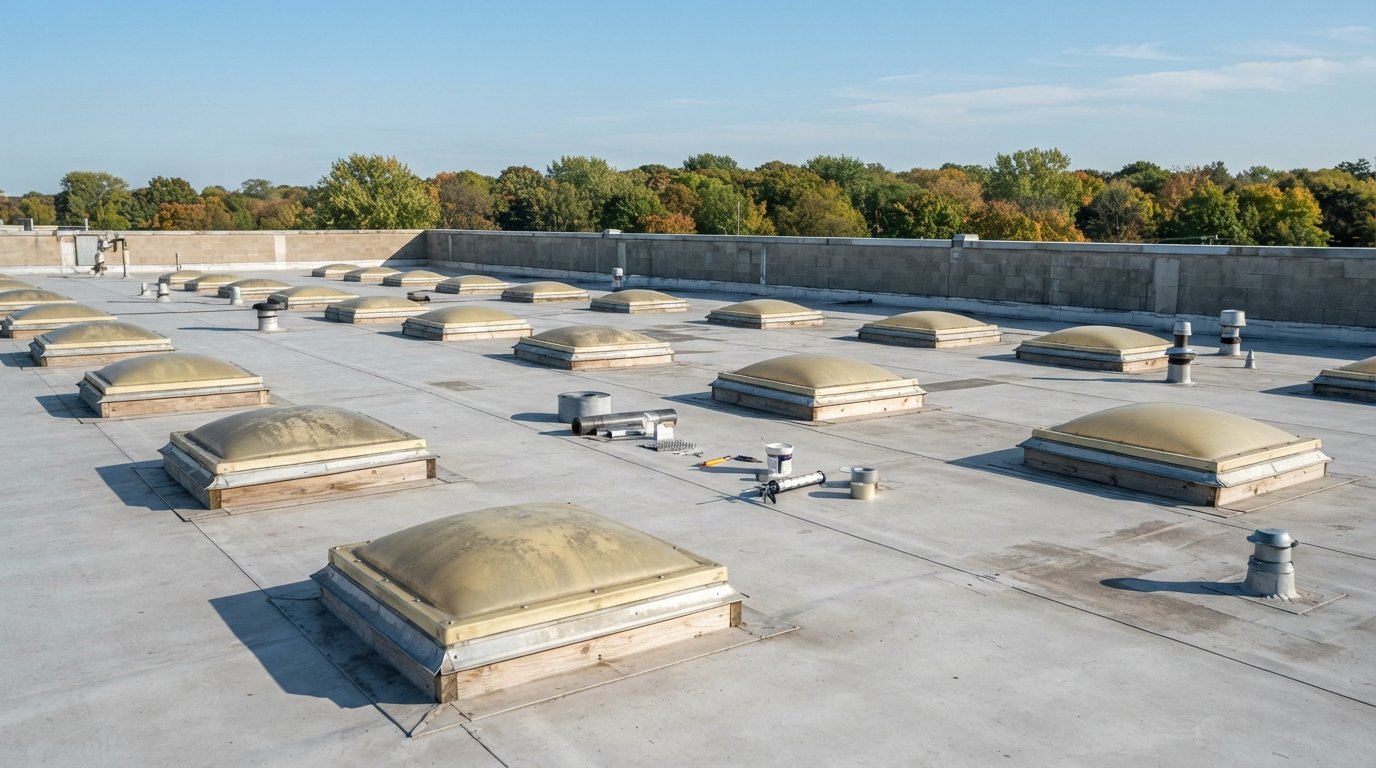
Walk the roof of almost any older warehouse, plaza or school and you will find the same thing: rows of skylight domes that were clear when they went in and are now yellow, chalky, crazed or cracked. Commercial skylight replacement is one of those jobs property managers tend to postpone until a dome breaks or a tenant complains about a drip onto stock. Planned properly, though, it is a straightforward project that restores daylight, stops leaks at the curbs and removes a real fall hazard from the roof.
This guide is for building owners, facility managers and property managers. It sits alongside our overview of commercial skylight installation and covers how aging domes and panels fail, what to check on the curbs and flashing, how to coordinate with the roofing membrane and its warranty, what daylighting can realistically do for a building, and how to schedule the work around tenants, staff or students.
When Commercial Skylight Replacement Makes Sense
Commercial skylights rarely fail all at once, so commercial skylight replacement is seldom an emergency until a dome breaks. They degrade gradually, and the decision to replace is usually driven by a mix of reasons rather than one event. The common triggers are:
- Loss of light. Yellowing and hazing gradually cut the daylight reaching the floor, so spaces that once relied on skylights now run their lights all day.
- Brittleness and cracking. Old acrylic in particular becomes brittle with UV exposure. A dome that cracks under hail, a dropped tool or thermal stress can let in water and debris.
- Leaks at the curb. Many leaks blamed on skylights are actually at the curb, the flashing or the membrane around the curb, not the dome itself.
- A planned re-roof. Replacing the roofing membrane without addressing the skylights is a missed opportunity, and leaving old units in a new roof can compromise the new system.
- Safety concerns. Aging domes are a recognized fall-through hazard for anyone working on the roof. Replacement is a good time to add screens or guards.
If you are looking at your options, our page on commercial skylight domes in acrylic and polycarbonate shows the typical unit types, and the broader commercial skylights page covers larger systems.
Acrylic, Polycarbonate And Glass: What You Are Replacing And With What
Most flat-roof commercial skylights in the GTA are domes or pyramids made of acrylic or polycarbonate, often in single, double or triple-wall configurations. Understanding the material helps you understand why they failed and what to install instead.
| Material | How it typically ages | Strengths | Trade-offs |
|---|---|---|---|
| Acrylic dome | Holds clarity reasonably well but grows brittle and may craze over time | Good light transmission, cost-effective, widely available | Lower impact resistance than polycarbonate, especially when old |
| Polycarbonate dome | Very tough, but can yellow or haze over time, depending on its UV protection | High impact resistance, suitable where hail, vandalism or foot traffic are concerns | May lose clarity over time; usually costs more than acrylic |
| Double or triple-wall dome | Each layer ages like its material; dirt or moisture between layers reduces light | Better thermal performance and less condensation than single-wall | Heavier and more expensive; needs a curb and frame matched to it |
| Glass skylight unit | Glass itself does not yellow; seals and frames are the aging points | Excellent clarity; available with low-emissivity coatings | Heavier and often costlier; more common in custom or architectural systems |
| Polycarbonate panels in a framed system | Panels can yellow and seals at bars can fail | Covers large openings such as atriums and ridges | Replacement often means re-panelling and resealing the whole system |
For most warehouses and plazas, the choice in a commercial skylight replacement comes down to acrylic or polycarbonate domes with double-wall construction. Schools and buildings with public roof access often favour polycarbonate for impact resistance. Ask the manufacturer or installer for the current specifications, including light transmission, thermal performance and UV protection, and compare them on the same basis.
Curbs And Flashing: The Part That Usually Leaks
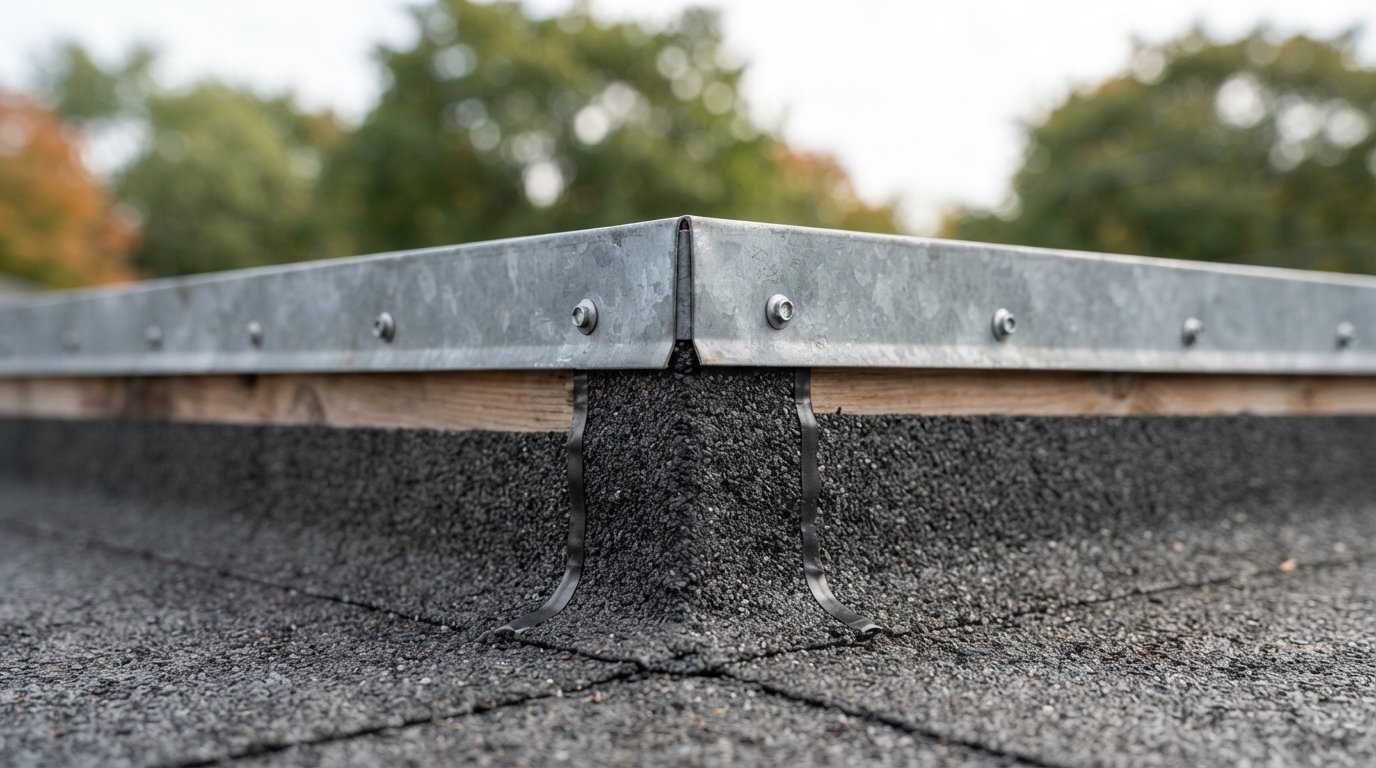
On a commercial flat roof, the skylight sits on a curb, a raised frame of wood or metal that lifts the unit above the roof surface. The membrane runs up the curb as base flashing, and metal counterflashing or the skylight frame covers the top edge. When a skylight leaks, the problem is often here, not in the dome.
What to check on each curb
- Height. Curbs need enough height above the finished roof surface to keep water and debris away from the joint. Roofers commonly work to a minimum curb height, and older curbs that have been buried by multiple re-roofs may now be too low.
- Condition of the wood. Wood curbs that have taken on water rot from the top and inside. Soft wood will not hold fasteners and should be replaced.
- Insulation. Uninsulated curbs are cold bridges that can drip condensation into the space below during the heating season.
- Membrane base flashing. Look for splits, open laps, shrinkage pulling away from the corners, and blisters.
- Counterflashing and fasteners. Loose or corroded metal and failed sealant at fasteners let water behind the membrane.
| Symptom inside or on the roof | Likely cause | Typical remedy |
|---|---|---|
| Drips around the skylight edge in rain | Failed base flashing or open laps at curb corners | Membrane repair or new base flashing by the roofer |
| Drips on cold days without rain | Condensation on single-wall dome or uninsulated curb | Double-wall dome, insulated curb, and a check of interior humidity |
| Water staining down the inside of the curb | Leak at the dome frame seal or counterflashing | Reseal or replace the dome; new counterflashing |
| Dome rocks or lifts at one corner | Rotted curb or loose fasteners | Rebuild or replace the curb, then refit the unit |
| Ponding water around the curb | Roof slope or drainage issue, or curb too low after re-roofing | Raise the curb and address drainage with the roofer |
This is why commercial skylight replacement is rarely just a dome swap. If the curbs are sound and the right height, a dome-only replacement can be quick. If not, the curb and flashing work is where the value lies, and skipping it simply moves the leak.
Coordinating With The Roofing Membrane And Its Warranty
Commercial roofs are often under a roofing manufacturer’s or contractor’s warranty, and skylight curbs are penetrations in that system. Any commercial skylight replacement that touches the base flashing has to respect that. Before work begins, find out:
- Whether the roof is under warranty, and who issued it.
- Whether the warranty requires the original roofer, or an approved roofer, to do any work on the membrane.
- What membrane type is installed, such as modified bitumen, TPO or EPDM, since each is flashed differently.
- Whether a re-roof is planned in the next few years, which may change what you do now.
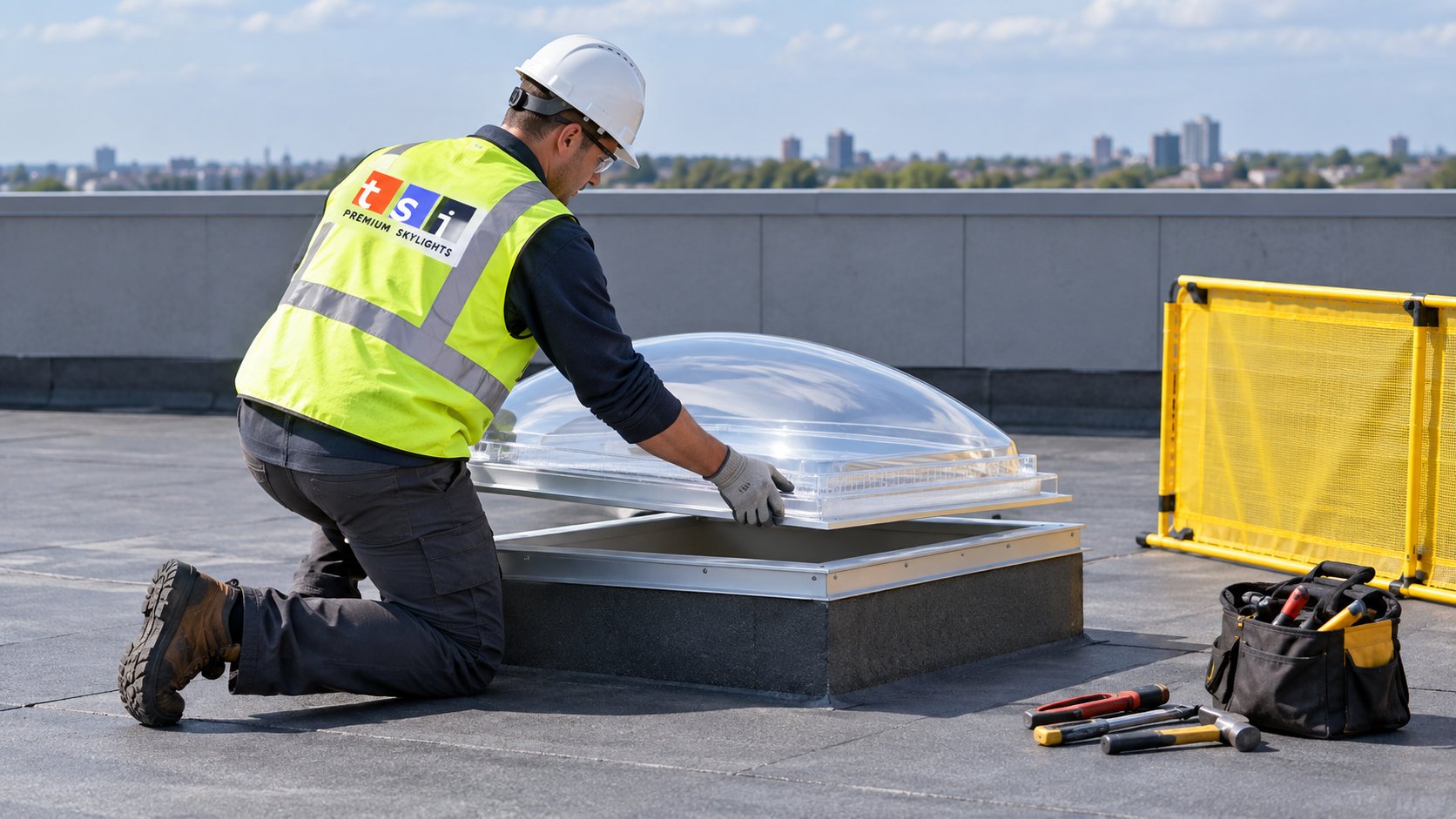
The cleanest approach is usually a coordinated job: the skylight contractor removes and replaces units and curbs, and the roofer handles the membrane and flashing on the same schedule. When a re-roof is planned, the best time for commercial skylight replacement is during that project, so new curbs are built to the right height for the new roof and flashed as part of the system.
How A Commercial Skylight Replacement Day Runs
Owners often ask what actually happens on the roof, especially when the building stays open. A well-run commercial skylight replacement follows a steady rhythm, one opening at a time, so no unit is left exposed longer than necessary.
- Protection below. Before anything is removed, the area under each skylight is cleared or covered with tarps or a catch platform, and staff are told which zones to avoid.
- Remove the old unit. Fasteners are cut or backed out and the old dome lifted off. Brittle acrylic can shatter, so crews handle it carefully and bag the pieces immediately.
- Inspect the curb. With the dome off, the top of the curb and the inside faces are checked for rot, low height and failed insulation. This is the point where a dome-only swap either proceeds or becomes a curb job.
- Repair or rebuild. Soft wood is replaced, curbs are raised if needed, and insulation is added. If the base flashing must be redone, the roofer does that work now.
- Set and secure the new unit. The new dome or frame is bedded on its gasket or sealant, fastened to the curb, and counterflashing is installed where the design calls for it.
- Close-out. Screens or guards are fitted, debris is removed from the roof and the space below, and each unit is photographed for the owner’s records.
On a straightforward roof with sound curbs, a crew can often complete several dome-only swaps in a day. Curb rebuilds and membrane work slow the pace considerably, which is why the curb inspection in step three drives the schedule for the whole commercial skylight replacement.
Daylighting: What New Skylights Can And Cannot Do
Clear new domes bring daylight back into spaces that have grown dim. In warehouses, distribution spaces and gyms, good daylight can reduce the need for electric lighting during the day, especially when combined with daylight sensors that dim fixtures automatically. Staff often find daylit spaces more pleasant to work in.
There are trade-offs. More light also means more solar heat in warm months and more heat loss in cold ones, so the right glazing and number of units matter. Diffusing or prismatic domes spread light more evenly and reduce glare and hot spots compared with clear domes. For a large building, the manufacturer or a lighting designer can model the daylight and energy balance. We avoid quoting savings figures without that analysis, because results depend on the building, its use and its lighting controls.
Scheduling Around Tenants, Staff And Students
The roof work itself is rarely the hard part; the building below is. When a dome comes off, the opening is exposed to the space beneath, and debris, dust or sealant can fall. Good planning keeps operations running.
| Building type | Common constraints | How the work is usually arranged |
|---|---|---|
| Warehouse or distribution space | Stock and racking beneath units; equipment traffic on the floor | Protect or clear the area below each unit; work in zones through the day |
| Retail plaza | Tenants open to the public; varied hours | Early mornings or closed days for units over sales floors; notices to tenants |
| School | Students present during term; roof access controls | Weekends, holidays or planned breaks; coordination with the board’s facilities staff |
| Office or light industrial | Workstations and equipment beneath skylights | After-hours work or temporary relocation of desks below openings |
| Multi-tenant industrial | Different tenants below each skylight | Unit-by-unit notice and access through the property manager |
Weather matters as well. Each opening must be closed the same day, either with the new unit or a secure temporary cover. Early autumn is a good season for this work: temperatures suit membrane and sealant work, and the roof is closed up before the heating season. Planning now also helps if you want replacements in schools completed during the next scheduled break.
Safety on the roof
Skylights are a recognized fall-through hazard. Ontario’s workplace safety rules require that workers on roofs be protected from falls, including through openings. Many owners add skylight screens or guards when replacing domes, which protects contractors, maintenance staff and anyone else who goes on the roof in future. Discuss the options with your contractor and your health and safety advisor.
Cost Factors And How To Get Comparable Quotes
The cost of commercial skylight replacement depends on unit size, material, wall count, curb condition, roof type, access and how much coordination the building requires. As a rough guide, a dome-only replacement on a sound curb costs much less than a full curb rebuild with new base flashing, and per-unit pricing typically drops when several units are done in one mobilisation. Treat any figure you hear as an estimate until the roof has been inspected.
To compare quotes fairly, ask each contractor to state:
- The dome or unit model, material and wall count.
- Whether curbs are reused, repaired, raised or replaced.
- Who handles membrane flashing and how the roof warranty is protected.
- Protection below openings and debris handling.
- Whether screens or guards are included.
- The schedule and working hours.
For owners with properties east of the city, our Durham Region skylight installation, replacement and repair team handles commercial roofs as well as homes, with the same approach to curbs, flashing and coordination.
Commercial Skylight Questions
Can I replace just the dome and keep the existing curb?
Why are my skylight domes turning yellow?
Will skylight work affect my roof warranty?
Is acrylic or polycarbonate better for a school?
Can the work be done while the building is occupied?
Do we need skylight screens or guards?
Book A Roof Assessment For Commercial Skylight Replacement
Toronto Skylight Installers inspects domes, curbs and flashing on commercial roofs, recommends dome-only or full curb replacement where each makes sense, and coordinates with your roofer and tenants so the building keeps running.
Call us today at (416) 365-7557 or request a free estimate.
Serving commercial properties in Durham Region and across the wider GTA.