

A condo skylight replacement looks like the same job as swapping a skylight on a detached house: remove the tired unit, set a new one, flash it, finish the inside. On the roof, it mostly is. Everything around the roof work is different, though. Someone other than you may own the roof, the board may need to approve the product, the roofing warranty may belong to the corporation, and the property manager controls who gets a ladder or a hatch key. Owners who plan for those steps usually get their new skylight on schedule. Owners who book a contractor first and ask permission later often end up with a crew turned away at the gate.
This guide walks through the approvals, access and coordination that come with a condo skylight replacement in a townhouse complex or low-rise condominium, from the point of view of an installer who has stood on a lot of shared roofs. It does not replace your declaration, your corporation’s rules or advice from your property manager, and it is not legal advice. What it does is tell you which questions to ask, in which order, so the work goes smoothly.
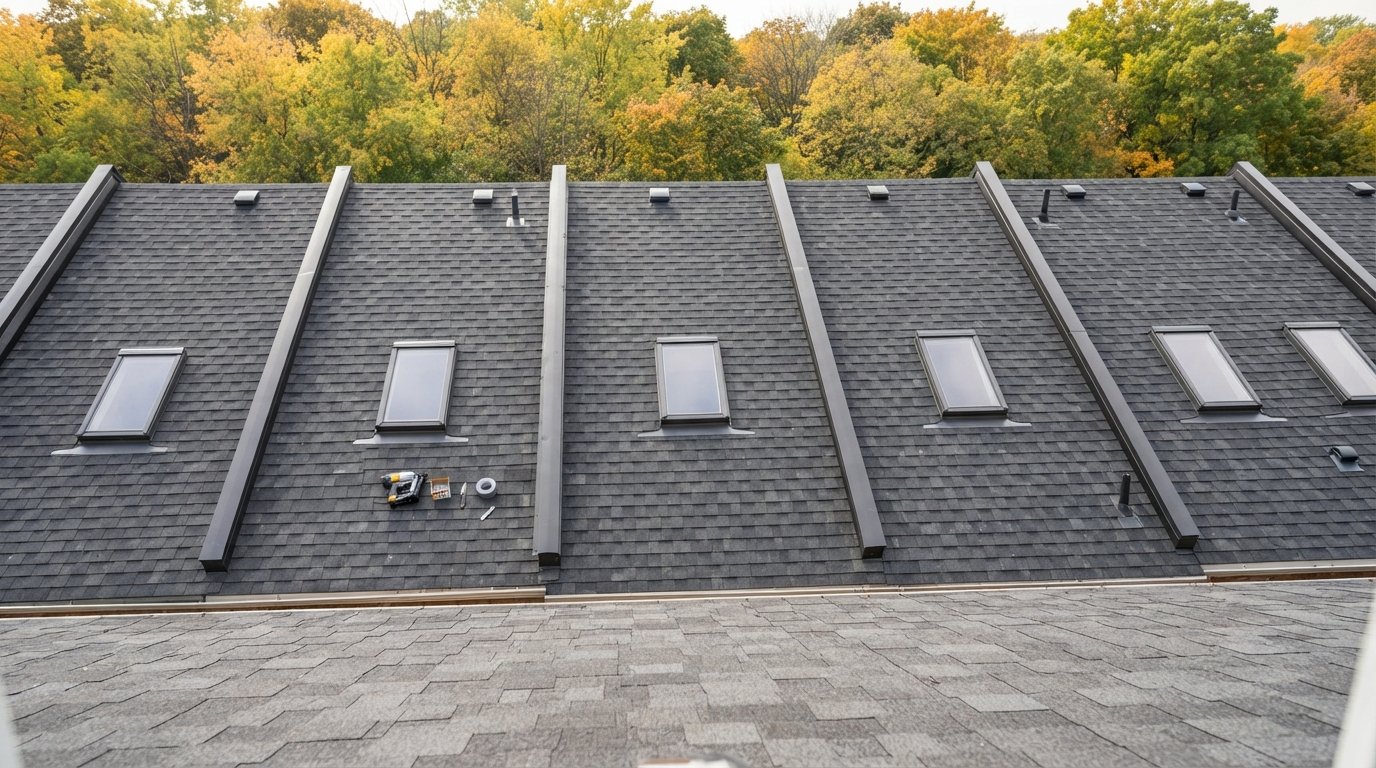
Why A Condo Skylight Replacement Needs A Different Plan
On a freehold house, the homeowner decides, the contractor quotes, and the work gets booked. In a condominium, three extra parties are involved even if nobody says so out loud: the corporation, which often owns or maintains the roof; the board, which approves alterations; and the property manager, who runs the day-to-day logistics. A roofing contractor may also be in the picture if the roof is under a workmanship warranty from a recent re-roof.
A skylight is a hole in the roof assembly. Replacing it means cutting back shingles or membrane, redoing flashing, and tying a new unit into underlayment that also protects the units beside you. If anything leaks afterwards, the corporation will want to know who touched the roof, with what product, and whether the work followed the manufacturer’s instructions. A well-documented condo skylight replacement answers those questions before they are asked.
Most corporations are glad to see a failing skylight dealt with properly; they simply want a complete request, a matching product and an insured contractor. For a closer look at the replacement work itself, including how old units come out and new flashing goes in, see our overview of professional skylight replacement for homes and townhouses.
Who Is Responsible For The Skylight? Start With The Declaration
The single most important document in any condo skylight replacement is the corporation’s declaration, along with its bylaws, rules and any schedule that spells out maintenance and repair responsibilities. Declarations are not all written the same way, and two complexes built by the same developer can split responsibility differently. Do not assume. Read the relevant sections or ask the property manager to point you to them.
In general terms, you will usually find one of these arrangements:
- The roof, including skylights, is a common element maintained and repaired by the corporation. In that case, replacement may be the corporation’s job and cost, often scheduled with other roof work, and an owner who replaces a unit privately may be doing something the corporation would have paid for or may be interfering with its warranty.
- The roof is a common element but skylights are the owner’s responsibility, often because they were optional upgrades or added later by a previous owner. Here the owner pays for the skylight, but the roof surrounding it is still the corporation’s, so the work needs approval and must be done to the corporation’s standards.
- Freehold townhouses with a common elements condominium or a shared roofing agreement. The owner may own their own roof section outright but still have obligations about appearance, materials or coordination with neighbours.
If the wording is unclear, ask the property manager, who usually knows how previous replacements in the complex were handled. If there is a real disagreement about who pays or who is liable, that is a conversation for the board and, if needed, the corporation’s lawyer or your own, not your contractor. Our role is to give you accurate information about the product and the work so that whoever decides can decide well.
Questions to settle before you get quotes
- Is the skylight part of the common elements or my unit, according to the declaration and any maintenance schedule?
- Does the corporation plan to replace skylights as part of an upcoming roof project?
- Is the roof under a roofing contractor’s workmanship warranty, and does any penetration work have to be done or inspected by that roofer?
- Does the corporation have an approved product list or a standard skylight that other owners have installed?
- Which insurance certificates and documents does the manager need from my contractor?
Getting Board Approval Without Stalling The Job
Most corporations require written approval for alterations that touch the common elements, and a condo skylight replacement almost always does. Boards typically meet monthly, sometimes less often, so a request that arrives the day after a meeting can sit for weeks. A complete package that the board can approve in one pass is the fastest route.
What boards want to see is not complicated. They want to know that the new unit will look like the others, that the work will not void anything, that the contractor is insured, and that the roof will be left as they found it. Your contractor should be able to provide most of the paperwork. Here is what a strong approval request usually contains.
| Item in the request | What it shows the board | Who usually provides it |
|---|---|---|
| Product specification sheet for the new skylight | Size, frame colour, glazing type and whether it matches existing units | Contractor, from the manufacturer’s literature |
| Flashing kit and installation method | That the unit will be flashed with a system designed for the roof type | Contractor |
| Certificate of liability insurance | Coverage level and, often, the corporation named as additional insured | Contractor’s insurer |
| WSIB clearance certificate | That the contractor is in good standing for workplace coverage | Contractor |
| Scope of work and schedule | How long the roof will be open, what is protected and how debris leaves site | Contractor, reviewed by owner |
| Photos of the existing skylight and roof | Condition before work, useful if questions come up later | Contractor or owner |
Some corporations also ask owners to sign an alteration agreement, which may make the owner responsible for future maintenance of the new unit or for damage caused by the work. Read it carefully and ask the property manager what it means for you. That document belongs to the corporation, and questions about its legal effect should go to the manager or a lawyer.
Roof Access And Protecting A Shared Roof
On a detached house, the crew sets a ladder against the eaves and goes up. In a condo complex, access is often the hardest part of the day. Stacked townhouses may only be reachable through a roof hatch in a common corridor. Low-rise buildings may require the crew to use a specific ladder location, avoid landscaped beds, or stay off shared terraces. Some roofs are flat with a membrane that cannot take foot traffic without protection.
Before the job date, confirm these details with the property manager and pass them to your contractor:
- Access point: which ladder location or hatch the crew may use, and who holds the key.
- Working hours: many corporations restrict noisy work to set hours on weekdays, and some do not allow weekend work.
- Parking and material staging: where the crew may park and store the new unit, since fire routes and visitor parking are usually off limits.
- Debris handling: whether a bin is allowed on site, or whether everything must be carried out the same day.
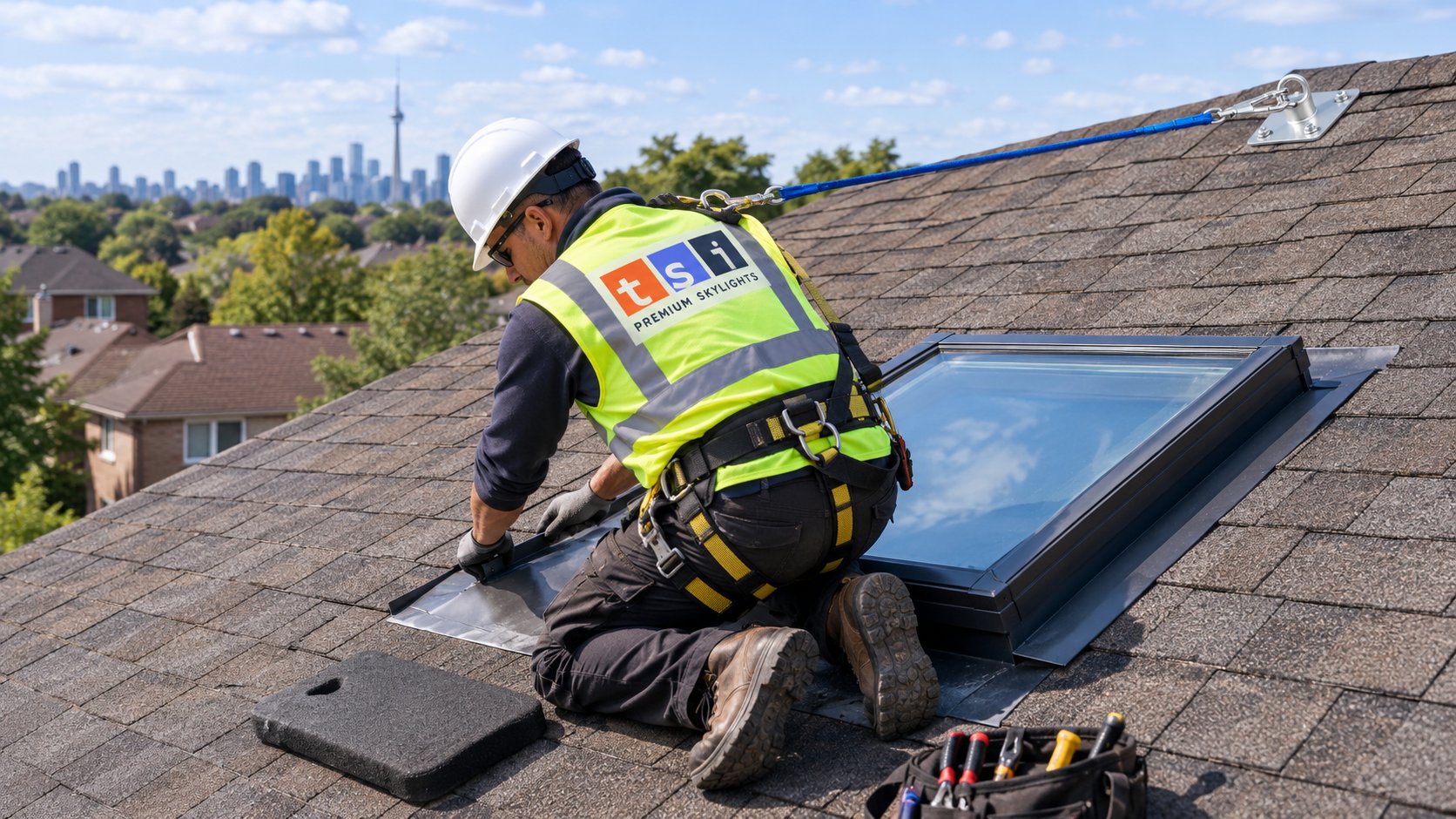
- Fall protection: whether the roof has permanent anchors the crew may use, or whether temporary anchors must be installed and later sealed.
Protecting the roof is where a careful installer earns their keep. Shingles on neighbouring sections are walked on, sometimes scuffed, and in cooler autumn weather they are stiffer and easier to crack. Membrane roofs can be punctured by a dropped screw or damaged by a ladder foot. Good crews lay down protection boards or pads along their route, keep fasteners in pouches or buckets, and inspect the path before they leave. Any damage they find, even if it was already there, should be photographed and reported to the manager.
Weather matters more on a shared roof. Once the old skylight is out, the opening must be closed the same day, because water that gets in may travel to a neighbour’s ceiling. Most early-autumn days are workable, but a crew should not start a condo skylight replacement with rain forecast for the afternoon.
Working With The Property Manager From Quote To Sign-Off
The property manager is not an obstacle; they are the person who can make the job easy. Treat them as part of the project team. Introduce your contractor early, copy the manager on schedule changes, and let them know when the work is finished so they can check the roof or arrange for the corporation’s roofer to inspect it.
A typical sequence looks like this. Timelines vary a lot with the board’s meeting schedule and product lead times, so treat the durations as rough guides only.
| Step | What happens | Typical timing |
|---|---|---|
| 1. Check responsibility | Owner reads the declaration and asks the manager who owns and maintains the skylight | A few days |
| 2. Site visit and quote | Contractor inspects the roof, measures the unit and prepares the product and scope details | 1 to 2 weeks |
| 3. Approval request | Owner submits the package; board reviews at its next meeting | 2 to 6 weeks, depending on meeting dates |
| 4. Order and notice | Contractor orders the unit and flashing; manager notifies neighbours and confirms access | Often 1 to 4 weeks for standard units |
| 5. Installation day | Old unit removed, new unit set and flashed, interior finished | Usually a single day per skylight in good weather |
| 6. Close-out | Contractor provides photos and product information; manager or roofer inspects | Within a week of the work |
Matching Skylights Across A Complex
Uniform appearance is one of the main reasons boards care about skylights. From the street or a neighbouring unit, a bronze frame among a row of grey ones stands out, and so does a raised dome among flat glass. Many corporations require that any replacement match the existing units in size, profile and frame colour, even when the owner pays.
Matching is usually possible, but not always exactly. Manufacturers update their product lines, and a skylight installed twenty or more years ago may not be available in the same form today. Here are the common scenarios and how they are usually handled.
| Situation | Usual approach | What to raise with the board |
|---|---|---|
| Same model still available | Order the current version in the same size and frame colour | Confirm the glazing and frame match the approved standard |
| Model discontinued, same rough opening size exists | Choose the closest current unit that fits the existing opening | Show the spec sheet and a photo of a comparable installation |
| Old unit is a plastic dome, board wants a consistent look | Replace with a similar dome or propose glass units as the new standard | Whether the corporation wants to adopt a new standard for all future replacements |
| Opening size no longer made | Reframe the opening to fit a standard size | Extra roof work, cost and whether the look from outside changes |
| Several owners replacing at once | Coordinate one order and one crew schedule | Possible savings on mobilisation and a single approval for all units |
That last scenario is worth pursuing. When one skylight in a complex fails, others of the same age are usually close behind. If you talk to neighbours and a few owners replace together, the manager handles one approval, one notice and one access arrangement, and the crew can work through several units in sequence. Some corporations take this further and adopt a standard product, such as a fixed skylight in a set size and colour, for every future condo skylight replacement.
What Tends To Go Wrong, And How To Avoid It
Most condo skylight replacement problems are not technical. They come from missing information or rushing past the corporation’s process:
- Work done without approval. The corporation may require the owner to remove or redo the work, or may refuse responsibility for future leaks around the unit. Always get written approval first.
- Roof warranty conflicts. If the corporation’s roof is under a roofer’s warranty, another contractor cutting into it may affect that coverage. Ask the manager before anyone touches the roof.
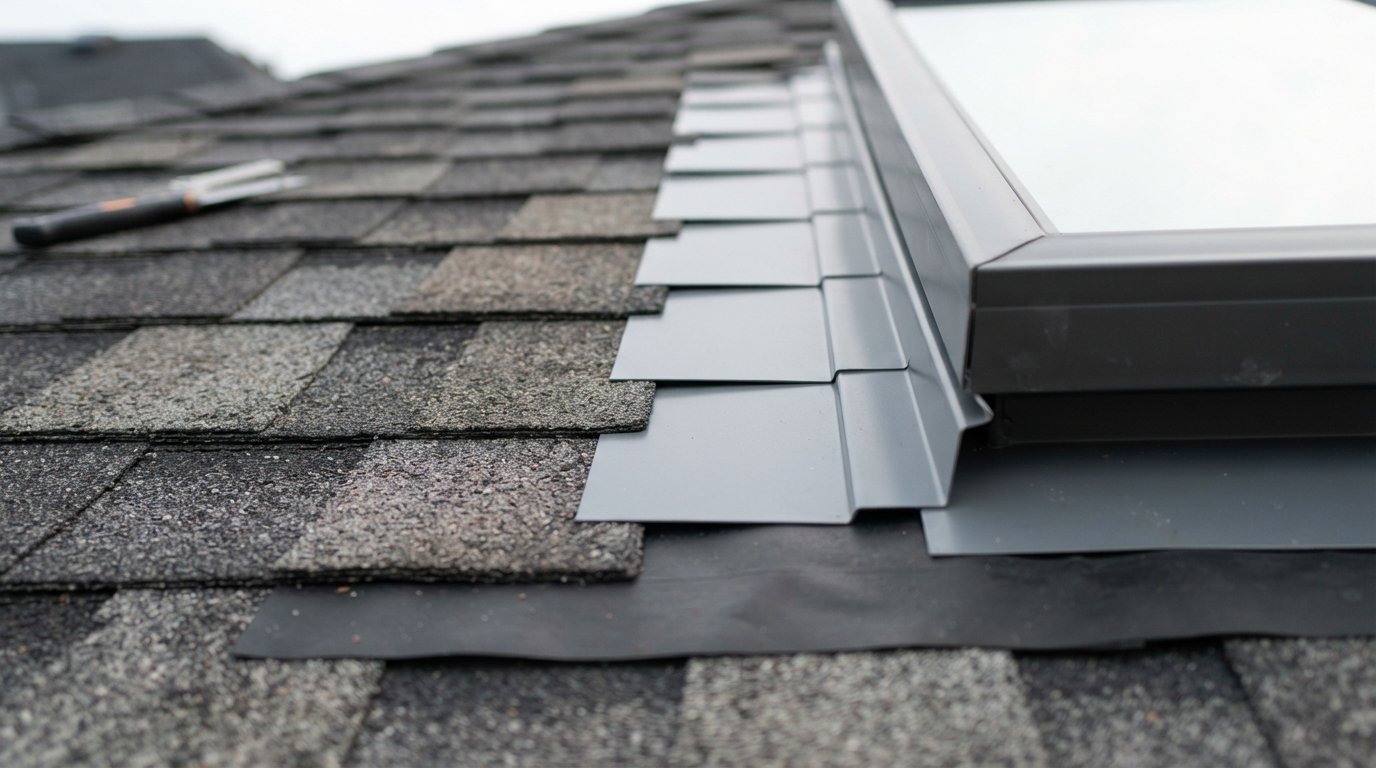
- Using the wrong flashing. Reusing old flashing or improvising with sealant is a common cause of leaks. Proper skylight flashing kits designed for the unit and roof type should be used.
- Interior finishing overlooked. Removing an old frame can disturb drywall in the light shaft. Discuss who repairs and paints interior finishes, since that is usually the owner’s cost.
- Access surprises on the day. A locked hatch, an unexpected landscaping crew, or no parking can cost a day. Confirm access in writing the week before.
- Neighbour complaints. Noise, debris or a crew walking on another owner’s roof without notice. The manager should notify affected owners in advance.
If you already have a leak, record where and when the water appears. That record helps the contractor and manager tell whether the skylight, the flashing or the surrounding roof is the source.
What It Typically Costs And Who Pays
Who pays depends entirely on the declaration and any alteration agreement, so start there. When the owner is responsible, the cost of a residential skylight replacement in a townhouse typically falls in a broad range, often from the low thousands per unit for a standard fixed skylight in a straightforward roof, rising for larger venting units, laminated glass, reframing, difficult access or interior drywall work. Treat any number as an estimate that depends on the house, the roof and the scope. A site visit is the only way to price it accurately.
A condo skylight replacement can also carry costs a freehold job does not: restricted access, carrying materials through common areas, temporary anchors or coordination with the corporation’s roofer. Ask for these to be listed separately; when several owners replace together, some can be shared.
Questions To Ask Your Skylight Contractor
Before you sign, a few direct questions will tell you whether a contractor understands condo work:
- Can you provide liability insurance with the corporation named as additional insured, and a current WSIB clearance?
- Which product and flashing system do you recommend, and can you supply spec sheets for the board?
- How will you protect neighbouring roof sections and common areas during the work?
- What documentation will you provide after the job, such as photos and product information for the corporation’s records?
If you are in a complex outside the city, the same approach applies. Our team handles skylight installation, replacement and repair across York Region and the wider GTA, and the process with managers and boards is largely the same wherever the complex is located.
Condo And Townhouse Skylight Questions
Do I need board approval to replace a skylight in my townhouse?
Who pays for a leaking skylight in a condo?
Can I choose any skylight model I like?
How long does the actual installation take?
Will replacing my skylight affect the roof warranty?
Is it worth coordinating with neighbours?
Plan Your Condo Skylight Replacement With A Team That Knows The Process
Toronto Skylight Installers works with townhouse owners, boards and property managers to plan skylight replacements that match the complex, respect shared roofs and come with the paperwork managers need. We can visit, measure, prepare product details for your approval request and schedule the work once the board has signed off.
Call us today at (416) 365-7557 or request a free estimate.
Serving homeowners and condominium communities in York Region and across the wider GTA.