

If your home was built or renovated around 2006, the skylight overhead is now approaching the end of its service life, and replacing an old skylight in Toronto has likely moved from “someday” to “this year.” A skylight installed two decades ago was sealed with materials and glazing technology that simply cannot match what is available in 2026. Across the GTA, we see the same pattern every spring: condensation between the panes, hairline drips during freeze-thaw cycles, and energy bills creeping upward as the seals fail. This guide walks Toronto and GTA homeowners through the warning signs, the right timing, real 2026 cost data, and the upgrade options worth considering before you commit to a replacement.
As a certified VELUX dealer, Toronto Skylight Installers has replaced thousands of aging units across Etobicoke, North York, Scarborough, and the surrounding suburbs. The decisions you make at the 20-year mark, glazing type, ventilation, flashing, and installer choice, determine whether your next skylight lasts another 25 years or starts leaking in five.
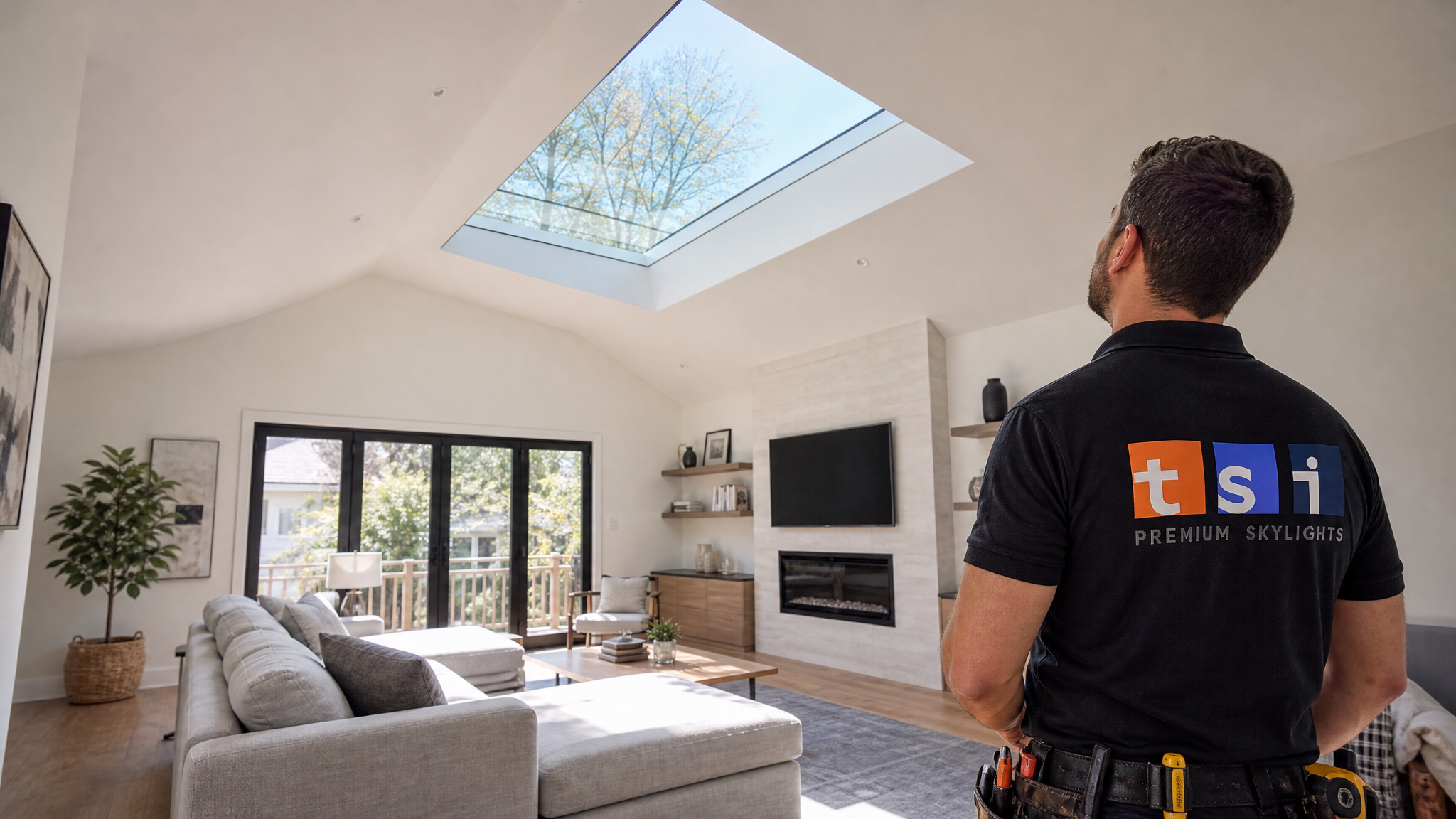
Why Replacing an Old Skylight in Toronto Becomes Urgent at 20 Years
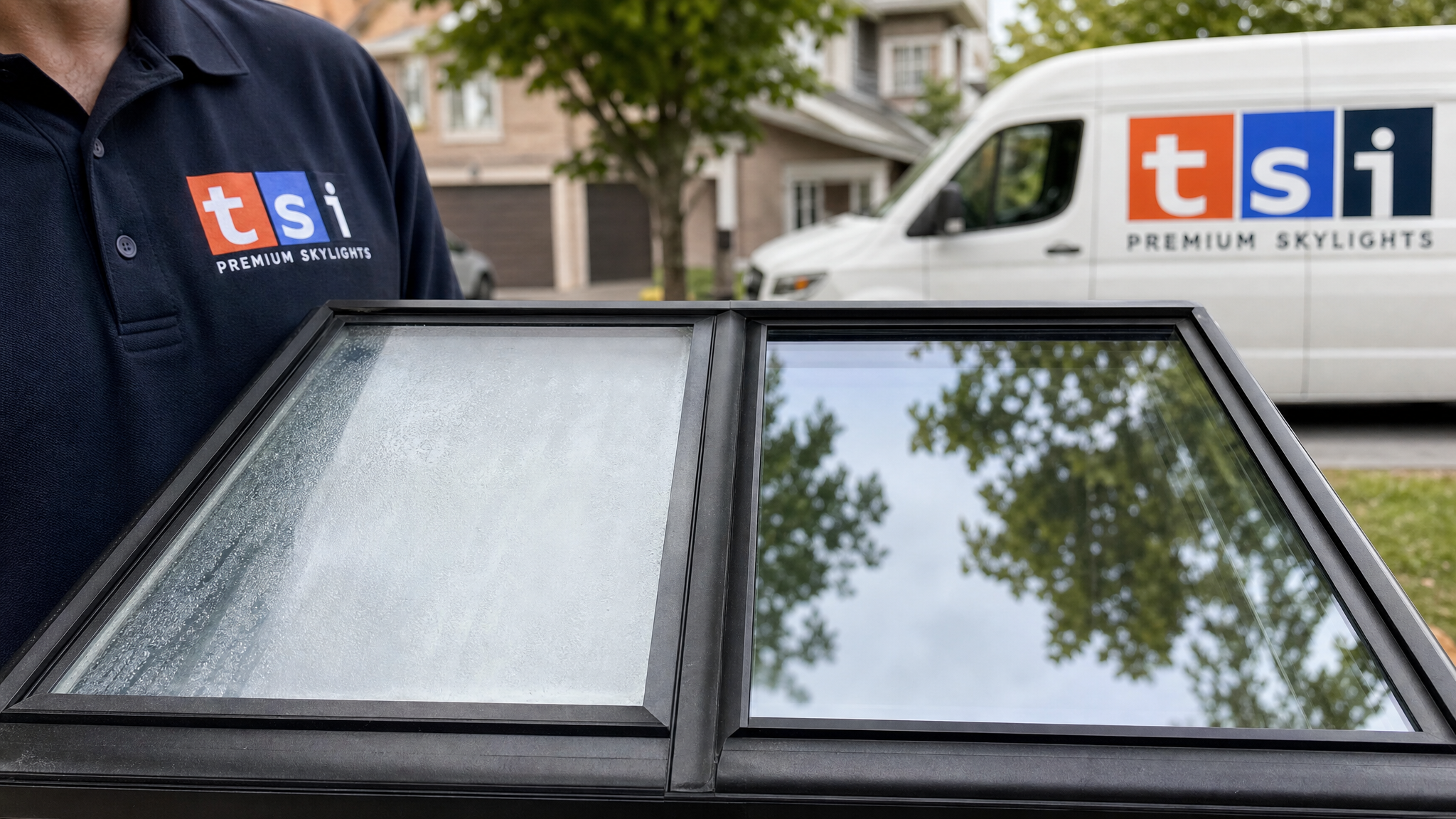
The reason replacing an old skylight in Toronto becomes pressing around the two-decade mark comes down to materials science. The acrylic or early dual-pane glass used in early-2000s units was never engineered to withstand 20 Ontario winters. Each freeze-thaw cycle, and the GTA averages more than 60 of them per season, expands and contracts the seal between the glass panes. Eventually the argon gas escapes, the desiccant saturates, and moisture creeps in. Once you see fog or water droplets trapped inside the glass, the insulating value is gone and there is no repair that restores it.
The curb and flashing age too. Twenty years ago, most skylights were “site-built” curbs flashed with tar and step metal that a roofer improvised on the spot. Modern VELUX units ship with engineered flashing kits matched to your roof pitch and shingle type. If your old unit is leaking at the corners rather than through the glass, the flashing has failed, and that is rarely worth patching on a unit already past its lifespan. In most cases a full skylight replacement is more cost-effective than chasing leaks on obsolete hardware.
There is also a comfort and energy dimension. A 2006-era skylight has a centre-of-glass U-factor roughly double that of a 2026 ENERGY STAR unit. In a Toronto winter that means radiant heat loss, cold drafts, and condensation dripping onto your drywall. Replacing the unit typically cuts the heat loss through that opening by 40 to 50 percent.
Warning Signs It Is Time to Replace, Not Repair
Not every skylight problem demands replacement. A cracked flashing or a worn gasket on a 10-year-old unit is a straightforward skylight repair. But once a unit crosses the 18 to 20 year line, the same symptoms point toward replacement instead. Use the table below to judge where your skylight sits.
| Warning Sign | What It Means | Repair or Replace |
|---|---|---|
| Fog or moisture between the panes | Seal failure, argon gas lost | Replace (no repair restores the seal) |
| Water staining on surrounding drywall | Flashing or curb failure | Replace if unit is 15+ years old |
| Yellowed or crazed acrylic dome | UV degradation of plastic glazing | Replace with glass unit |
| Cold draft or frost on inner glass | Single or failed dual glazing | Replace with double or triple glazing |
| Crank or motor seized (venting unit) | Worn mechanism, parts discontinued | Repair if recent, replace if 12+ years |
| Visible cracks in the pane | Impact or thermal stress failure | Replace immediately (safety risk) |
If you are seeing two or more of these signs at once, a unit nearing 20 years is telling you the same thing it told hundreds of our other clients: the economical move is replacement. Patching one symptom on an aging skylight usually just delays the inevitable while the leak quietly damages your ceiling, insulation, and rafters.
The Best Time of Year to Replace a Skylight in the GTA
Timing matters more for skylights than for almost any other home upgrade because the work briefly opens your roof to the sky. In the GTA, the window from late April through October offers stable, dry conditions and predictable scheduling. A standard deck-mounted replacement is a single-day job, but you want a dry forecast so the new flashing and underlayment can be installed and sealed properly.
| Season | Conditions | Recommendation |
|---|---|---|
| Spring (Apr-Jun) | Mild, occasional rain, high demand | Excellent; book early to secure dates |
| Summer (Jul-Aug) | Hot, dry, longest daylight | Ideal for flashing and sealant cure |
| Autumn (Sep-Oct) | Cool, stable, low humidity | Excellent; beat the winter rush |
| Winter (Nov-Mar) | Snow, ice, short days | Emergency only; sealants cure poorly |
Winter replacement is possible for emergencies, a cracked pane or active leak cannot wait, but cold-weather sealant cure times and snow on the roof add complexity. If your skylight fails in January, an emergency skylight repair can stabilise the opening until a proper replacement in spring. For planned upgrades, booking in late winter for a spring install gives you the best choice of dates before the May rush.
2026 Skylight Replacement Costs in Toronto and the GTA
Replacement pricing in 2026 depends on the type of unit, glazing, roof pitch, and whether the existing opening can be reused. The figures below reflect typical supplied-and-installed pricing across the Toronto area for a standard residential roof with reasonable access. Replacing into an existing, properly sized opening is always less expensive than cutting a new one, which is one reason replacement is often more affordable than homeowners expect.
| Skylight Type | Unit Style | Installed Cost (2026, CAD) | Lifespan |
|---|---|---|---|
| Fixed (non-venting) | Deck-mounted, double-glazed | $1,400 – $2,400 | 20-25 years |
| Manual fresh-air | Crank-operated venting | $1,900 – $3,000 | 20-25 years |
| Electric fresh-air | Motorised, rain sensor | $2,600 – $4,000 | 20-25 years |
| Solar-powered fresh-air | Solar motor, rain sensor | $2,800 – $4,400 | 20-25 years |
| Sun tunnel | Tubular daylight unit | $900 – $1,800 | 15-20 years |
| Flat-roof skylight | Curb-mounted with dome/glass | $2,200 – $4,500 | 20-25 years |
Costs rise if your roof has a steep pitch, difficult access, or if the original opening needs resizing to fit a modern standard. They also rise if interior drywall, a light shaft, or finished ceiling needs to be rebuilt. Compare the replacement figures above against the alternative of repeated repairs on a failing unit: two or three service calls on an aging skylight can approach the cost of a brand-new, warrantied unit that will not trouble you again for two decades.
2026 Upgrade Options Worth Considering
The single biggest advantage of replacing an old skylight in Toronto today is the leap in technology over a 20-year-old unit. A 2006 skylight was, at best, a fixed pane that let in light. In 2026 you can choose from venting, motorised, solar, and smart-controlled units, all with vastly better energy performance. Here is how the main upgrade paths compare for GTA homes.
Glazing upgrade. The most universal improvement is moving from a single or early dual-pane unit to a modern double- or triple-glazed VELUX with low-E coatings and argon fill. This alone transforms winter comfort and dramatically reduces condensation, the number-one complaint we hear from owners of older skylights.
Fixed to venting. If your old unit was a fixed skylight, replacement is the natural moment to add ventilation. A manual fresh-air skylight works well within easy reach, while an electric fresh-air skylight suits high or hard-to-reach ceilings.
Solar-powered and smart control. The most popular 2026 upgrade in the GTA is the solar-powered fresh-air skylight, which opens and closes on a remote, closes automatically when its rain sensor detects moisture, and needs no electrical wiring to the roof. It also qualifies as a solar-powered product under certain federal energy incentive programs, improving the effective return on investment.
| Upgrade Path | Best For | Key Benefit | Relative Cost |
|---|---|---|---|
| Double-glazed fixed | Light-only openings, hallways | Lowest cost, big energy gain | $ |
| Manual fresh-air | Reachable ceilings, bathrooms | Natural ventilation, no wiring | $$ |
| Electric fresh-air | High ceilings, great rooms | Remote operation, rain sensor | $$$ |
| Solar fresh-air | Any room, no roof wiring | Auto-close, possible incentives | $$$ |
| Flat-roof glass unit | Modern flat or low-slope roofs | Maximum daylight, sleek profile | $$$ |
For flat or low-slope GTA roofs, a modern flat-roof skylight with a flush glass top replaces the old bubble dome and delivers far more daylight. And if your goal is simply to bring light into a dark interior room without a full opening, a sun tunnel is an affordable alternative.
What a Professional Replacement Actually Involves
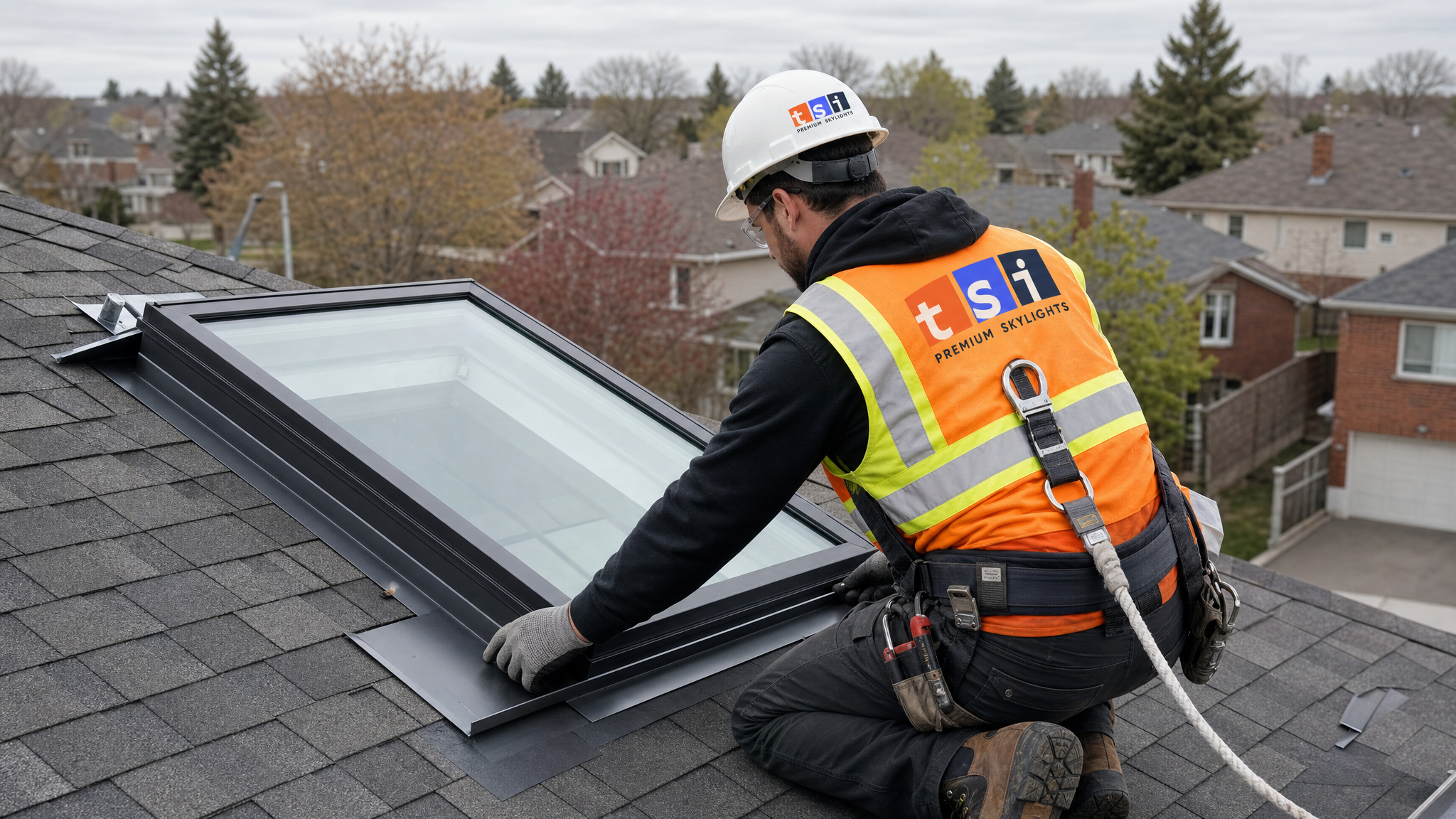
A correct skylight replacement is a precise sequence, not a quick swap. Cutting corners on any step is what causes the leaks that plague poorly installed units. When our crews carry out a skylight installation or replacement, the process follows the manufacturer’s specification exactly so the warranty stays intact.
| Step | Work Performed | Typical Time |
|---|---|---|
| 1. Inspection | Measure opening, assess roof deck and decking condition | 30-45 min |
| 2. Removal | Strip old unit, flashing, and shingles around curb | 1-2 hours |
| 3. Deck prep | Repair rot, fit new underlayment and ice/water shield | 1 hour |
| 4. Unit install | Set new skylight, fasten, fit engineered flashing kit | 2-3 hours |
| 5. Weatherproofing | Re-shingle, seal, install gutter and head flashing | 1-2 hours |
| 6. Interior finish | Trim, drywall touch-up, light-shaft repair if needed | 1-3 hours |
The engineered flashing kit is the part most often skipped by general roofers, and it is the single most important component for a leak-free result. It integrates the skylight into the shingle layers exactly as the manufacturer designed, which is why factory warranties require it. For commercial buildings and larger glazing assemblies, dedicated commercial skylights follow a similar but heavier-duty process.
Choosing the Right Installer for Your Replacement
The quality of the installer matters as much as the quality of the skylight. A premium VELUX unit fitted by an inexperienced roofer can still leak within a year, while a properly installed unit lasts its full rated life. When evaluating installers in the GTA, look for certified dealer status, manufacturer-trained crews, written warranties on both product and labour, and a portfolio of replacements on roofs like yours.
Ask whether the quote includes the engineered flashing kit, interior finishing, and disposal of the old unit, omissions here are where surprise charges appear. A reputable installer will also pull any permits required by your municipality and confirm the new unit meets current Ontario Building Code requirements for glazing and fall protection. If you are replacing as part of a roof renewal, coordinating the skylight and roofing work together avoids paying twice to open the same area.
Schedule Your Old Skylight Replacement in Toronto Today
If your skylight is approaching or past the 20-year mark, replacing an old skylight in Toronto now, before the next leak, protects your ceiling, lowers your energy bills, and brings two decades of better daylight into your home. As a certified VELUX dealer, Toronto Skylight Installers handles everything from assessment to flashing to interior finish, with workmanship that keeps your manufacturer warranty intact.
Call us today at (416) 365-7557 or book a free skylight consultation to get an honest assessment of whether your unit needs repair or replacement and a clear, all-in quote.
Toronto Skylight Installers proudly serves homeowners across Toronto and the GTA with expert skylight replacement, installation, and repair.