

Skylight flashing is the invisible hero of every skylight installation — the component that prevents water from entering your home at the most vulnerable junction between the skylight frame and the surrounding roof surface. When skylight flashing is properly installed, it sheds water seamlessly around the skylight for decades without a single leak. When it fails — due to age, poor initial installation, incompatible materials, or physical damage — the result is water intrusion that can cause thousands of dollars in damage to insulation, drywall, framing, and interior finishes before the homeowner even realizes there is a problem. This comprehensive guide explains everything Toronto homeowners need to know about skylight flashing: what it is, how it works, why it fails, what professional replacement costs, and how Toronto Skylight Installers ensures every skylight installation features factory-engineered flashing systems that prevent leaks for the life of the skylight.
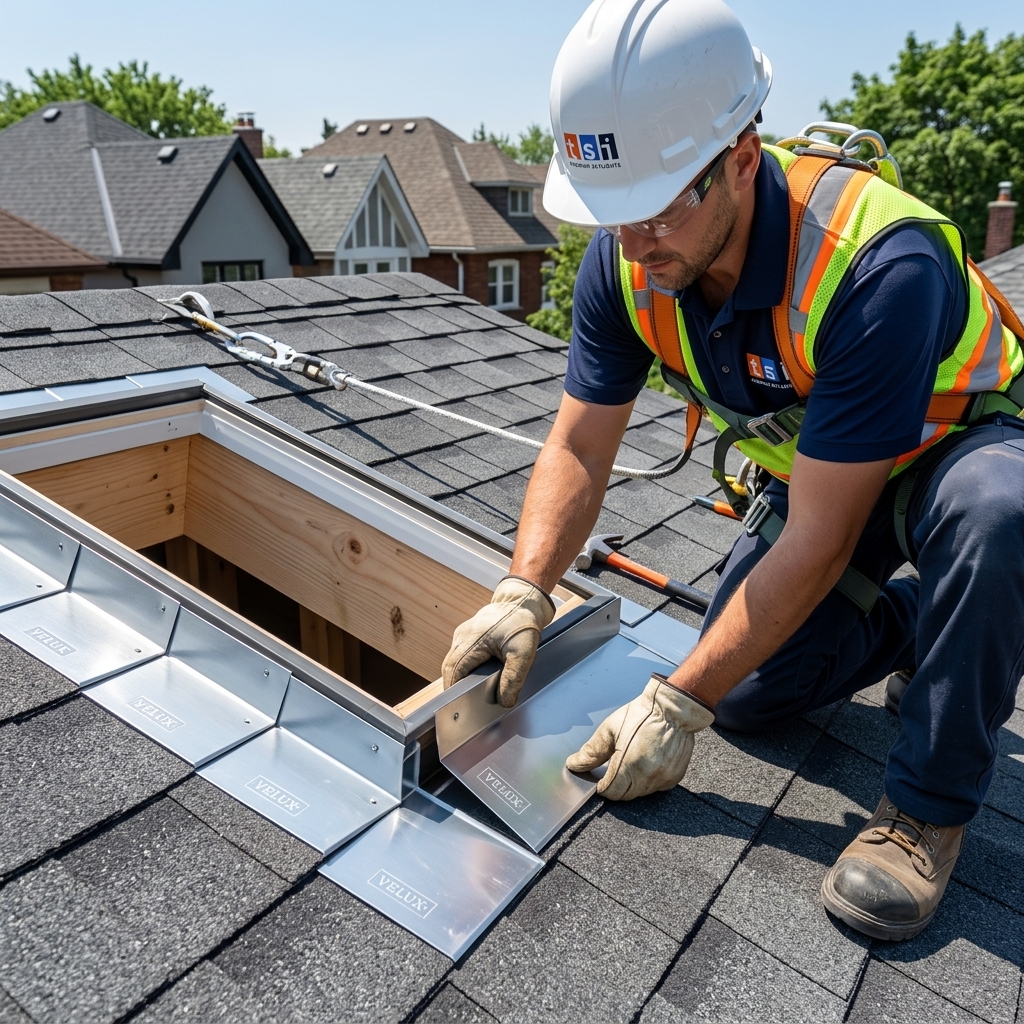
What Is Skylight Flashing and How Does It Work?
Skylight flashing is a system of metal pieces that form a watertight barrier around the skylight frame where it meets the roof surface. The flashing system directs water around the skylight and back onto the shingle surface below, preventing any water from penetrating the gap between the skylight frame and the roof deck. A complete skylight flashing system consists of multiple components that work together.
| Flashing Component | Location | Function |
|---|---|---|
| Sill flashing (bottom apron) | Below the skylight along the lower edge | Directs water away from the bottom of the skylight onto the shingles below |
| Step flashing | Along both sides of the skylight | Individual L-shaped metal pieces woven with each shingle course to redirect water sideways |
| Head flashing (top/counter flashing) | Above the skylight along the upper edge | Diverts water flowing down the roof around and away from the top of the skylight frame |
| Counter flashing | Overlapping the step flashing against the frame | Covers the top edge of step flashing to prevent water from getting behind it |
| Saddle/cricket | Above large skylights on steeper roofs | A small peaked diverter that prevents water and debris accumulation above the skylight |
Why Skylight Flashing Fails in Toronto
Toronto’s climate is particularly harsh on skylight flashing systems. The following factors cause flashing failure.
- Age and thermal fatigue: Repeated expansion and contraction from Toronto’s temperature extremes (-30°C to +35°C — a 65°C annual range) causes metal fatigue, loosened fasteners, and separation between flashing components over 15-25 years
- Ice dam damage: Ice dams force water uphill under shingles and flashing. Repeated ice dam events can lift, bend, and permanently deform skylight flashing, creating gaps that leak during subsequent rain and snowmelt events
- Improper initial installation: This is the most common cause of premature skylight flashing failure. Using generic flashing materials instead of factory-engineered flashing kits, improper step flashing weave with shingles, insufficient overlap, missing sill pan, and reliance on caulk or roofing cement instead of mechanical flashing all lead to early failure
- Roof replacement without flashing replacement: When a roof is re-shingled but the existing skylight flashing is not replaced, the old flashing — which has already experienced years of thermal fatigue — is now expected to perform for another 20-25 years under new shingles. This almost always leads to premature leaks. Toronto Skylight Installers strongly recommends replacing skylight flashing kits during every roof replacement
- Caulk-dependent installations: Caulk and roofing cement are temporary materials that dry, crack, and fail within 3-7 years in Toronto’s climate. Any skylight flashing installation that relies on caulk as its primary waterproofing method (rather than mechanical metal overlaps) will fail prematurely
Signs of Skylight Flashing Failure
| Warning Sign | Location | What It Indicates |
|---|---|---|
| Water stains around skylight on ceiling | Interior ceiling near skylight perimeter | Active or intermittent leak through failed flashing |
| Bubbling or peeling paint near skylight | Interior ceiling/wall near skylight | Moisture penetration causing paint adhesion failure |
| Visible rust on flashing | Exterior — visible from roof level | Galvanized coating has failed, metal is corroding and will develop holes |
| Lifted or separated flashing | Exterior — gaps visible between flashing and frame | Thermal fatigue or ice dam damage has created water entry points |
| Excessive caulk visible around skylight | Exterior — thick caulk beads around frame | Previous failed repair attempts using caulk instead of proper flashing |
| Mould or musty smell near skylight | Interior — around skylight shaft | Chronic moisture intrusion promoting mould growth in insulation and framing |
VELUX Factory-Engineered Flashing Kits
Toronto Skylight Installers exclusively uses VELUX factory-engineered flashing kits for every skylight installation and replacement. VELUX flashing kits are precision-engineered to fit each specific skylight model and are designed to integrate with the most common roofing materials (asphalt shingles, cedar shakes, metal, tile). The factory-engineered kit ensures every component is sized correctly, the step flashing pieces interlock properly with shingle courses, and the head flashing provides adequate coverage above the skylight — eliminating the installation errors that are common with field-fabricated generic flashing.
| VELUX Flashing Kit | For Use With | Material | Cost |
|---|---|---|---|
| EDL (low-profile) | Asphalt shingles (most common in Toronto) | Aluminum | $80-$150 |
| EDW (tile) | Concrete or clay tile roofing | Aluminum | $100-$180 |
| EDP (slate/flat tile) | Slate and flat profile tiles | Aluminum | $100-$180 |
| ECL (combination — multiple skylights) | Side-by-side or stacked skylight configurations | Aluminum | $150-$300 |
The cost of a VELUX flashing kit ($80-$300) is a tiny fraction of the total skylight installation investment — and using the factory-engineered kit rather than generic flashing eliminates the single most common cause of skylight leaks. Toronto Skylight Installers includes the appropriate VELUX flashing kit in every installation and replacement quote.
Skylight Flashing Repair vs. Replacement
| Condition | Recommended Action | Cost |
|---|---|---|
| Minor caulk failure at one point | Professional re-sealing with polyurethane sealant | $200-$500 |
| Step flashing lifted at 1-2 locations | Lift shingles, reseat and reseal step flashing | $300-$800 |
| Widespread flashing deterioration | Full flashing kit replacement | $800-$2,000 |
| Flashing failure with deck damage | Full flashing replacement + sheathing repair | $1,500-$4,000 |
| Old skylight with failed flashing | Complete skylight + flashing replacement | $2,500-$6,000 |
Skylight Flashing Maintenance for Toronto Homeowners
While skylight flashing is largely a set-it-and-forget-it system when properly installed, Toronto homeowners can extend flashing life and catch problems early with simple maintenance practices. During your annual gutter cleaning (which you should be doing twice yearly — spring and fall), visually inspect the skylight flashing from ground level or a ladder. Look for any visible gaps, lifted metal, rust staining on the shingles below the skylight (indicating corrosion), and excessive caulk or tar patches that indicate previous repair attempts. From inside the home, check the ceiling and walls around each skylight for any signs of moisture — water stains, bubbling paint, musty odour, or mould spots. These interior signs often appear long before a visible exterior leak because water travels along framing members before emerging through the ceiling surface.
After every major storm (wind events exceeding 80 km/h, significant hail, or heavy ice loading), perform a visual check of all skylights from both exterior and interior. Storm damage to skylight flashing may not produce an immediate leak — the damage can create a pathway that only leaks during specific wind-driven rain directions or during heavy rainfall. Early detection of storm-related flashing damage through prompt post-storm inspection allows repair before secondary water damage occurs.
Toronto Skylight Installers recommends professional skylight flashing inspection every 5 years for skylights less than 15 years old, and every 2-3 years for skylights older than 15 years. Our inspection includes close-up examination of all flashing components, sealant condition assessment, and a detailed report with photo documentation. For homeowners with skylight repair needs identified during inspection, we provide same-visit repair estimates to address problems before they cause interior damage. Proactive skylight flashing maintenance is always less expensive than water damage remediation — a $200-$400 inspection can prevent $5,000-$15,000 in ceiling, insulation, and framing damage from undetected flashing failure.
How Skylight Flashing Integrates with Different Roof Types
Different roofing materials require different skylight flashing approaches. On asphalt shingle roofs — the most common in Toronto — VELUX EDL low-profile flashing kits integrate seamlessly with the shingle courses, with each step flashing piece woven between shingle layers. On cedar shake roofs, the thicker shake material requires deeper step flashing profiles and more overlap to accommodate the irregular surface. On metal roofs, skylight flashing must be designed to work with the metal panel’s thermal expansion movement — typically using a curb-mounted skylight with a custom metal counterflashing system soldered or sealed to the surrounding metal panels. On flat roofs (common on Toronto additions and commercial buildings), VELUX flat-roof skylights use integrated curb flashing with membrane-compatible flanges that bond directly to the flat roofing membrane (TPO, EPDM, or modified bitumen). Toronto Skylight Installers carries the complete range of VELUX flashing kits for every roof type and selects the appropriate kit based on your specific roofing material during the initial consultation.
Why does my skylight leak around the edges?
How much does skylight flashing replacement cost?
Should I replace skylight flashing when getting a new roof?
What is the best material for skylight flashing?
Can I repair skylight flashing with caulk?
How long does skylight flashing last?
Protect Your Skylights — Call Toronto Skylight Installers
Toronto Skylight Installers provides expert skylight flashing inspection, repair, and replacement services using VELUX factory-engineered flashing systems. As certified VELUX dealers, we ensure every installation meets the highest waterproofing standards for Toronto’s demanding climate.
Call (416) 365-7557 or request a skylight inspection.
Toronto Skylight Installers — Toronto’s certified VELUX skylight dealer for skylight installation, replacement, repair, and flashing kits across the GTA.