

The hardest part of skylight repair East York work is not fixing the leak. It is finding it. On the borough’s older houses, water very often enters the roof somewhere other than the skylight, travels along a rafter or across the top of the light shaft, and emerges at the first opening it reaches, which is the skylight. Applying sealant to the skylight in that situation achieves nothing except delaying the real repair while the deck stays wet. This guide explains how a genuine diagnosis is carried out on an older East York roof, what the real causes usually turn out to be, and what the repairs cost in 2026.
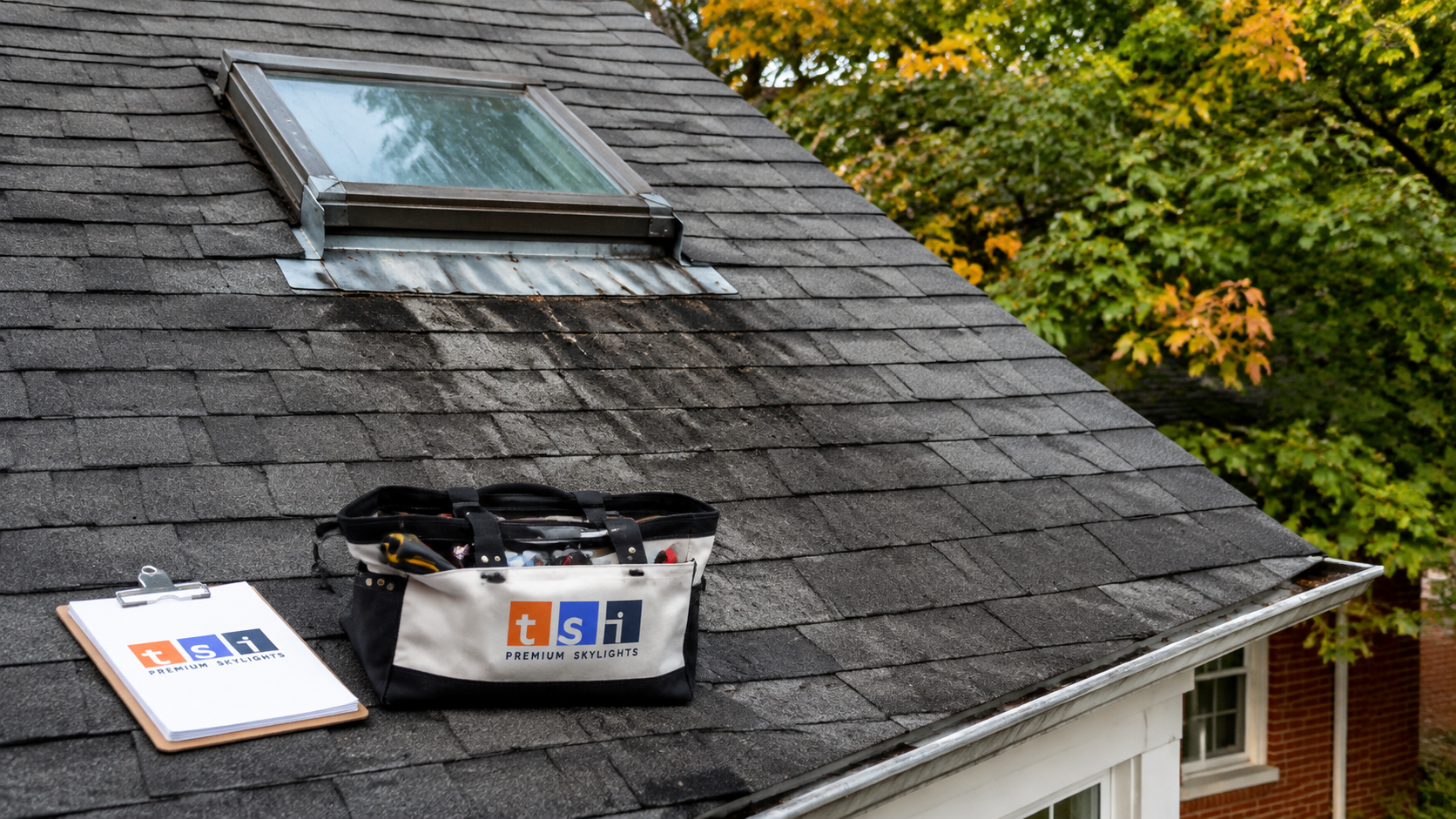
Why Skylight Repair East York Diagnosis Is Harder On Older Roofs
East York’s housing dates largely from the 1910s through the 1950s, and four characteristics of those roofs complicate a diagnosis.
Board sheathing. Older roofs were decked with individual planks laid with small gaps between them rather than continuous plywood. Water that gets under the shingles anywhere can travel sideways along the top of a board and drop through a gap some distance from where it entered. On a plywood deck water tends to stay closer to its entry point.
True dimension rafters. Deep, irregularly spaced rafters give water long uninterrupted paths to run down. A leak at a chimney flashing four feet upslope routinely presents as a wet skylight.
Layered history. Many East York roofs have had two or three shingle jobs, an added vent, a relocated plumbing stack and a decommissioned chimney over their lifetime. Each of those is a penetration, and old abandoned penetrations are a frequent and overlooked leak source.
Steep pitches. Steep roofs shed water well, which reduces leak risk overall, but they also give water momentum. Water entering at a compromised detail can travel a surprising distance before it finds somewhere to leave the assembly.
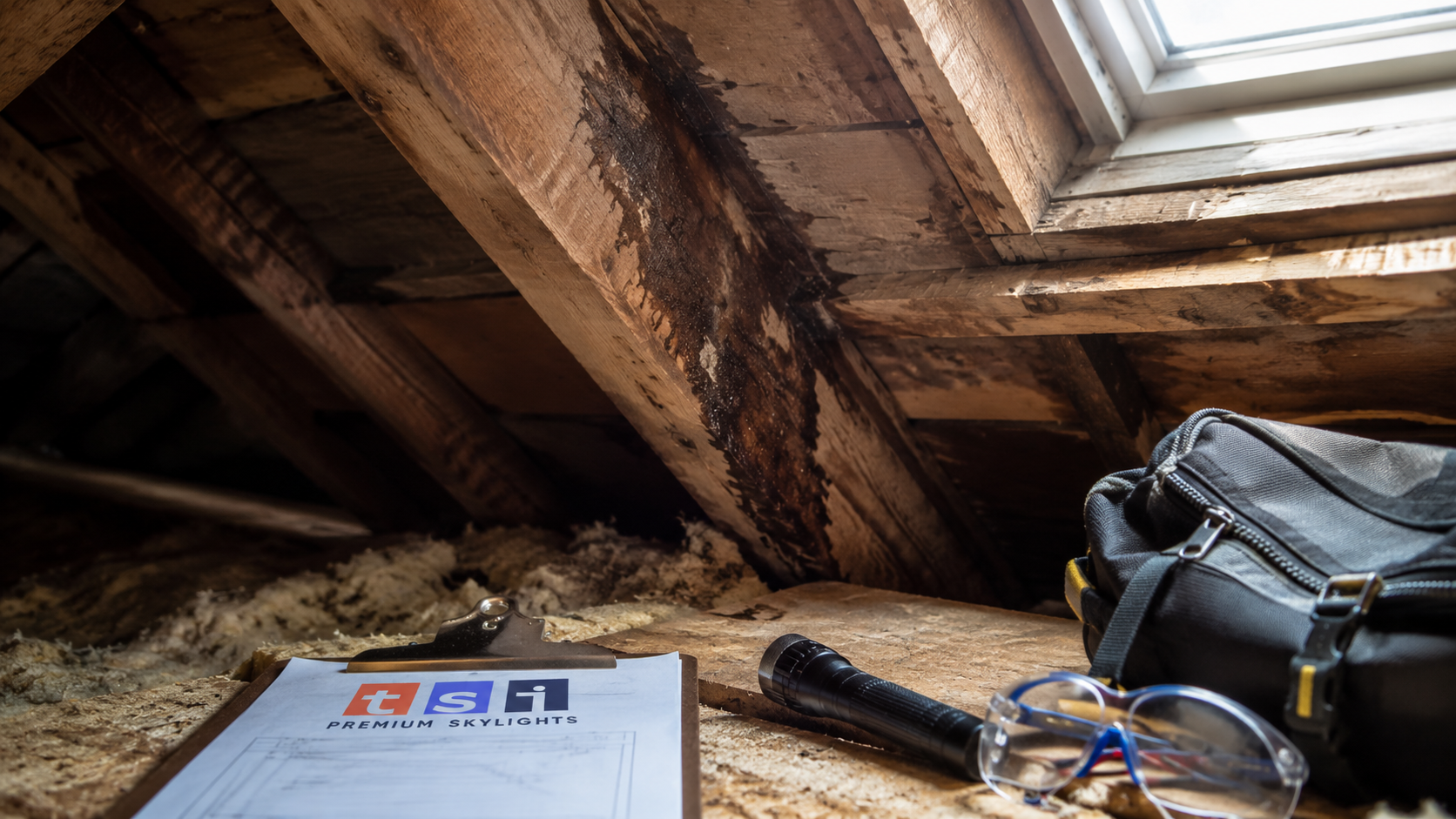
The practical consequence is that a diagnosis on an East York roof has to start in the attic, not on the roof surface, and certainly not at the ceiling stain.
Leak Or Condensation: Rule This Out First
Before any roof work is considered, establish whether water is actually entering from outside.
| Observation | Indicates a leak | Indicates condensation |
|---|---|---|
| When it appears | During or after rain or snowmelt | Cold mornings and cold snaps, rain or not |
| Where it appears | Usually one corner or one side | Evenly around the interior frame or all shaft edges |
| How it looks | Running water, spreading stains, sometimes discoloured | Even beads or a clear film that wipes off |
| Effect of running exhaust fans | None | Noticeably reduces the moisture |
| Worst season | Autumn rain and spring thaw | Coldest, driest weather |
Older East York homes are prone to condensation for a specific reason: they tend to run humid in winter, particularly where basements have been finished, and their attics are frequently under insulated with soffit vents blocked by old blown insulation. That combination puts warm moist air against cold framing. The fix is insulating and vapour sealing the light shaft and clearing the attic ventilation, and no roof work is involved at all.
The Real Causes Of Leaks On Older East York Roofs
- Step flashing that was never woven correctly. Each piece must sit under the shingle course above and over the one below, all the way up both sides. On older roofs it is common to find a continuous strip of metal, or nothing but hardened sealant, where woven step flashing should be.
- A head detail that dams water instead of diverting it. Water arriving from upslope has to be carried out onto the shingle plane either side of the unit. A head flashing relying on caulk fails within a few years.
- A rotten site built curb. Untreated timber curbs go soft at the corners after decades of minor ingress. Nothing fastened to soft wood holds a watertight line.
- Deteriorated deck boards. Boards immediately below the sill are the most likely place to find rot, because that is where water has been running longest. A new unit set on a soft deck will leak again.
- Upslope penetrations. Chimneys, vent stacks, old abandoned flues and previous repair patches upslope of the skylight are frequent true sources on layered older roofs.
- Ice damming. Attic heat loss melts snow, which refreezes at a cold surface and backs water up under the shingles. The remedy is attic insulation and ventilation, not more roofing.
- Failed unit seals and corroded frames. Older aluminium frames corrode at the mitred corners and older gaskets perish, letting water through the unit itself rather than around it.
Only two of those seven are failures of the skylight as a product. The rest are workmanship, adjacent detailing or attic conditions, which is why replacing the unit without diagnosing the cause frequently produces a second leak in the same spot.
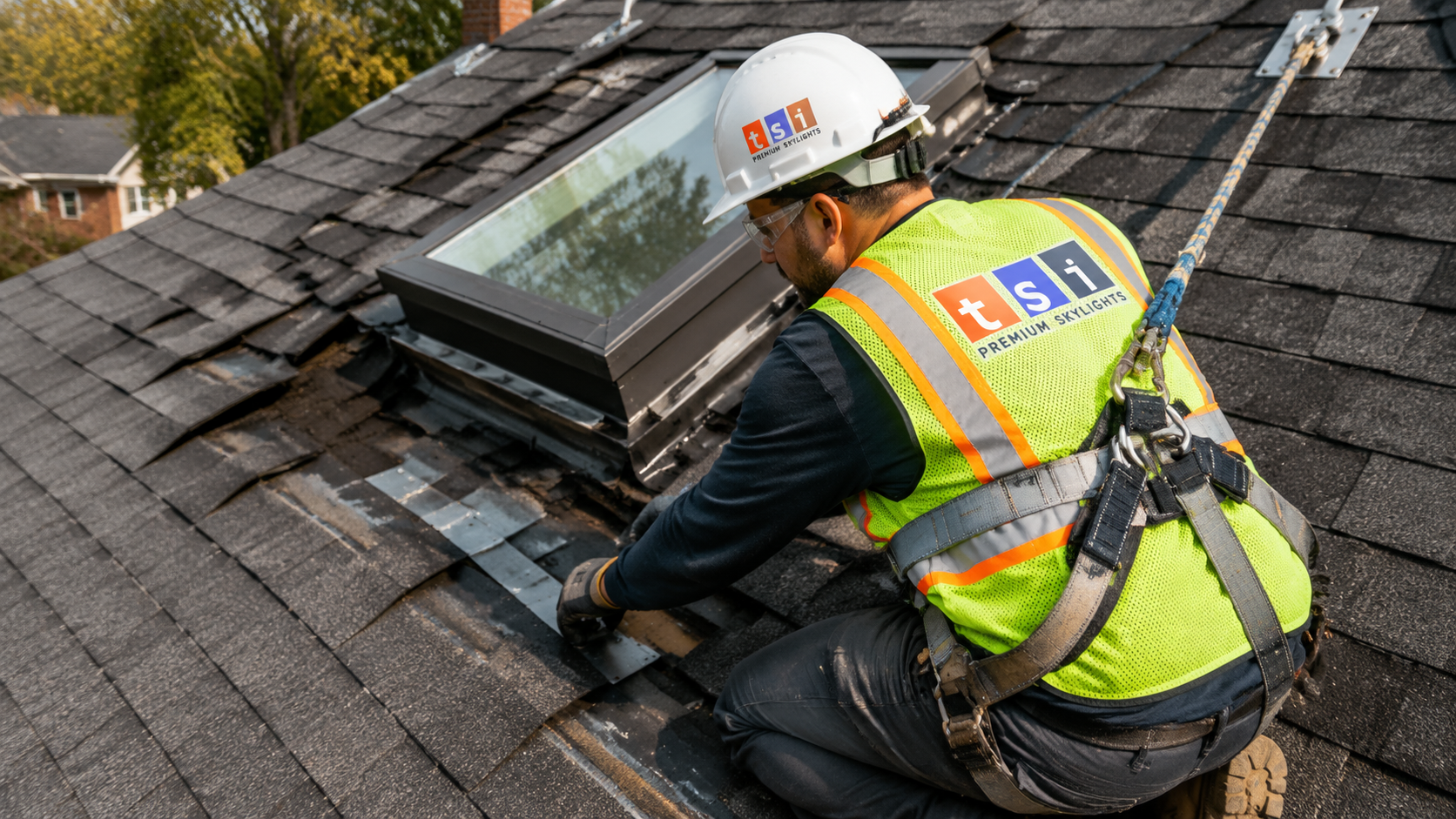
How A Proper Diagnosis Runs
- Interior examination. The shape and position of the staining is recorded. Even staining around all four shaft edges points to condensation. Staining concentrated in one corner or running down one wall points to a water path.
- Attic inspection with a light. This is the decisive step on an older roof. Staining on rafters and on the underside of the board sheathing is traced upslope to its highest point, because water runs down. The highest stain is closest to the entry. Insulation coverage, vapour barrier condition and soffit vent clearance are assessed at the same time.
- Roof inspection with shingle courses lifted. The flashing is examined for what it actually is rather than what it appears to be from the surface. The curb, if present, is probed for softness, and the deck around the opening is checked.
- Controlled water testing. Where the source remains unclear, water is applied in stages starting well below the skylight and moving progressively upslope, with an observer inside. The stage at which water appears identifies the entry zone precisely.
Skipping the attic step is the most common reason a leak comes back after a repair. Our full local scope is set out on the East York skylight services page, and the diagnostic and remedial work itself on our skylight repairs service page.
What The Repairs Involve
A proper flashing repair begins by removing the affected shingle courses so the flashing is fully exposed. Old step flashing is taken out rather than bent back and reused, because metal that has cycled through decades of thermal movement has already fatigued at the folds. The deck beneath is inspected while open and soft boards replaced. Where board sheathing has gaps, a plywood collar is fitted around the opening so the membrane and flashing have a continuous surface to bond to.
Self adhered ice and water membrane is then applied around the opening and lapped correctly with the surrounding underlayment. New step flashing goes in course by course up both sides, and the head flashing goes in last, under the shingles upslope, shaped so water is carried out onto the shingle plane on either side. The shingle courses are cut in and reinstated.
If the true source turned out to be upslope, that detail is repaired as well, whether it is a chimney flashing, a vent boot or an abandoned penetration that should have been properly closed years ago. Repairing only the skylight in that case almost always means a return visit.
What Skylight Repairs Cost In East York In 2026
| Repair | 2026 range | Duration |
|---|---|---|
| Diagnostic inspection with attic tracing | $180 to $400 | 1 to 2 hours |
| Controlled water testing where needed | Add $150 to $350 | 1 to 2 hours |
| Reflash one side of the unit | $450 to $1,100 | Half day |
| Full reflash, all four sides, unit retained | $900 to $2,000 | Half to 1 day |
| Rebuild a rotten timber curb | $500 to $1,100 | Half day |
| Replace deteriorated deck boards and fit a plywood collar | $400 to $1,100 | Half day |
| Repair an upslope chimney or vent flashing | $400 to $1,400 | Half day |
| Insulate and vapour seal an existing light shaft | $700 to $1,800 | 1 to 2 days with finishing |
Steep roofs, which are common in East York, add rigging time to any of these, typically $200 to $600 depending on the pitch and access. That is an honest reflection of a longer day worked safely rather than a surcharge for difficulty.
When Repair Stops Making Sense
| Situation | Repair or replace | Reasoning |
|---|---|---|
| Unit under 15 years old, one flashing side disturbed | Repair | Sound unit, isolated cause |
| Unit over 20 years old needing a full reflash | Replace | Same roof opening labour, new unit and warranty |
| Haze trapped between the panes | Replace | Sealed unit cannot be resealed in place |
| Yellowed or crazed acrylic dome | Replace | Material has reached the end of its life |
| Condensation only, unit and flashing sound | Repair from inside | No roof work required at all |
| Repair cost approaching half a replacement | Replace | Better long term value with a fresh warranty |
Maintenance That Prevents Most Of These Repairs
Most of the leaks we attend on older East York roofs were preventable, and the preventive work is neither expensive nor complicated.
Clear leaves and needles from above the skylight twice a year, in autumn and again in spring. Debris held against the head flashing keeps water in contact with the detail for hours after the rain stops, which is precisely the condition a flashing joint is least able to tolerate. On a steep East York roof under mature trees this is the highest value maintenance task available.
Check the attic after the first heavy rain of autumn. Fresh staining on rafters or on the underside of the sheathing shows up long before anything reaches the ceiling drywall, and a leak found in the attic is a small repair rather than a remediation project.
Confirm that soffit vents are clear of insulation every few years. Old blown insulation migrates and blocks the intake path, which makes the attic run warm and humid, drives condensation and contributes to ice damming above the skylight. Restoring the vent path is inexpensive and it protects everything in the attic, not just the skylight.
Operate venting hardware fully twice a year even if you rarely use it. Mechanisms that sit unused seize, and a venting unit that no longer seats properly admits water continuously without ever looking obviously broken.
Finally, look at the sealant. Not because sealant is the waterproofing, it is not, but because a growing accumulation of hardened caulk around a unit is a reliable record of previous failed patch repairs. It tells you the assembly has been struggling for a while and that a proper reflash or a replacement is due.
Acting Before The Autumn Rain
Late autumn is when marginal details on older East York roofs are found out. Sustained rain, followed by the first freeze thaw cycles, turns slow seepage that has been quietly wetting the deck into a stain on the ceiling, and by then the cost includes drywall and wet insulation as well as the roof work.
September and early October are the right window for both diagnosis and repair. Temperatures still allow self adhered membranes and sealants to bond as designed, days are long enough to open and close a roof section in one visit, and dry stretches are reliable enough to schedule around. It is also the sensible time to clear leaves from above the unit, since debris held against the head flashing keeps water in contact with the detail far longer than a clean roof would.
Why does skylight repair East York work start in the attic?
Can my leaking skylight just be sealed with caulk?
What does a skylight leak diagnosis cost in East York?
Does board sheathing make leaks harder to find?
Is my winter moisture a leak or condensation?
When should I replace rather than repair?
Arrange A Skylight Repair East York Diagnosis
Older East York roofs hide their leaks well, and the difference between a repair that lasts and one that returns is almost entirely in the diagnosis. Toronto Skylight Installers is based in the Toronto area and works throughout East York, tracing the source in the attic and lifting shingle courses to see the real flashing before recommending any work.
Call us today at (416) 365-7557 or request a free consultation ahead of the sustained autumn rain.
Toronto Skylight Installers serves East York and the wider GTA, from Leaside and Todmorden through the older neighbourhoods east of the Don Valley.