

A skylight that drips onto the hallway floor during a spring thaw and a skylight that beads with moisture every cold morning look like the same problem from the ground, but they almost never share the same cause. That distinction is the single most useful thing a homeowner can learn about skylight repair Pickering properties actually need, because the wrong diagnosis leads to the wrong work: sealant smeared over a flashing failure, or an expensive glass unit swapped out when the real culprit was a poorly insulated shaft. Getting skylight repair in Pickering right starts with reading the evidence correctly, then matching the fix to the failure.
Pickering sits on the western edge of Durham Region, close enough to Lake Ontario that overnight humidity and temperature swings behave differently here than they do further inland. Combine that with a housing stock that ranges from postwar bungalows and older brick homes near the lake to sprawling newer subdivisions and estate lots to the north, and you get a wide spread of skylight ages, curb designs and roof pitches in a relatively small area. The result is that skylight repair in Pickering is rarely a one-size job. This guide walks through how leaks and condensation differ, how the repairs are actually performed, what the work costs in 2026, and when repair stops making financial sense.
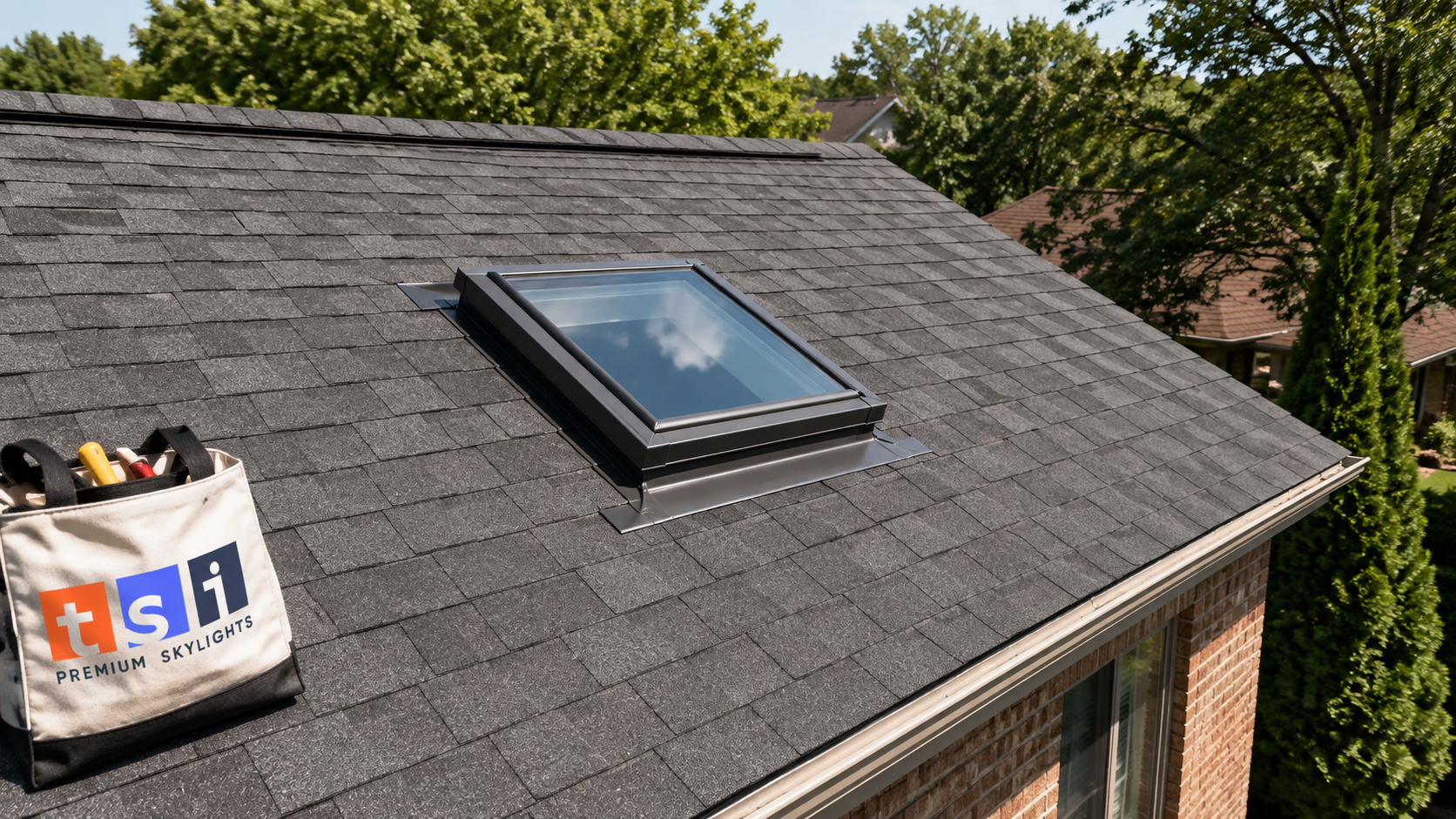
Why Skylight Repair in Pickering Usually Starts With a Misdiagnosis
The most common call a skylight contractor gets is some version of “my skylight is leaking.” In practice, a meaningful share of those calls turn out to be condensation, not water intrusion. The two produce similar stains, similar drips and similar homeowner panic, but they require completely different work. Any honest approach to skylight repair in Pickering begins with separating the two before anyone opens a tube of sealant.
Water intrusion means precipitation or meltwater is finding a path through the roof assembly: past the flashing, under the shingles, through a failed seal, or around a curb that was never detailed properly. Condensation means warm, humid indoor air is reaching a cold surface, usually the interior glass pane or the drywall of the light shaft, and giving up its moisture there. One is a building envelope breach. The other is a building physics problem involving humidity, insulation and air movement.
There is a third category worth naming: a sealed unit that has lost its integrity. Modern skylights use insulated glass with an inert gas fill and a perimeter seal. When that seal fails, moisture migrates into the cavity between panes and shows up as haze, streaking or fogging that no amount of cleaning removes. That is not a leak and not room condensation, and it cannot be repaired in place. The glass unit or the whole skylight has to be replaced.
Homeowners who understand these three failure modes ask better questions and get better outcomes. Any technician doing skylight repair Pickering homeowners hire should be able to explain which category the problem falls into, and why, before quoting anything.
How Pickering’s Housing Character Shapes Skylight Problems
Pickering’s built environment spans several eras, and each era brings its own skylight tendencies. Understanding which group your home falls into narrows the diagnosis quickly, and it explains why skylight repair in Pickering can look very different from one street to the next.
Older brick homes and postwar bungalows. Skylights in these houses are frequently retrofits, added during a kitchen or bathroom renovation decades after the roof was framed. Retrofit installations tend to have shallow site-built curbs, improvised flashing, and light shafts framed inside an attic space that was never insulated to modern standards. These are the homes where condensation complaints cluster, because a long, uninsulated shaft running through a cold attic is essentially a chimney for warm indoor air.
Newer subdivision homes. Homes built in the last two to three decades usually have factory skylights with integrated flashing kits, installed by the original roofer. The units themselves are generally sound, but the flashing systems are now reaching the end of their service life on the earliest of them. On these roofs, leaks are more often about aged flashing, deteriorated shingle tie-ins and failed gasketry than about bad original workmanship.
Estate lots and larger custom homes. Larger properties often carry multiple skylights, sometimes ganged in a row or installed on steeper or more complex roof geometry. More units means more penetrations, and complex rooflines mean valleys and dead spots where water and debris collect against a curb. Repair work here is usually less about a single failure and more about bringing a whole set of penetrations back to a consistent standard.
Flat and low-slope sections. Additions, rear extensions and some modern builds carry low-slope roof sections. Skylights on these surfaces need a properly built and adequately tall curb, because water sits on a low-slope roof rather than running off it. Undersized curbs are one of the most persistent causes of chronic leaking, and no amount of sealant fixes a curb that is too short. Purpose-built flat roof skylight units exist precisely because sloped-roof hardware does not translate to a flat deck.
Reading a Leak: Where Water Actually Gets In
When a skylight genuinely leaks, the entry point is almost never the glass. Glass is the most reliable component in the assembly. The failures happen at the transitions, where one material has to hand water off to another.
Head flashing and the upslope side. The upper edge of a skylight is where water arrives with the most force, since everything above it on the roof drains toward that point. Head flashing has to divert that flow around the unit. When it corrodes, lifts, or was never lapped correctly under the course above, water runs behind it and enters the roof deck. This is the single most common true leak point found during skylight repair in Pickering service calls.
Step flashing along the sides. Side flashing works as a series of overlapping pieces, each tucked under a shingle course. If any single piece is reversed, short, or nailed through its face, water gets a path. Older retrofit installs sometimes skip step flashing entirely and rely on a continuous bead of caulking, which will always fail eventually.
The sill and apron at the bottom. Water that has run down the sides of the skylight collects at the base. The apron flashing has to carry it out over the shingles cleanly. Debris packed at the sill, common on lower-slope roofs or under overhanging trees, holds moisture against the flashing and accelerates corrosion.
The curb itself. On curb-mounted units, the wooden curb is a structural element that must be plumb, square, of adequate height and fully wrapped by membrane and metal. Curb rot is one of the more involved findings in any skylight repair Pickering inspection, because it means water has been present long enough to degrade the framing. Repairing a rotted curb means opening the roof around the opening, replacing lumber and rebuilding the waterproofing from the deck up.
Fasteners and gaskets. Every fastener penetrating the flashing is a potential entry point. On venting units, the gasket that seals the sash against the frame hardens and compresses over time, and a unit that closed tightly fifteen years ago may now leave a hairline gap.
A thorough inspection checks all of these, works from the attic side as well as the roof side where access allows, and looks at the surrounding roof condition too. A skylight sitting in the middle of a failing roof field is not really a skylight problem. Detailed skylight repair services should always include an assessment of the roof surface that surrounds the unit, because the two systems fail together more often than separately.
Condensation: The Problem Most Often Mistaken for a Leak
Condensation forms when indoor air, carrying moisture from cooking, showering, laundry, houseplants and simply breathing, contacts a surface below its dew point. Glass is the coldest surface in most rooms, and a skylight is glass mounted in the coldest plane of the building. Add a light shaft that funnels warm air upward, and you have created an efficient condensation machine.
The tell-tale signs differ from a leak in ways that are easy to spot once you know what to look for. The table below sets out the practical differences that skylight repair Pickering technicians use on site.
| Observation | Points to a leak | Points to condensation |
|---|---|---|
| Timing of moisture | During or shortly after rain, or during a thaw after snow load | On cold mornings, during showers or cooking, regardless of precipitation |
| Location of moisture | Stains spreading outward on the shaft or ceiling, often on one side | Even beading on the interior glass surface, water pooling on the lower frame |
| Water appearance | May be discoloured, carries grit or shingle granules, leaves a ring | Clear, clean water with no residue or staining ring |
| Response to humidity control | No change when indoor humidity is lowered | Improves noticeably when humidity drops or ventilation improves |
| Between the glass panes | Not applicable | Persistent haze or fog between panes indicates a failed sealed unit |
| Attic evidence | Wet sheathing, dark staining or damp insulation near the opening | Frost or dampness spread widely across the attic, not just at the skylight |
One nuance matters a great deal in Pickering’s climate. During a hard cold snap, condensation on a poorly detailed shaft can freeze inside the assembly. When the temperature climbs, that accumulated frost melts all at once and runs down the shaft, producing a dramatic “leak” on a sunny day with no rain in sight. Homeowners understandably call it a roof leak. It is a vapour problem, and sealant on the roof will do nothing for it.
How Proper Skylight Repair Work Is Actually Performed
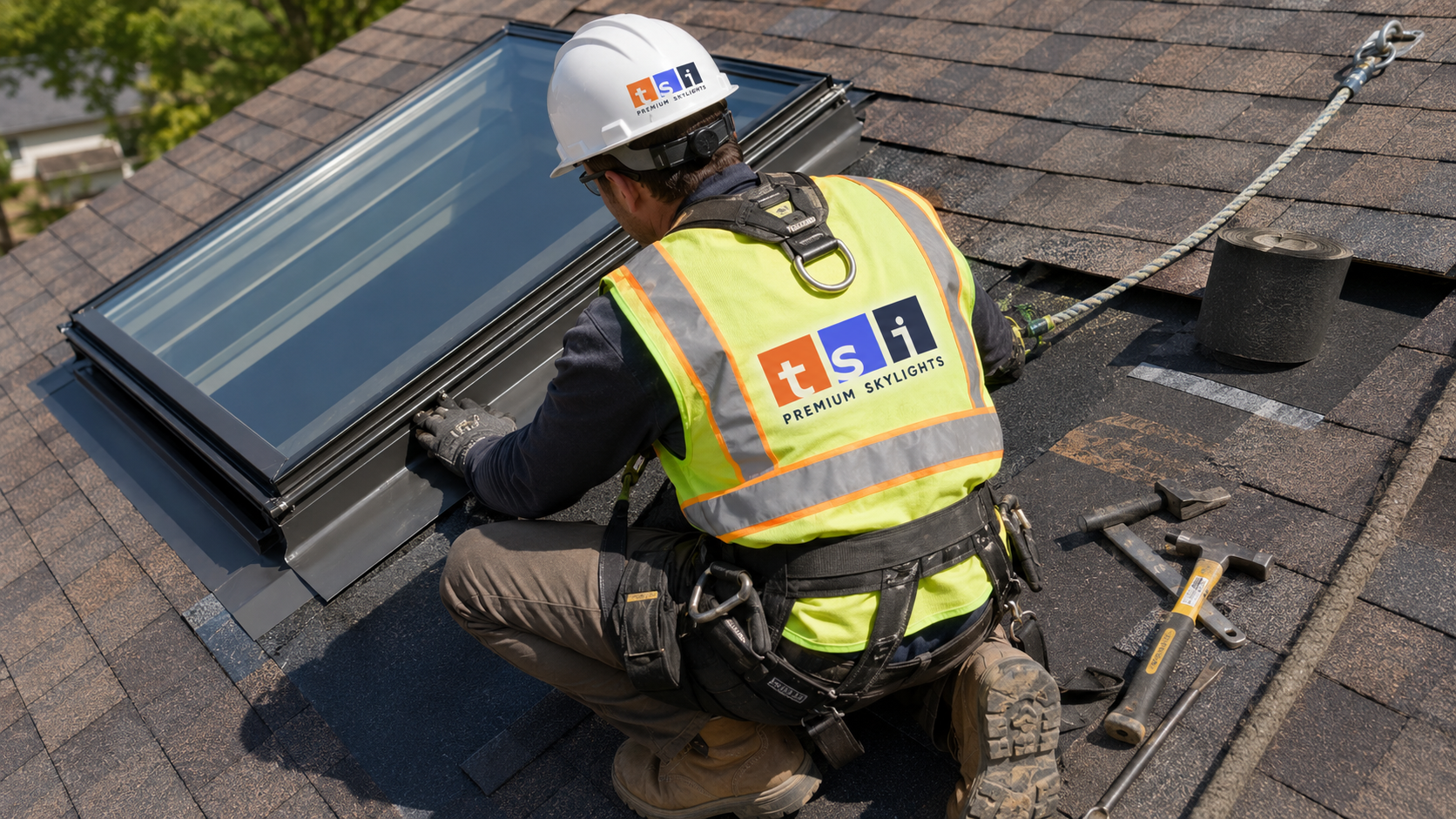
The difference between a repair that lasts a decade and one that fails the following season comes down to whether the work respects how a roof sheds water. Roofs shed water by layering, with each element lapped over the one below it. Sealant is a supplementary material, not a primary defence. Any quote for skylight repair in Pickering that consists mainly of caulking should be treated with caution.
Reflashing a skylight
A proper reflash means removing shingles around the perimeter of the unit, stripping the old flashing entirely, inspecting the deck and curb for rot, installing new self-adhered membrane at the perimeter, fitting a new flashing kit matched to the skylight model and roof covering, and reinstalling shingles with correct laps. Done correctly, the flashing is protected by the roofing above it rather than exposed to weather.
Rebuilding a curb
When the curb has deteriorated, the repair extends into carpentry. The unit comes out, damaged lumber is cut back to sound material, the curb is rebuilt to an appropriate height for the roof slope, and the whole assembly is re-membraned before the skylight goes back in. On low-slope roofs, curb height is critical, and a rebuild is often the opportunity to correct an original curb that was always too short.
Replacing gaskets and hardware
Venting skylights have moving parts. Gaskets, hinges, operators and, on electric or solar units, motors and control boards all have finite lives. Where the frame and glass remain sound, replacing worn hardware restores function at a fraction of the cost of a new unit. Solar-powered venting models have the added benefit of actively exhausting humid air, which is why a solar powered fresh air skylight is often recommended in bathrooms and kitchens where condensation is chronic.
Repairing the interior shaft
Water damage inside the shaft needs its own attention. Wet drywall must come out, not simply be painted over, because gypsum that has been saturated will continue to feed mould growth. The repair is the right moment to add insulation and a continuous air and vapour barrier to the shaft framing, which addresses the condensation risk at the same time as the cosmetic damage.
What Skylight Repair Costs in Pickering in 2026
Pricing varies with roof pitch, access, unit type, roof covering and how much of the surrounding assembly has to be opened. The ranges below reflect what skylight repair Pickering homeowners can expect to pay in 2026 and are intended for budgeting, not as a quote. Steep roofs, third-storey access and multiple ganged units push toward the upper end.
| Service | Typical 2026 range | What it covers |
|---|---|---|
| Diagnostic inspection and leak trace | $150 to $325 | Roof and interior assessment, moisture testing, written findings; often credited against booked work |
| Emergency temporary seal | $300 to $650 | Stopping active water entry until a permanent repair can be scheduled |
| Gasket, seal and hardware replacement | $450 to $1,100 | Perimeter gaskets, operator or hinge parts on a venting unit |
| Full reflash on an asphalt shingle roof | $700 to $1,600 | New flashing kit, membrane, shingle removal and reinstatement |
| Curb rebuild and reflash | $1,200 to $2,600 | Carpentry, deck repair, new membrane, new flashing, reinstallation |
| Interior shaft repair and insulation upgrade | $500 to $1,500 | Drywall replacement, insulation, vapour barrier, finishing and paint |
| Skylight unit replacement, fixed model | $1,700 to $3,400 | Supply and install of a new fixed unit including flashing |
| Skylight unit replacement, venting or solar model | $2,800 to $5,400 | Supply and install of a venting, electric or solar unit with controls |
Two cost factors surprise homeowners regularly. The first is that repairing several skylights at once is meaningfully cheaper per unit than repairing them one at a time, because setup, access and safety rigging are shared. The second is that repair work coordinated with a roof replacement costs far less than the same work done separately, since the shingles around the opening are already coming off. If your roof is within a few years of replacement, it is worth asking whether the timing should be combined.
Repair or Replace: Making the Call Honestly
Repair is the right answer more often than replacement, but not always. The deciding factors are the age of the unit, whether the sealed glass is intact, the condition of the frame and curb, and whether the same problem has recurred. Chasing a chronic leak through repeated repairs on a twenty-five year old unit is usually the most expensive path available, and it is the outcome a good skylight repair in Pickering assessment is meant to prevent.
| Condition found | Recommended action | Typical service life after work |
|---|---|---|
| Flashing deteriorated, unit under 15 years old, glass clear | Reflash and retain existing unit | 10 to 15 years |
| Fogging or haze between panes | Replace glass unit or full skylight | 20 to 25 years for a new unit |
| Frame cracked, warped or leaking at corners | Full replacement | 20 to 25 years |
| Curb rot with sound skylight unit | Rebuild curb, reinstall existing unit | 10 to 20 years, subject to unit age |
| Unit over 20 years old with any recurring leak | Replacement, ideally with roof work | 20 to 25 years |
| Condensation only, no water entry, unit sound | Insulation, vapour barrier and ventilation improvements | Ongoing, provided humidity is managed |
Where replacement is the answer, a like-for-like swap is not the only option. Homeowners frequently take the opportunity to move from a fixed unit to a venting one, to add a second skylight to a dark room, or to bring light to a hallway or closet with a sun tunnel skylight where a full shaft is impractical. Where the existing unit is simply obsolete, planned skylight replacement is generally more economical than a series of increasingly involved repairs.
Fixing Condensation for Good: Insulation, Air Sealing and Ventilation
If the diagnosis is condensation, the solution has three parts, and skipping any one of them tends to leave the problem partially unsolved. This is the part of skylight repair in Pickering that happens inside the house rather than on the roof.
Reduce the moisture load. Indoor relative humidity in the range of 30 to 40 percent through the cold months is a reasonable target for most Ontario homes, lower during extreme cold. That means using bathroom and kitchen exhaust fans and letting them run long enough to clear moisture, venting the clothes dryer outdoors, and turning a humidifier down rather than up when windows and skylights start beading.
Stop warm air from reaching cold surfaces. The light shaft is the pathway. An uninsulated or leaky shaft lets conditioned air migrate into the attic and lets cold attic air chill the shaft’s interior surfaces. Insulating the shaft to current standards and sealing the air barrier at every joint, corner and penetration eliminates the mechanism.
Keep the attic cold and dry. A properly ventilated attic stays near outdoor temperature, which keeps the roof deck and the exterior of the shaft from becoming a condensing surface. Blocked soffit vents, insulation stuffed into the eaves and inadequate exhaust venting all undermine this, and they cause problems well beyond the skylight.
Where condensation persists after all three are addressed, the remaining variables are usually the unit itself, particularly an older single-glazed or early double-glazed skylight with a highly conductive frame, or a room that simply generates more moisture than its ventilation can remove. Upgrading to a modern insulated unit with a thermally broken frame changes the arithmetic considerably. Homeowners considering that step can review the options for fixed skylight units and venting alternatives before deciding.
Permits, Code and Seasonal Timing for Skylight Repair in Pickering
Straightforward repair work, reflashing, gasket replacement, shaft repairs and like-for-like replacement of an existing unit in an existing opening, generally does not require a building permit. What does trigger a permit is structural change: cutting a new opening, enlarging an existing one, or any work that involves altering roof framing members. In those cases the City of Pickering’s building department is the authority, and the work must comply with the Ontario Building Code. A contractor who tells you no permit is ever needed for any skylight work is not being straight with you, and homeowners should confirm the requirement for their specific scope before work begins.
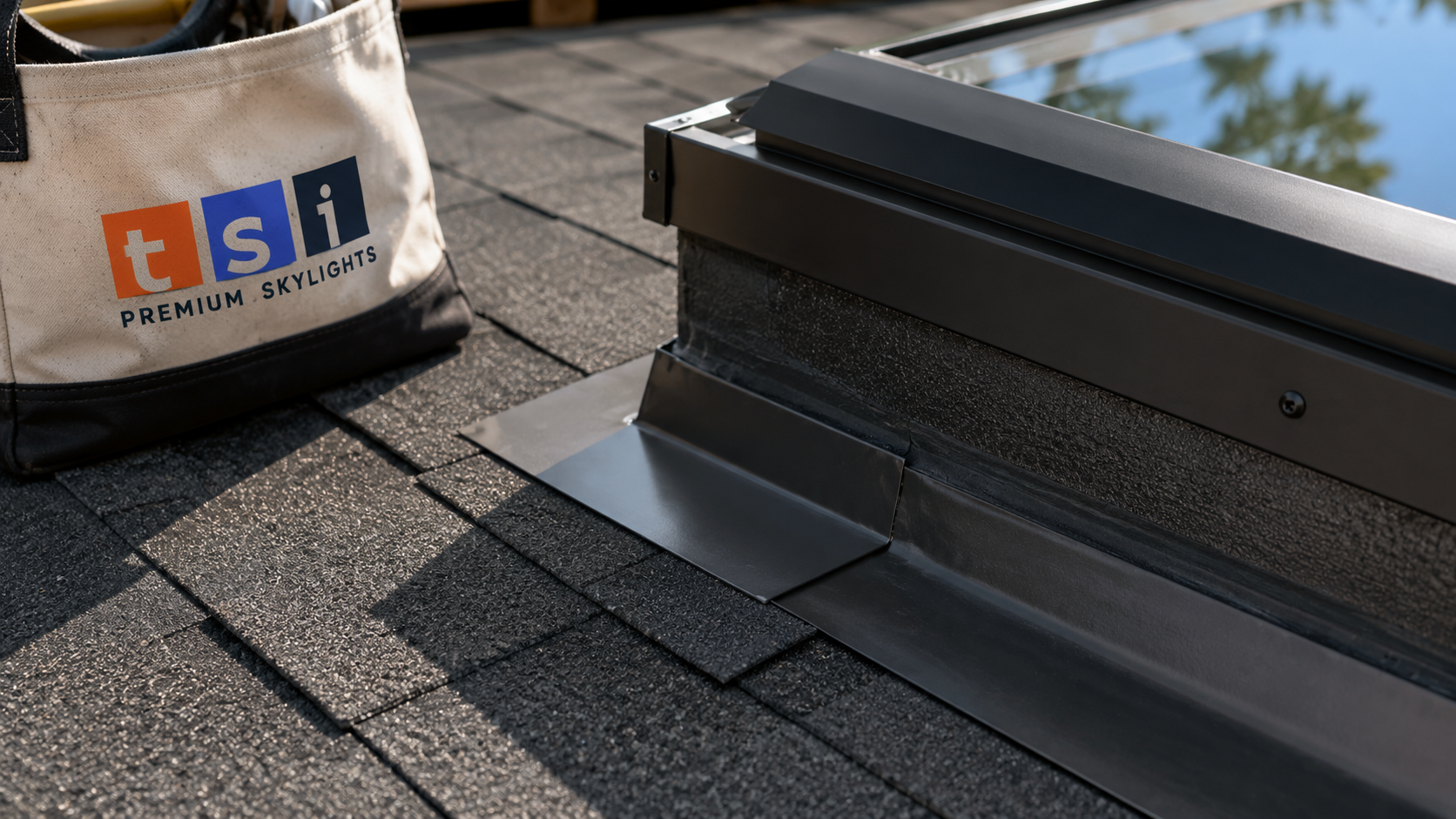
Code considerations that come up regularly include glazing type in overhead applications, which normally requires laminated or tempered assemblies, minimum curb heights on low-slope roofs, and the insulation and vapour barrier requirements that apply to the shaft as part of the building envelope. These are not optional details; they are the difference between a repair that satisfies an inspector and one that has to be redone.
On timing, the most productive window for skylight repair in Pickering runs from late spring through autumn, when adhesives and self-adhered membranes bond reliably and shingles are pliable enough to lift without cracking. Emergency work happens year round, because active water entry cannot wait, but winter repairs are more often stabilising measures than permanent fixes. Booking discretionary work in the warm months produces better results and usually shorter lead times.
Choosing a Contractor for Skylight Repair Work
Skylight work sits at the intersection of roofing and glazing, and not every roofing crew is equipped for it. When you are comparing quotes for skylight repair in Pickering, a few practical filters help.
- Ask how they will diagnose before quoting. A firm that quotes a repair over the phone without seeing the assembly is guessing.
- Ask what the repair actually includes. The answer should describe shingle removal, membrane and a flashing kit, not a tube of sealant.
- Confirm insurance and WSIB coverage. Rooftop work carries real risk, and coverage protects the homeowner as much as the crew.
- Ask about the warranty on both labour and materials. Manufacturer warranties on skylight units are often void if the unit was not installed to specification, which makes installer competence a warranty issue, not just a quality one.
- Expect proper fall protection on site. Harnesses, anchors and rope grabs are required on Ontario residential roofs, and a crew that works without them is cutting other corners too.
Toronto Skylight Installers is based in the Toronto area and works throughout the eastern GTA, including full Pickering skylight installation and repair services for homeowners across the city. Whether the problem is a chronic leak on a low-slope addition, a fogged sealed unit in a kitchen, or a shaft that streams with condensation every January, the starting point is the same: a proper diagnosis, then the repair the evidence actually supports. That is the difference between skylight repair Pickering homeowners get lasting value from and the kind that comes back the following season.
Maintenance That Extends the Life of Any Repair
Once a skylight has been repaired properly, a modest amount of upkeep protects the investment. The habits below extend the life of that work, and they cost nothing but attention. Twice a year, ideally in late spring and mid autumn, clear leaves, needles and grit from the upslope side and sill of every skylight. Debris dams hold water against flashing and are the leading cause of premature corrosion. Trim overhanging branches back from the roof surface where practical, since they drop debris and hold moisture against shingles.
Inspect the interior of each shaft seasonally. Fresh staining, soft drywall, peeling paint or a musty smell all signal moisture that has not been resolved. Catching a small change early is dramatically cheaper than responding after ceiling damage appears. On venting units, operate the mechanism a few times each season so hardware does not seize, and check that the gasket still compresses evenly when closed.
Finally, keep the skylight in mind when planning other roof work. Any time shingles are being replaced, valleys reworked or eavestroughs upgraded, that is the least expensive moment to bring the skylight flashing up to current standard. Coordinating trades saves money and eliminates the finger pointing that follows when a leak appears after two separate contractors have worked on the same roof plane.
How do I know if I need skylight repair in Pickering or a full replacement?
Is water dripping from my skylight always a leak?
What does skylight repair cost in Pickering?
Do I need a permit to repair a skylight in Pickering?
Can a leaking skylight be repaired in winter?
Why does my skylight fog up between the glass panes?
Book Your Skylight Repair in Pickering Today
Skylight repair in Pickering is not work that rewards waiting, and a skylight problem rarely improves on its own. Flashing continues to corrode, curbs continue to absorb water, and condensation quietly feeds mould inside a shaft where nobody can see it. Toronto Skylight Installers works throughout Pickering and the eastern GTA on exactly this kind of work, starting with a straight diagnosis and a clear explanation of whether you are dealing with water intrusion, condensation or a failed sealed unit, then quoting only the repair the evidence supports.
Call us today at (416) 365-7557 or request a free consultation. We will assess the skylight, the surrounding roof and the interior shaft, and give you honest options with real numbers.
Toronto Skylight Installers is based in the Toronto area and proudly serves homeowners in Pickering, Ajax, Whitby, Oshawa, Scarborough and across the Greater Toronto Area.