

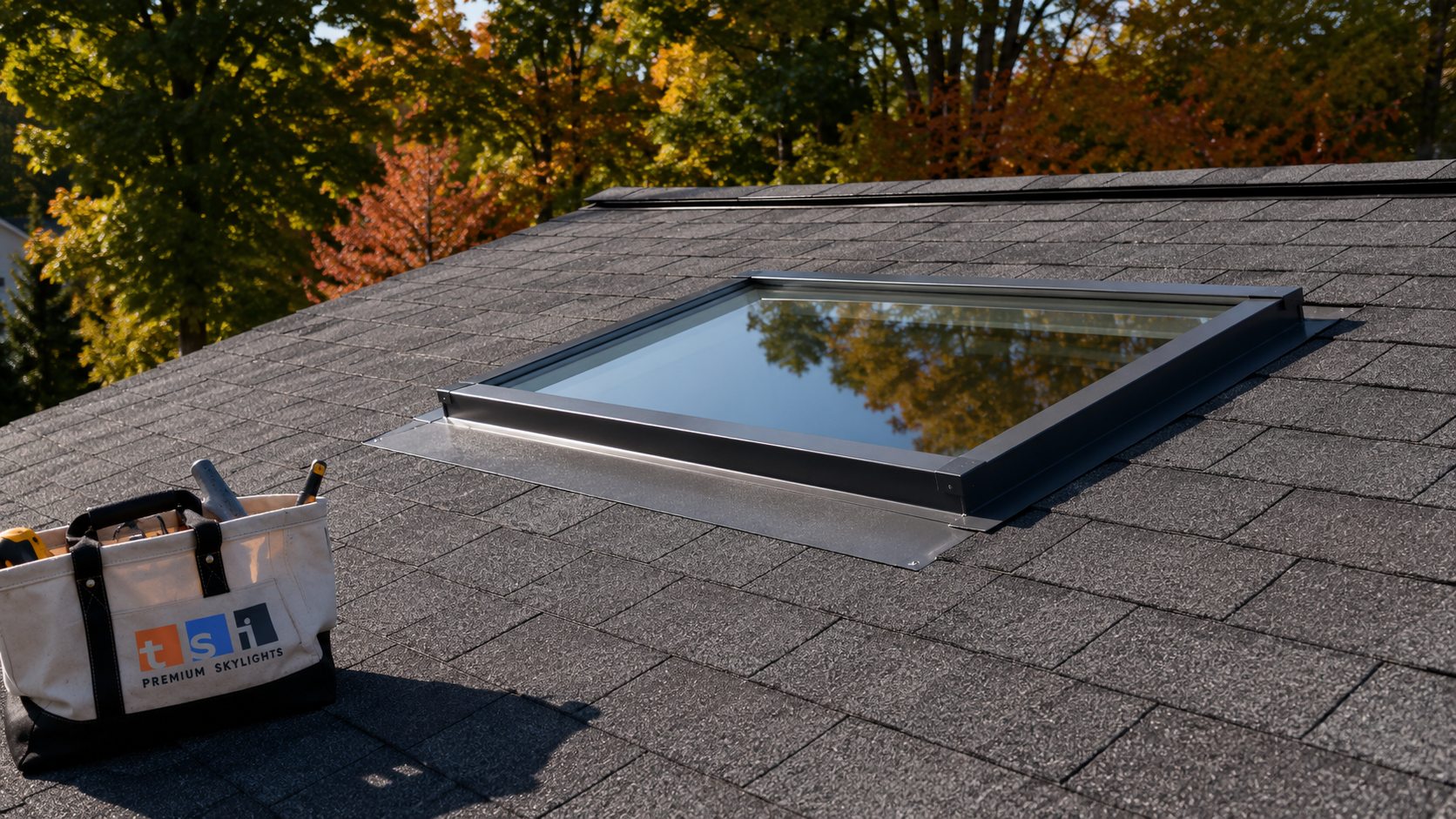
A great many Scarborough homes carry skylights installed during the renovation waves of the late 1980s and 1990s, and almost all of those units were acrylic domes set on site built timber curbs. Two decades of Ontario sun and freeze thaw cycling is roughly the design life of that assembly, which is why skylight replacement Scarborough enquiries cluster around houses that have not had roof work in a while. Swapping an aging dome for a modern sealed glass unit is one of the better value projects available on a house: it costs a fraction of a new installation, it takes a day, and the difference in the room below is immediate.
Why Skylight Replacement Scarborough Homes Need Comes Up Around Twenty Years
Acrylic is a good material for a lot of purposes and a poor one for overhead glazing in this climate. Ultraviolet exposure gradually breaks down the plasticisers that keep it flexible. Each winter, the sheet expands and contracts against a fixed frame through dozens of freeze thaw cycles. The result, reliably, is yellowing, then a fine surface crazing, then brittleness and cracking. Fifteen to twenty years is a realistic service life in Toronto.
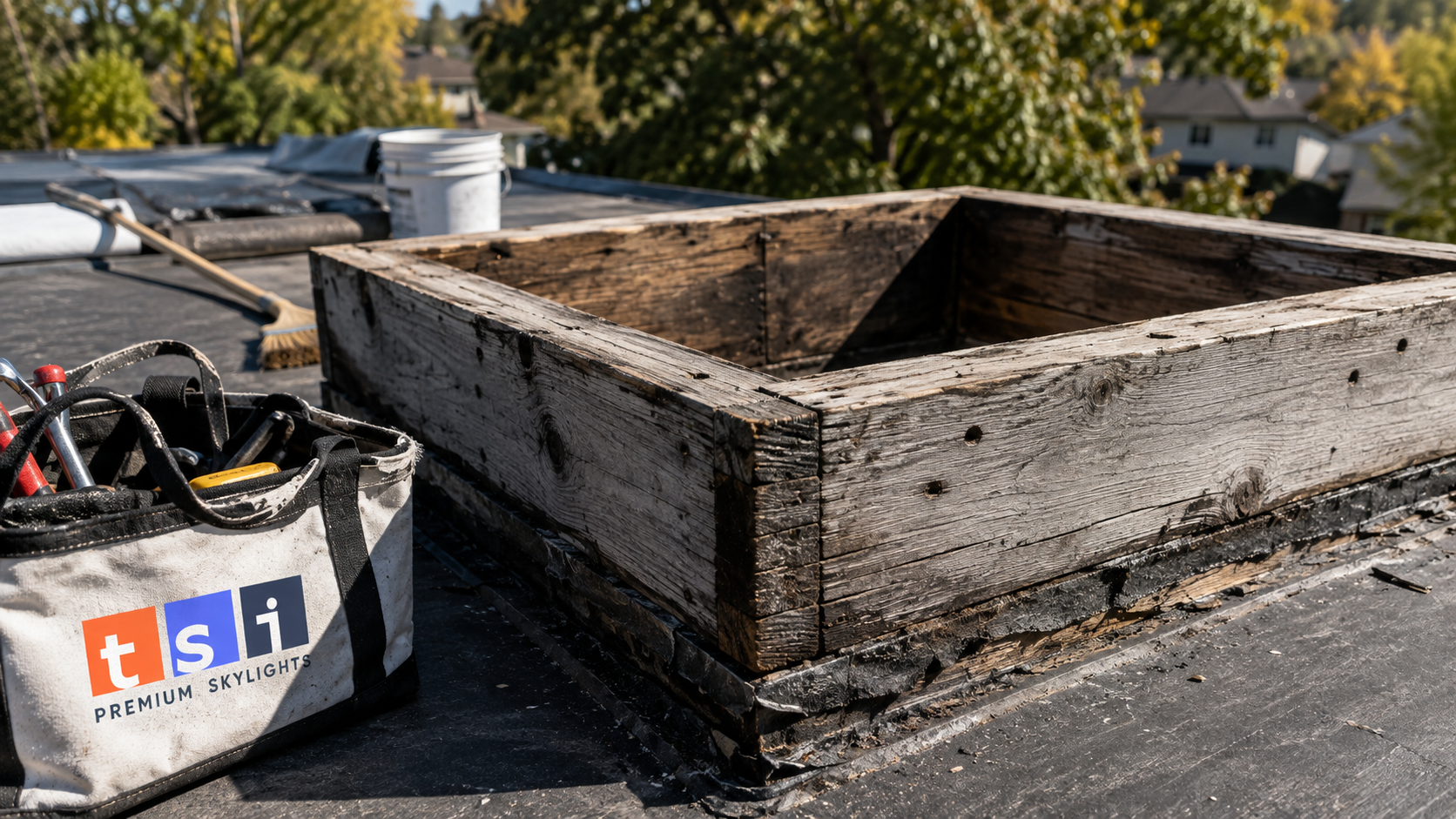
The curb ages alongside it. Most of these units sit on a timber curb built on site, often from untreated lumber, sealed with caulk at the base. Sealant has a service life measured in a handful of years, not decades, so small amounts of water find their way into the curb corners long before anyone notices anything indoors. By year twenty the corners are usually soft.
The optical decline is the part homeowners underestimate. A yellowed, clouded dome transmits far less daylight than it did when new, and it does so gradually enough that nobody registers the change. Replacing it with clear glass often makes a hallway or kitchen look like a different room, which is why the reaction to a replacement is usually stronger than the reaction to a repair.
Scarborough’s building pattern concentrates all of this. Because so much of the borough was built and then renovated in the same broad windows, neighbouring houses tend to reach the end of their skylight life at roughly the same time. If a house on your street has recently had roof work, yours is probably on a similar clock.
Deciding Between Repair And Replacement
| What you are seeing | Most likely cause | Repair or replace |
|---|---|---|
| Yellowed, hazy or crazed acrylic dome | Ultraviolet and freeze thaw degradation | Replace the unit |
| Milky haze trapped between two glass panes | Failed insulated glass seal | Replace the unit |
| Water appearing during and after rainfall | Failed flashing, curb or frame | Replace, or reflash if the unit is recent and sound |
| Water only on cold mornings, at ceiling edges | Condensation in an unsealed light shaft | Repair, insulate and vapour seal the shaft |
| One lifted piece of step flashing, unit sound | Wind damage or a past shingle repair | Repair |
| Thick layers of old caulk around the perimeter | Repeated failed patch repairs | Replace the flashing assembly, usually the unit too |
The underlying economics are worth understanding. Most of the cost of any skylight work is the labour of opening the roof: lifting shingle courses, stripping flashing, and reinstating everything afterwards. That labour is identical whether you are salvaging an old unit or fitting a new one. Paying it to preserve a skylight with two or three years left is rarely a good decision.
Choosing The Replacement Unit
Because the roof is open either way, a replacement is the cheapest opportunity you will ever have to change the type of skylight you own.
- Fixed glass units. The least expensive and the least likely to need service, with no operating hardware at all. Right for hallways, stairwells, living rooms and any room where daylight rather than airflow is the point.
- Manual venting units. Opened with a crank or a pole. Practical in a Scarborough bungalow where the ceiling is within reach, and genuinely useful for summer stack ventilation.
- Solar powered venting units. Open on a remote, close automatically on a rain sensor, and require no wiring because an integrated panel charges an internal battery. The right specification for bathrooms and kitchens where moisture removal matters as much as light.
- Electric venting units. Mains powered, usually chosen where the unit sits in shade and a solar panel would underperform.
Glass specification is the other decision. In Toronto the sensible default is a laminated inner pane with a low emissivity coating and argon fill: it cuts winter heat loss, rejects summer solar gain, filters the ultraviolet that fades flooring and artwork, and gives you safety glass overhead. On south and west facing roofs, ordering a factory fitted blind at the same time controls glare and late afternoon heat far more neatly than anything retrofitted later.
Curb Mounted Or Deck Mounted: The Decision That Changes The Price
If the old unit sits on a raised timber curb, and most 1980s and 1990s domes do, there are two paths forward.
Keep the curb. Repair or rebuild the timber curb and fit a modern curb mounted glass unit onto it. This is the faster and cheaper option, and it is the correct one on a low slope rear addition where the curb is genuinely doing necessary work by lifting the unit above the water plane.
Remove the curb. Take the curb out entirely and fit a modern deck mounted unit flush into the roof plane. This costs more, but it looks considerably better from the street, sheds water more cleanly because there is no raised obstruction interrupting the flow, and permanently eliminates the curb as a future rot point. On a standard 4:12 to 7:12 Scarborough roof plane this is usually the better long term choice.
An installer should measure the actual pitch before recommending either, since below roughly 3:12 a deck mounted unit is not appropriate at all.
What Skylight Replacement Costs In Scarborough In 2026
These ranges cover typical Scarborough work in 2026 and include the new unit, a matched flashing kit, labour, removal and disposal of the old unit, and shingle work around the opening.
| Scope | 2026 supplied and installed range | Duration |
|---|---|---|
| Acrylic dome replaced with curb mounted glass unit | $1,900 to $3,200 | Half to 1 day |
| Acrylic dome removed, curb removed, deck mounted glass unit fitted | $2,600 to $4,300 | 1 day |
| Like for like glass unit replacement | $1,600 to $2,900 | Half to 1 day |
| Upgrade to manual venting unit | $2,300 to $3,700 | 1 day |
| Upgrade to solar powered venting unit | $3,100 to $4,900 | 1 day |
| Rebuild a deteriorated timber curb | Add $500 to $1,100 | Same visit |
| Localised deck board replacement below the sill | Add $300 to $900 | Same visit |
Two conditions are common enough on twenty year old units that they belong in your budget as a contingency: soft curb corners, and rot in the deck immediately below the sill where water has been running. A quote that names these possibilities up front is a more useful document than one that promises a fixed number and then issues a change order once the roof is open.
Homeowners can see the range of local work we handle on our Scarborough skylight services page, and the technical scope of the work itself on our skylight replacement service page.
What You Gain Beyond A Dry Ceiling
Homeowners tend to think of replacement purely as a leak prevention exercise, but the practical gains extend well past that.
Thermal performance. An acrylic dome, or a glass unit whose seal has failed, is effectively a hole in your insulation envelope. A modern sealed unit with a low emissivity coating and argon fill keeps interior heat from radiating out in January and rejects a meaningful share of solar heat in July. In a Scarborough bungalow with a skylight over the main hallway, that difference is noticeable in both directions.
Comfort at the ceiling. Poorly performing units run cold enough on their interior surfaces that they drop below the dew point, producing frost on the frame and cold draughts falling into the room. Replacing the unit removes the cold surface and the draught with it.
Safety. Older domes and single pane units break into pieces. A laminated inner pane holds together when struck, which matters for overhead glazing, particularly under mature trees where falling branches are a genuine risk.
Noise. A laminated pane damps sound transmission noticeably. Anyone who has lain awake under an old dome during a hailstorm will appreciate the difference.
Warranty. A new unit carries a manufacturer warranty on the product and the sealed glass, typically ten to twenty years, and a competent installer provides a separate written workmanship warranty on the installation itself. Those are two distinct documents and you should have both.
Resale. A visibly aged and repeatedly caulked skylight is one of the things a home inspector will note and a buyer will price against. A recent replacement with paperwork removes that conversation entirely.
How The Work Runs On The Day
- Interior protection. Floors and contents below the opening are covered and a dust barrier set up before anything is disturbed.
- Shingles lifted. The courses around the unit are cut back carefully so they can be reinstated, and the old flashing is exposed.
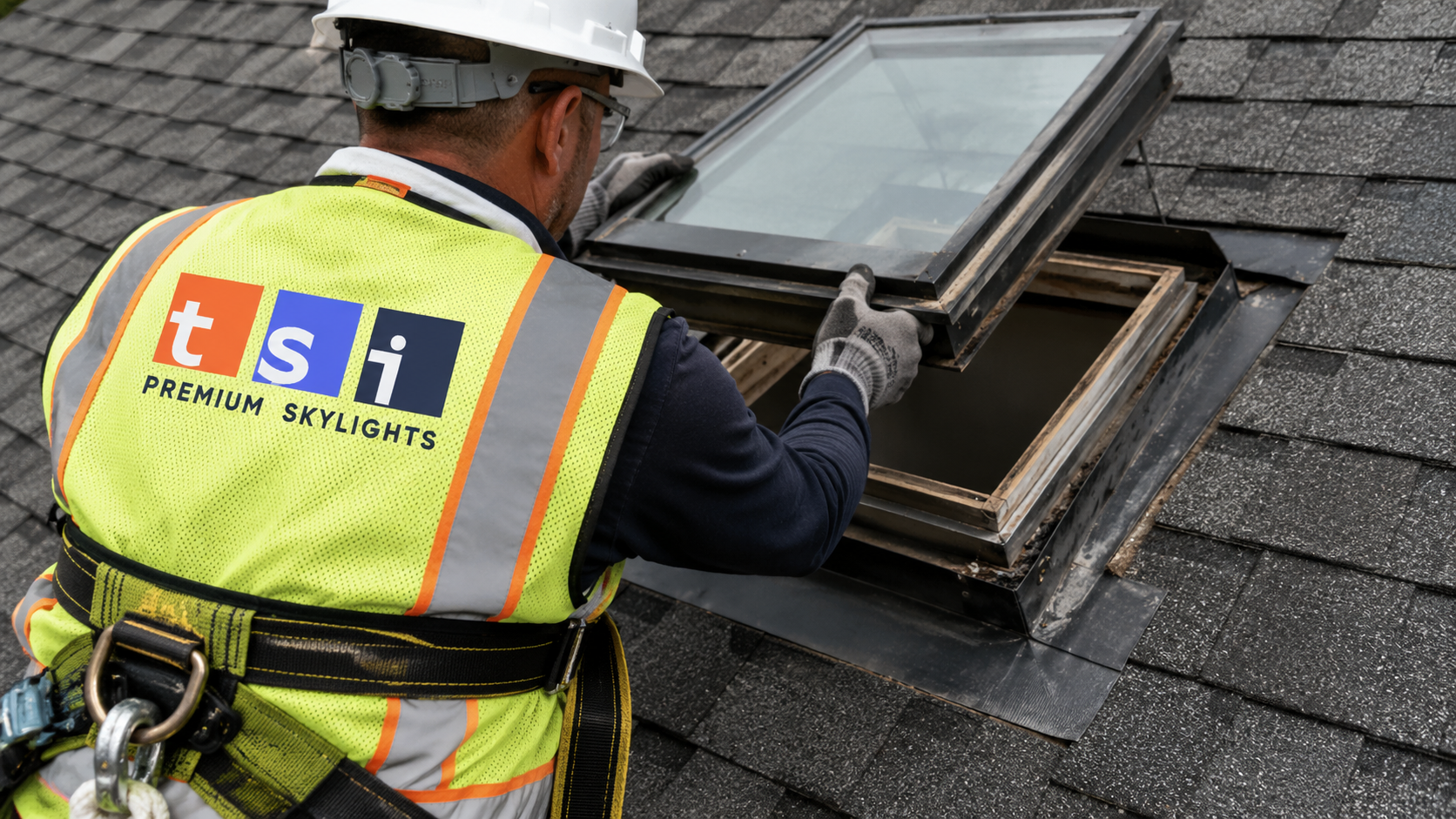
- Old unit and flashing removed. The skylight comes out, all old flashing is stripped rather than reused, and the opening, curb and surrounding deck are inspected while fully visible.
- Substrate repaired. Soft curb sections or deck boards are replaced, then self adhered ice and water membrane is applied around the opening and lapped correctly with the existing underlayment.
- New unit set and flashed. The matched kit is installed in the manufacturer’s sequence: sill flashing first, then step flashing woven course by course up both sides, then head flashing tucked under the shingles above.
- Shingles reinstated and site cleared. Courses are cut in around the unit and the roof and grounds are swept for nails.
The roof is left watertight before the crew leaves, on every day of the job. If the light shaft was never insulated or vapour sealed, replacement is the natural moment to correct that from below rather than opening finished drywall again later.
Timing: Replace Before The Wet Season
| Period | Suitability | Practical notes |
|---|---|---|
| September to mid October | Best | Membranes and sealants bond properly, reliable dry stretches |
| Late October to November | Workable but tight | Rain delays, schedules at their fullest |
| December to March | Limited | Cold adhesives, brittle shingles, higher cost |
| April to June | Good | Stable temperatures, spring rain delays |
| July to August | Good | Very hot roof surfaces, busy schedules |
An aging dome that survived a dry summer is not evidence that it will survive a wet November. Sustained autumn rain followed by the first hard freeze thaw cycles is exactly the sequence that turns slow seepage into a stained ceiling, and remediating drywall and wet insulation in February costs far more than the replacement would have in September.
How much does skylight replacement Scarborough homeowners need typically cost?
How long do acrylic dome skylights last in Toronto?
Should I keep the existing curb or remove it?
Do I need a permit to replace a skylight in Scarborough?
What extra costs commonly appear once the old unit is removed?
Will replacing my skylight noticeably brighten the room?
Arrange Your Skylight Replacement Scarborough Assessment
If your Scarborough skylight is an acrylic dome from the 1990s, it is at or past the end of its service life, and the sensible move is an assessment rather than another winter of hoping. Toronto Skylight Installers is based in the Toronto area and works throughout Scarborough, inspecting the unit, the curb and the surrounding deck before quoting.
Call us today at (416) 365-7557 or request a free consultation while dry autumn working weather is still available.
Toronto Skylight Installers serves Scarborough and the wider GTA, from the Bluffs and Birch Cliff north through Agincourt, Malvern and beyond.