

Autumn windstorms bring down a lot of branches in Ontario, and a skylight is one of the more vulnerable spots on a roof when a limb lets go. If one lands on yours, or a storm rips at the flashing and water starts coming through the ceiling, you may find yourself thinking about a skylight insurance claim for the first time. The process goes more smoothly when you know what to document, what to leave to professionals, and what questions to ask your insurer before any permanent work begins.
This guide is general information from a skylight contractor’s point of view, not insurance or legal advice. Every policy is different. Read your own policy wording and speak with your insurer or broker about how it applies to your situation.
When a skylight insurance claim makes sense
Not every skylight problem is an insurance matter. In broad terms, home insurance policies are generally designed around sudden, accidental events, and they commonly exclude damage that comes from wear and tear, poor maintenance or slow deterioration. How your policy draws that line is in its wording, and two policies that look similar can treat the same event differently.
From a skylight contractor’s perspective, most of the calls we see after a storm fall into one of two groups:
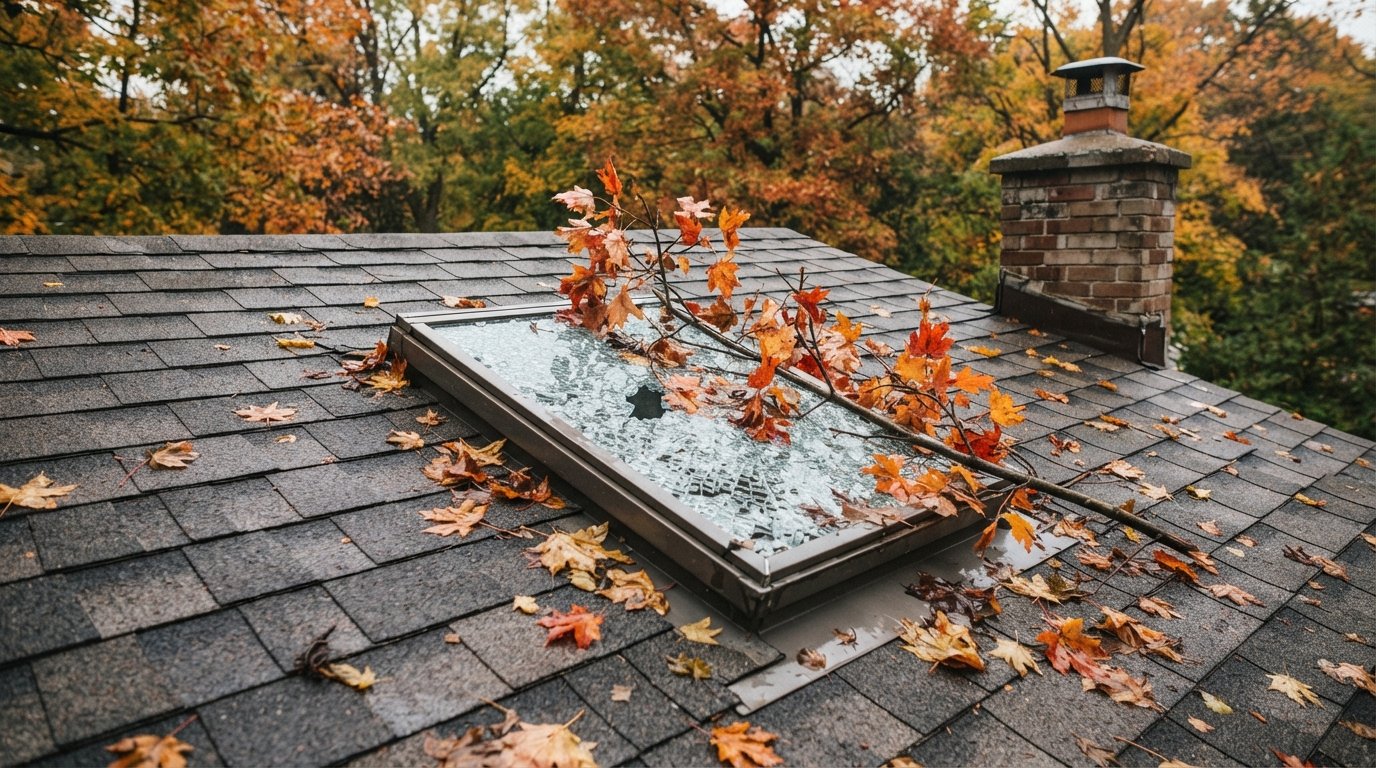
- Sudden damage: a branch strikes the glass, wind lifts or tears flashing, hail cracks a dome, or something blows into the skylight and breaks it. The damage appears at a specific moment, often during a storm you can point to.
- Gradual leaks: a seal that has been failing for years, flashing that has rusted through, a curb that has slowly rotted, or condensation dripping every winter. The first stain may appear after a storm, but the cause has been building for a long time.
The difference matters because policies often treat the two very differently. A broken skylight from a falling limb is the kind of event many homeowners expect to discuss with their insurer. A slow leak from an old unit is often viewed as maintenance. Some policies may still respond to resulting interior damage in certain circumstances while excluding the worn-out skylight itself. Do not assume either way: ask your insurer before you decide whether a skylight insurance claim is worth opening.
| Situation | How it usually presents | How policies often view it (check yours) |
|---|---|---|
| Branch breaks the glass during a windstorm | Sudden breakage, debris on the roof, water inside soon after | Often discussed as sudden, accidental damage |
| Wind tears flashing or lifts the unit | Leak begins during or right after a storm, visible lifted metal | May be treated as wind damage, depending on wording |
| Hail cracks a dome or glass | Multiple small impacts, sometimes on other roof surfaces too | Often discussed as storm damage |
| Seal failure on an older unit | Slow drip, stains that grow over months | Often considered wear and tear or maintenance |
| Fog between panes | Cloudy glass that does not wipe clean | Usually considered age-related, may be a manufacturer warranty question |
| Winter condensation dripping | Water on cold days with no rain | Generally not a storm event; a ventilation or humidity issue |
First steps after a storm damages your skylight
The first hour matters more than people expect, mostly for safety and for limiting further damage. Here is a sensible order of operations.
- Keep people and pets out from under the skylight. Cracked glass and debris can fall. If the inner pane is broken, close the door to the room if you can.
- Do not climb onto the roof. Wet shingles, broken glass and hanging branches are a dangerous combination, especially in wind. Let professionals handle anything outside.
- Protect the interior. Move furniture and rugs, put down plastic sheeting and buckets, and turn off any light fixture near the water if it is safe to do so at the panel.
- Document before anything is moved, as far as safety allows (more on this below).
- Arrange temporary protection through a professional so the opening is covered before more rain arrives.
- Contact your insurer or broker promptly to report the damage and ask how they want you to proceed.
If you are unsure whether you will file a skylight insurance claim at all, follow these steps anyway. They protect the house either way, and they keep your options open. Many policies expect the homeowner to take reasonable steps to prevent further damage after an event. That usually means you are not expected to leave water pouring in while you wait for an adjuster, but the details, including what costs may be reimbursed, depend on your policy. Ask your insurer what they expect, and keep every receipt.
Documenting damage from inside the house
Good documentation helps whoever reviews your skylight insurance claim understand what happened and when. You do not need to go anywhere unsafe to collect it. Most of what is useful can be captured from inside the house and from the ground.
- Wide photos and video of the room showing the skylight, ceiling and floor, so the location and extent of damage are clear.
- Close-ups of cracks, broken glass, water stains, wet drywall, damaged flooring and any debris that came through.
- The date and time, and a note of the weather: when the storm hit, when you noticed the damage, and when water began to come in.
- Photos from the ground or a window of any visible branch, fallen tree or lifted flashing, without climbing anything.
- Damaged contents such as furniture, electronics and rugs, before you move or dispose of them. Ask your insurer before throwing anything away.
- A simple written timeline of what you did and who you called, including the times.
Keep the original files with their date information, and back them up somewhere other than your phone. If a contractor attends, ask them to photograph the exterior damage on the roof and include those images in their report. Roof photos taken by the contractor often show things you cannot see from below, such as whether the flashing was lifted by wind or had already rusted through, which is exactly the kind of detail that helps when a skylight insurance claim is reviewed.
| What to record | Where to capture it | Why it helps |
|---|---|---|
| Overall room and skylight | From the doorway, inside | Shows location and scale of damage |
| Broken glass, cracks, stains | Close-up from below | Shows the type of damage and its extent |
| Fallen branch or tree | From the ground or a window | Links the damage to a specific event |
| Damaged contents | Inside, before moving items | Supports any contents part of a claim |
| Exterior roof damage | Taken by the contractor on the roof | Captures flashing, curb and glass details safely |
| Receipts for emergency work | Kept with your files | Shows the steps taken to limit further damage |
Temporary protection: what professionals do
Once the immediate danger is dealt with, the opening needs to be covered before the next band of autumn rain. This is not a job for a homeowner on a ladder. A skylight with broken glass sits on a sloped, often wet roof, and the work involves handling sharp fragments and securing material against wind.
On a call for emergency skylight repairs after storm damage, the usual approach is:
- Make the area safe: remove loose glass and debris from the roof and the skylight frame, and clear any branch resting on the unit if it can be done safely.
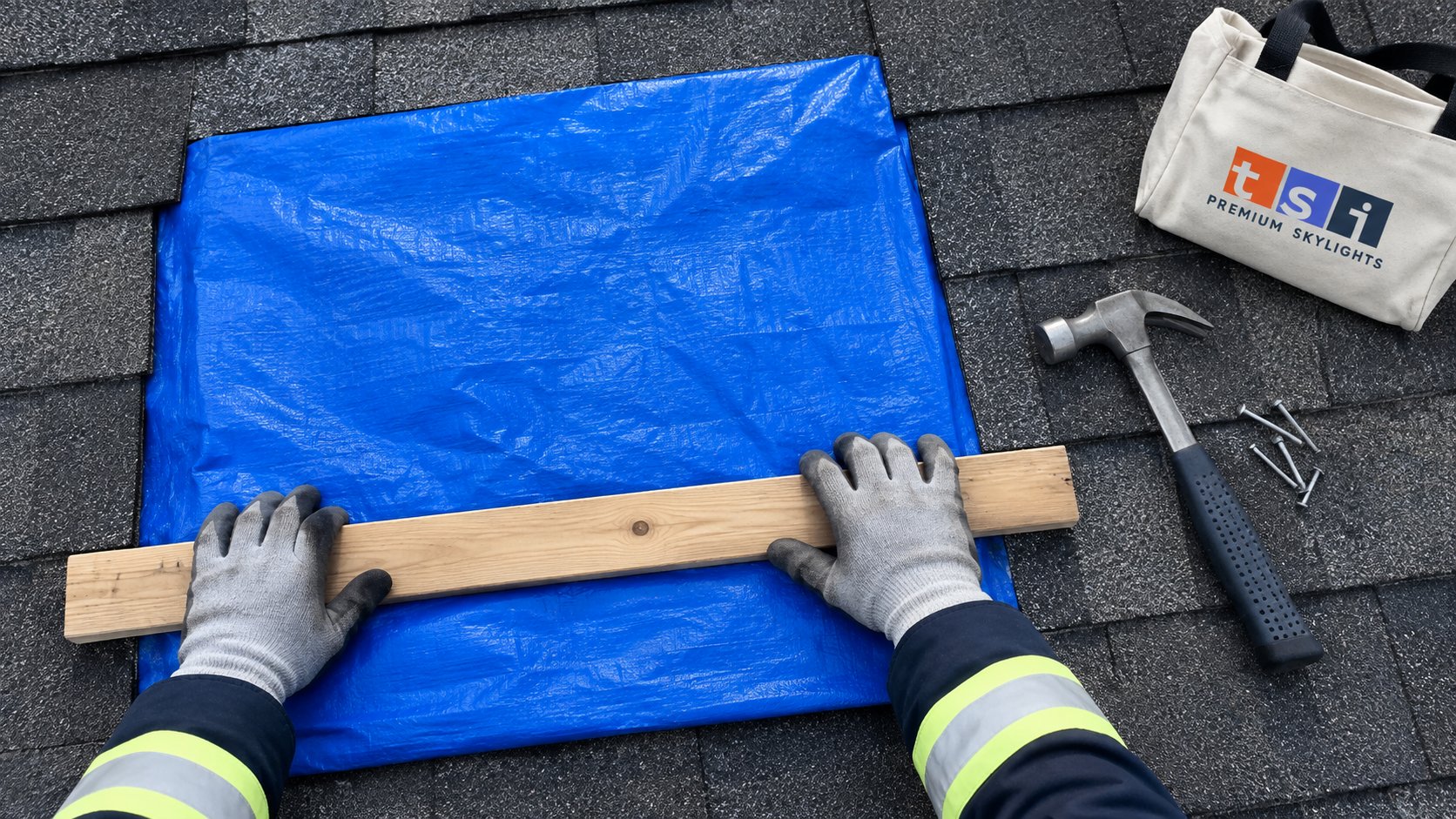
- Cover the opening with heavy-duty sheeting, a rigid panel or both, fastened and lapped so water sheds over it rather than under it.
- Protect the interior where glass has fallen or the inner pane is broken, often with sheeting across the shaft opening.
- Record the damage with photos and notes for your file and for the insurer.
Temporary protection is exactly that. It should hold for days or a few weeks, but it is not designed to see a skylight through a winter. Plan the permanent repair or replacement once your insurer has had the chance to review the claim. If the adjuster wants to see the damage before anything is removed, ask the contractor to leave broken components on site or bag them, rather than taking them away.
Working with your insurer and adjuster
Each insurer has its own process, but a few general points apply to most claims involving a skylight.
Report early and ask questions
Call your insurer or broker as soon as practical. Ask whether they want to send an adjuster before any work beyond temporary protection, whether you should get your own estimate, and what documentation they need. Write down the claim number and the names of the people you speak to.
Understand your deductible
Your deductible is the portion you pay before coverage applies. Ask what it is for this type of loss, since some policies use different deductibles for different perils. For a single cracked pane, the repair may cost less than the deductible, in which case a claim may not make sense. Some homeowners also consider whether a small claim could affect their premium or claims history. That is a conversation to have with your broker, not something a contractor can answer for you.
Get a clear contractor report
A useful report from a skylight contractor describes what was found, with photos, what likely caused it in plain terms, and what repair or replacement is recommended and why. It should separate storm damage from pre-existing conditions honestly. A contractor’s role in a skylight insurance claim is to describe the damage and the work required; whether the event is covered is a decision made by the insurer under the policy.
Be wary of pressure after storms
After big windstorms, door-to-door operators sometimes appear offering to handle everything, including the claim. Be cautious about signing anything that hands control of your claim or payments to a contractor, and never sign a contract you have not read. Check credentials and insurance, and take time to compare.
Repair or replacement after a claim
Once the insurer has reviewed the skylight insurance claim, you will need to decide how to restore the skylight. The decision usually comes down to the extent of damage and the age and condition of the unit.
Glass replacement can make sense when only the glass is broken, the unit is relatively modern, and the frame, flashing and seals are sound. Replacement glass for some units is available from the manufacturer; for others, a new insulated glass unit has to be made to size.
Full replacement is often the better choice when the frame is bent, flashing is torn, the unit is old enough that parts are no longer available, or the skylight was already near the end of its life. Replacing the whole unit also allows new flashing and underlayment to be installed properly. Our skylight replacement page explains the process.
Some policies may pay to restore the skylight to its pre-loss condition but not for upgrades beyond that, such as moving from a fixed skylight to a venting one. If you want to upgrade, ask the insurer how the difference is handled before work starts. Keep any warranty documents for the new unit, and read the manufacturer’s current terms rather than relying on a summary.
Interior repairs are usually part of the picture too: wet drywall in the shaft or ceiling, insulation in the attic, paint and sometimes flooring. Drywall and insulation that stayed wet for a long time should be checked for mould and replaced if needed. Make sure the scope covers the shaft as well as the skylight.
| Work | When it is typical | Rough range (estimate, varies by house and access) |
|---|---|---|
| Emergency temporary protection | Broken glass or open leak after a storm | Often a few hundred dollars, more for difficult access or after-hours calls |
| Glass replacement on a sound unit | Only the glass is damaged | Often about $600 to $1,800 depending on size and glass type |
| Full skylight replacement | Frame, flashing or unit damaged, or old unit | Often about $1,800 to $4,500 per unit |
| Shaft and ceiling repair | Water damage to drywall and insulation | Varies widely with the extent of damage |
These ranges are only broad estimates for typical homes. Size, roof pitch, roof covering, access, and the extent of interior damage all move the number, and a written estimate after an inspection is the only reliable figure.
Reducing the risk before the next storm
You cannot stop a windstorm, but you can reduce the chance that your skylight is the weak point.
- Have overhanging trees assessed by a certified arborist. Dead limbs hanging over the roof are a frequent cause of sudden skylight damage in autumn storms.
- Book a professional inspection of older skylights. Flashing, seals and curbs that are already failing are more likely to be damaged and are more likely to be viewed as wear and tear.
- Keep records of skylight installation dates, inspections and maintenance. If you ever have to make a skylight insurance claim, they can help show the unit was in reasonable condition.
- Review your policy now, before anything happens, so you know what is covered, what is excluded and what your deductible is.
Our York Region skylight installation, replacement and repair team, along with crews across the GTA, carries out storm inspections and routine skylight repairs so small problems are found before a storm turns them into big ones.
Does home insurance cover a skylight broken by a falling branch?
Is a slow skylight leak covered by insurance?
What should I photograph for a skylight insurance claim?
Can I get the skylight covered before the adjuster arrives?
Should I repair or replace a storm-damaged skylight?
Can the skylight contractor decide whether my claim is covered?
Get help with storm damage and your skylight insurance claim
If an autumn storm has damaged your skylight, start with safety, documentation and a call to your insurer, then let professionals handle the roof. Toronto Skylight Installers can provide temporary protection, a clear written report with photos, and a repair or replacement plan you can share with your insurer.
Call us today at (416) 365-7557 or request a free estimate.
Storm damage help for skylights in York Region and the wider GTA.