

Daylight is one of the few home upgrades that improves a room every single day without adding a utility bill, and it is exactly what most homes east of Toronto are short on. Whether you own a postwar bungalow with a low, dark hallway or a newer two-storey in a subdivision where the second floor bathrooms have no exterior wall, the fastest fix is overhead glass. That is why interest in skylights Durham Region homeowners can actually rely on has grown steadily, and why it pays to understand what a proper installation involves before you call anyone.
This guide covers what skylights Durham Region homeowners are quoted in Ajax, Pickering, Whitby and Oshawa in 2026, which units suit which roofs, how the Ontario Building Code affects the work, what a realistic installation timeline looks like, and how to tell a competent installer from a roofer who occasionally cuts holes. Toronto Skylight Installers is based in the Toronto area and serves homeowners right across Durham Region, so the numbers and practices below reflect what crews actually encounter on local roofs.
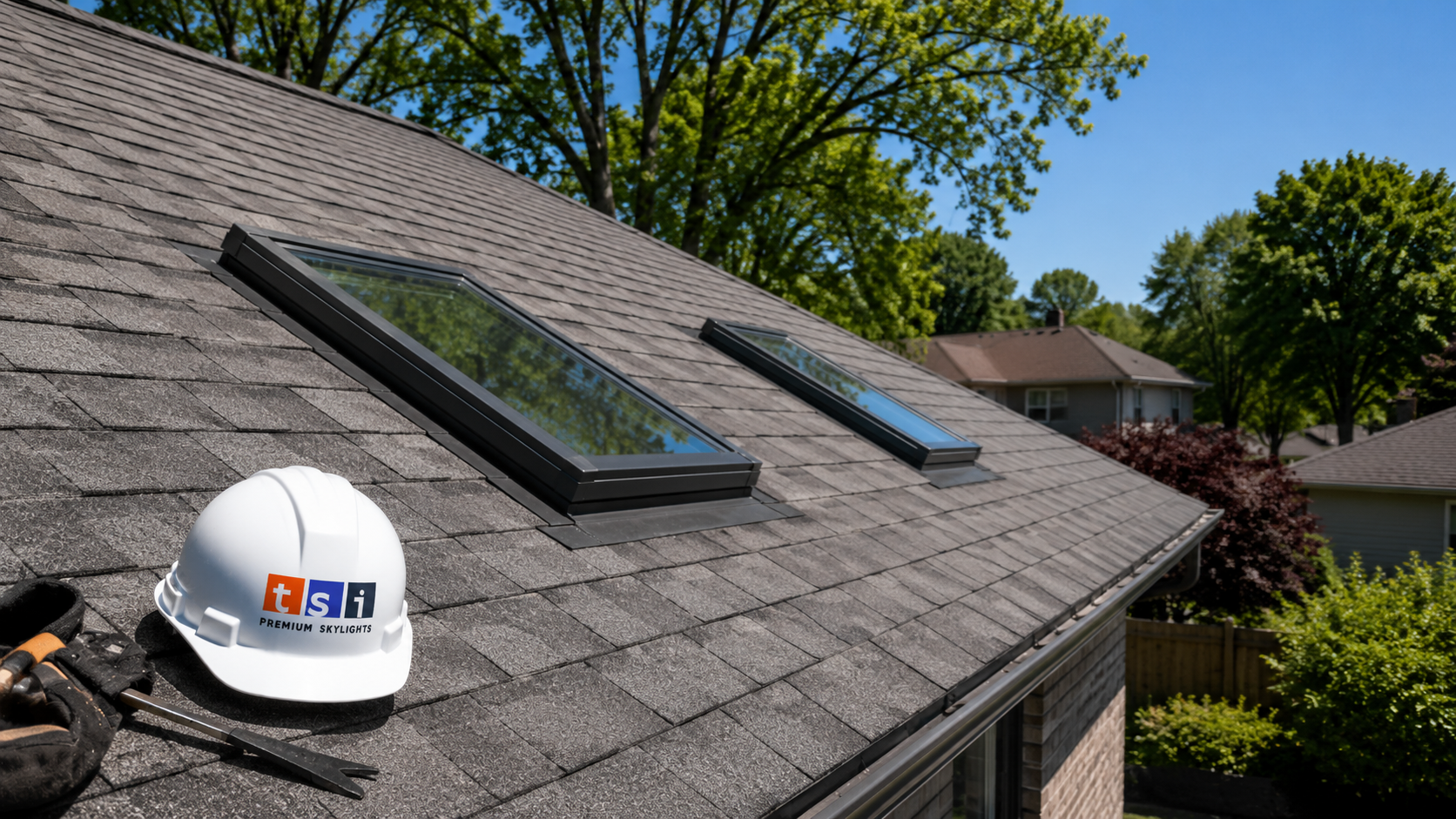
Skylights Durham Region Homeowners Should Consider: Ajax, Pickering, Whitby and Oshawa
Durham Region is not one housing type. It is at least four, and the right answer for skylights Durham Region properties need depends heavily on which one you own. South Ajax and south Oshawa carry a large stock of postwar and mid-century bungalows and side-splits with shallow attics, original framing, and rooms that were never designed around natural light. Newer subdivisions in north Whitby, north Ajax and north Oshawa are dominated by two-storey homes built from the late 1990s onward, with engineered trusses, steeper roof pitches and finished second floors. North Pickering and pockets of Whitby include estate lots and custom builds with vaulted ceilings, complex roof geometry and large open-plan spaces. Scattered through all four municipalities are older brick homes, many with additions carrying flat or low-slope roof sections.
Each of those categories changes the job. A bungalow usually means a shaft through an unfinished attic, which is straightforward but requires careful framing and insulation. A truss-framed two-storey means the opening has to fit between web members without cutting anything structural, or an engineered detail is required. A vaulted ceiling often allows a direct, shaft-free install, which is the cleanest result available. A flat-roofed addition needs a curb-mounted unit rather than a deck-mounted one. Anyone quoting skylights Durham Region homeowners ask about without first asking what your ceiling and roof framing look like is guessing.
Climate is the other variable that shapes skylights Durham Region roofs can carry over the long term. Homes closer to Lake Ontario in south Pickering, south Ajax and south Whitby see more freeze and thaw cycling and more wind-driven rain off the lake, which puts real stress on flashing and sealant. Further north, snow load sits longer on roofs. Both conditions punish a lazy installation, and both are the reason flashing quality matters more here than the brand name on the glass.
Choosing Between Skylight Types for Durham Region Roofs
There are five practical categories of skylights Durham Region homes commonly use, and the choice usually comes down to roof pitch, room function and budget rather than personal preference.
Fixed skylights do not open. They are the least expensive, the least likely to leak over a long service life because there are fewer moving parts, and the right choice for hallways, stairwells, living rooms and bedrooms where you want light rather than airflow. A fixed unit is the default recommendation for most bungalow hallway installs.
Manual venting skylights open with a rod or crank. They suit rooms within reach, and they work without power, which some homeowners prefer. The trade-off is that a rod-operated unit above a stairwell is realistically never going to be opened.
Electric fresh air skylights open with a remote or wall switch and close automatically when a rain sensor is triggered. They require a wired supply, which adds electrical work and, on a finished second floor, some drywall repair.
Solar-powered fresh air skylights run off an integrated solar panel and battery, so no wiring is needed. That makes them the practical venting choice for finished ceilings where running a circuit would mean opening walls. Because they are classified as a solar-powered product, they have historically qualified for certain incentives, which narrows the cost gap against electric units. A solar-powered venting skylight is often the best value in a bathroom or ensuite.
Sun tunnels are a different product entirely. A small dome on the roof feeds a reflective tube down to a flush ceiling diffuser. They deliver a surprising amount of daylight to interior bathrooms, closets, laundry rooms and windowless hallways, they require no shaft framing, and they are the cheapest way to add daylight. They do not provide a view of the sky, and they do not vent. For dark interior spaces in a bungalow, a sun tunnel often solves the problem for a fraction of the cost of a full skylight.
For additions, dormers and garage conversions with low-slope decks, flat roof skylights use a raised curb so water drains around rather than against the unit. Never let anyone install a standard deck-mounted skylight on a flat roof.
| Skylight Type | Best Suited To | Supplied and Installed (2026) | Notes |
|---|---|---|---|
| Fixed deck-mounted | Hallways, stairwells, living rooms | $1,900 to $3,200 | Lowest lifetime risk, no moving parts |
| Manual venting | Reachable ceilings, kitchens | $2,600 to $4,200 | Needs an operating rod or crank |
| Electric fresh air | High ceilings with attic wiring access | $3,400 to $5,600 | Add $250 to $600 for electrical |
| Solar-powered fresh air | Bathrooms, ensuites, finished ceilings | $3,600 to $6,000 | No wiring required, rain sensor included |
| Sun tunnel | Interior baths, closets, laundry | $1,200 to $2,400 | No shaft framing needed |
| Curb-mounted for flat or low-slope roofs | Additions, rear extensions, garages | $2,800 to $5,500 | Requires a properly built and flashed curb |
Prices for skylights Durham Region homeowners install assume a single-unit install on an accessible asphalt shingle or membrane roof at standard residential heights. Multiple units installed on the same visit almost always reduce the per-unit cost because setup, staging and disposal are shared.
What Skylight Installation Costs Across Durham Region in 2026
The single biggest driver of price on skylights Durham Region homeowners order is not the glass. It is what sits between your ceiling and your roof deck. A vaulted ceiling install can be done in a day with no shaft at all. A flat ceiling under a deep attic can need a three metre light shaft framed, insulated, vapour sealed, drywalled and finished, and that work can cost more than the skylight itself.
Roof condition is the second driver. If shingles are near the end of their life, the honest recommendation is to coordinate the skylight with the reroof rather than flash a new unit into a roof you will tear off in two years. Roof pitch, height above grade and access also matter: a steep third-storey roof needs more staging and fall protection time than a bungalow.
| Line Item | Typical Range | When It Applies |
|---|---|---|
| Removal and disposal of an existing unit | $150 to $400 | Replacements only |
| Roof deck cutting and structural blocking | $350 to $900 | All new openings |
| Flashing kit sized to the roof covering | $180 to $450 | Every install, non-negotiable |
| Light shaft framing, insulation and vapour barrier | $900 to $2,500 | Flat ceilings with attic space above |
| Drywall, taping and interior paint | $300 to $800 | Any new or enlarged shaft |
| Electrical supply for a powered unit | $250 to $600 | Electric venting models |
| Factory blinds or shades | $250 to $700 per unit | Optional, best ordered with the skylight |
| Building permit where structure is altered | $200 to $600 | Cutting or modifying rafters or trusses |
As a working benchmark, most Durham homeowners replacing two ageing units on an accessible roof land somewhere between $4,500 and $8,500 for the pair, and most homeowners adding a brand new skylight with a full drywalled shaft land between $3,500 and $7,000 for a single opening. Estate homes with vaulted great rooms and oversized glass can exceed those ranges considerably, because larger units require heavier glazing, more crew and sometimes mechanical lifting.
Ontario Building Code, Permits and Structural Rules
Skylights are regulated glazing, not decorative accessories, and skylights Durham Region homes receive are governed by the same provincial rules as anywhere else in Ontario. Under the Ontario Building Code, overhead glazing in a dwelling generally must be laminated or otherwise safety rated so that a failure cannot drop glass into the room below. Reputable manufacturers already supply tempered outer glazing with a laminated inner pane on residential units, which satisfies this in normal residential applications. Insist on it, particularly over a bed, a stairwell, a tub or a shower.
Permits are municipal, and Ajax, Pickering, Whitby, Oshawa, Clarington, Uxbridge, Brock and Scugog each administer their own building department. As a general rule, a straight replacement of an existing skylight in the same opening does not require a permit, while cutting a new opening that alters a rafter or a truss does. Engineered roof trusses are the important case: they are designed as a system, and no member may be cut, notched or drilled without an engineered repair detail. This is the most common reason a straightforward looking skylight project in a newer Whitby or north Oshawa subdivision turns into an engineered one.
Energy performance also applies. Ontario supplementary standards effectively require modern low emissivity, argon filled, insulated glazing units in new residential installations. That is not simply a compliance matter, it is comfort: a single glazed or seal failed unit is a cold surface all winter, and it will produce condensation regardless of how well it was flashed.
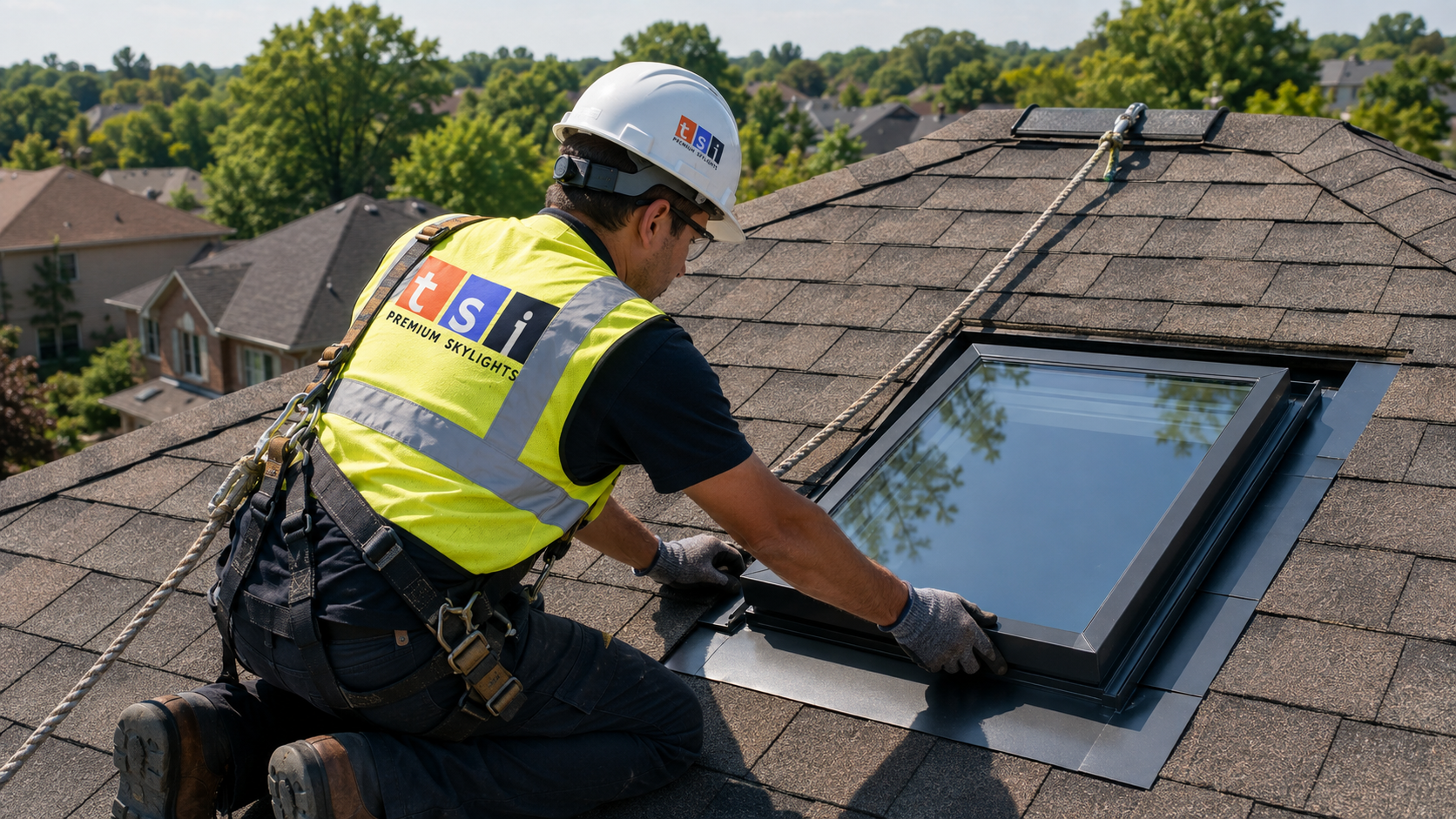
Finally, work at height on a residential roof falls under Ontario occupational health and safety requirements for fall protection. A crew working on your roof should be tied off. If they are not, that tells you something about how the rest of the job will be done.
What the Installation Process Actually Looks Like
A professional install of skylights Durham Region homeowners commission follows a predictable sequence, and knowing it makes it easy to evaluate a quote.
- Assessment. Interior ceiling type, attic access, framing layout, roof pitch, roof age and orientation are all checked before anything is ordered. Orientation matters: north facing units deliver steady, even light, while south and west facing units deliver much more heat gain and usually want a factory shade.
- Specification and ordering. Unit size, model, glazing and flashing kit are matched to the roof covering. Lead times on standard sizes are typically one to three weeks, longer for custom or oversized glass.
- Interior protection and shaft opening. The room is sheeted off, the ceiling is opened, and the shaft is framed. Dust control at this stage separates good crews from bad ones.
- Roof opening, curb and flashing. The deck is cut, blocking is added, the unit is set, and the manufacturer flashing kit is woven into the shingles or membrane with underlayment and ice and water shield above the unit. The opening is never left open overnight.
- Insulation and finishing. The shaft is insulated and vapour sealed, drywalled, taped and prepared for paint. Skipping the vapour barrier is the leading cause of a skylight that appears to leak in February but is actually condensing.
- Commissioning and cleanup. Venting units are tested, rain sensors are verified, shades are fitted and the site is cleared.
Timeline for a single fixed unit in a vaulted ceiling: often one day. A single unit with a full framed shaft: typically two days, plus a return visit for paint. Two or three units on the same roof: two to three days. Weather delays are normal, and no honest contractor cuts a roof open on a day with rain forecast.
Maintenance, Repairs and the Problems We See Most
Modern skylights Durham Region installers fit last a long time. The glazing seal on a quality unit is generally warranted for a decade or more, and the unit itself commonly serves twenty to thirty years. What fails first is almost always the flashing, the surrounding roof covering or the sealant, not the glass.
The most valuable diagnostic distinction is between a leak and condensation. A genuine leak shows up during or shortly after rain, often stains a specific corner of the shaft, and gets worse with wind direction. Condensation shows up on cold mornings, is worst in winter, appears evenly around the glass edge and is usually caused by high indoor humidity, an under insulated shaft, or poor attic ventilation. Replacing a perfectly good skylight because of condensation is a common and expensive mistake.
| Symptom | Likely Cause | Usual Remedy | Typical Cost |
|---|---|---|---|
| Staining at the upper corners of the shaft | Failed or improperly woven flashing | Strip back shingles and reflash | $650 to $1,400 |
| Haze or moisture between the panes | Insulated glazing seal failure | Replace the glazing unit or the skylight | $1,400 to $3,200 |
| Drips on cold mornings, dry during rain | Condensation from humidity or a cold shaft | Improve shaft insulation and attic venting | $300 to $1,200 |
| Cracked, chalky or shrinking exterior sealant | Ultraviolet ageing of the gasket and sealant | Gasket and seal service | $350 to $700 |
| Venting unit will not open or close | Motor, control or rain sensor failure | Motor or control replacement | $400 to $900 |
| Shingles curling or bare around the curb | Roof covering at end of service life | Reroof the section and reflash the unit | Quoted with the roof |
Two habits extend the service life of skylights Durham Region homes rely on considerably. Clear leaves and needles from the upslope side of the unit each autumn so water is not dammed against the head flashing, and run a bathroom exhaust fan properly if the skylight is in a bathroom. Most Durham homes have adequate fans that are simply not run long enough after showers.
How to Choose an Installer for Skylights Durham Region Homes Deserve
Roofing and skylight work overlap, but they are not the same trade, and skylights Durham Region contractors quote should be priced as a complete assembly. A skylight touches the roof, the framing, the insulation, the vapour barrier and the interior finish, and a crew that only does one of those will leave the rest to you. When comparing quotes, look for the following.
- The quote names the specific model, size and glazing package, not simply “skylight supplied and installed”.
- A manufacturer flashing kit matched to your roof covering is listed as a line item. Sealant alone is not flashing.
- Shaft framing, insulation, vapour barrier and drywall are either included or explicitly excluded, so there is no surprise.
- The contractor carries liability insurance and WSIB coverage, and will show both without hesitation.
- Both the manufacturer warranty and a separate written workmanship warranty are stated in years.
- The crew works tied off, and the roof is left watertight at the end of every working day.
You can review the full range of Durham Region skylight installation and repair services we provide across Ajax, Pickering, Whitby, Oshawa, Clarington and the northern townships, and read more about our approach to professional skylight installation before you book. Homeowners west of Durham can also find local information for York Region, including Markham.
Replacement Versus Repair for Older Durham Homes
Many calls about skylights Durham Region homeowners make involve a unit installed in the 1990s or early 2000s, often a builder grade acrylic dome or an early insulated glass unit. The decision framework is fairly simple. If the frame is sound, the glazing is clear and the problem is confined to flashing or sealant, repair. If the glazing seal has failed, the frame is distorted, the unit is a single glazed or acrylic dome, or the roof is being replaced anyway, replace. Skylight replacement during a reroof is by far the most cost effective moment to do the work, because staging, tear off and flashing are already happening.
Of all the skylights Durham Region homeowners ask us about, a replacement into an existing opening is usually the least disruptive project. There is no new ceiling opening, no fresh drywall, and often no permit. Most same size replacements are completed in a single day per unit, and the improvement in comfort from moving to a modern low emissivity, argon filled unit is immediately noticeable in both January and July. Where a unit has been leaking for years, expect the crew to also assess the shaft drywall and insulation for hidden moisture damage before closing everything up, and budget for skylight repair work to any surrounding structure that has been affected.
How much do skylights cost in Durham Region?
Do I need a building permit for a skylight in Ajax, Pickering, Whitby or Oshawa?
How long does a skylight installation take?
Are skylights Durham Region homeowners install prone to leaking?
Should I replace my skylight when I replace my roof?
Can skylights be installed on a flat or low-slope roof?
Book Your Skylights Durham Region Consultation Today
Whether you are adding daylight to a dark bungalow hallway in Oshawa, replacing a fogged unit in a Whitby two-storey, or planning glass for a vaulted great room in Pickering, the work is worth doing once and doing properly. The skylights Durham Region homeowners plan carefully tend to be the ones that never cause trouble again. Toronto Skylight Installers provides written, model-specific quotes, manufacturer flashing on every unit, and crews who leave your roof watertight at the end of each day.
Call us today at (416) 365-7557 or request a free consultation to have your ceiling, attic and roof assessed before you commit to anything.
Toronto Skylight Installers serves Durham Region and the wider Greater Toronto Area, including Ajax, Pickering, Whitby, Oshawa, Clarington, Uxbridge and Scugog.