

Managing south facing skylight heat gain Toronto is one of the most common challenges homeowners raise with us every June. A south-oriented skylight captures more direct sunlight than any other orientation — roughly 50 to 70 percent more solar energy per square metre than a north-facing unit — which means the right glass specification and shading strategy can be the difference between a bright, comfortable living space and an overheated room that drives up your air-conditioning bill all summer long. Whether you are planning a new installation or upgrading an existing unit, understanding the science behind solar heat gain, the coatings available in 2026, and the shade accessories designed specifically for Toronto’s climate will help you make a confident, long-term decision.
Toronto’s summers have grown measurably warmer over the past decade. Environment Canada records show that the Greater Toronto Area now regularly records afternoon highs above 30 °C from late May through early September, with heat alerts increasingly common in Mississauga, Markham, Vaughan, and Brampton as well as the core city. For a south-facing skylight, that translates to intense solar irradiance from roughly 10 a.m. to 4 p.m. on clear days — exactly the hours when most households are trying to keep rooms cool. Getting the glass coating and shading combination right is therefore not a luxury; it is an energy-efficiency and comfort necessity for 2026 installations.
At Toronto Skylight Installers, we have guided hundreds of GTA homeowners through this exact decision. This guide walks through every factor you need to consider: solar heat gain coefficients, low-e glass types, argon and krypton gas fills, spectrally selective coatings, motorised and manual shade options, and the payback timelines that justify a higher-specification unit. We also address the installation process for south-facing openings on both pitched and flat roofs, explain what building-code compliance looks like in Ontario for 2026, and answer the questions we hear most often from clients in Toronto and the surrounding suburbs.
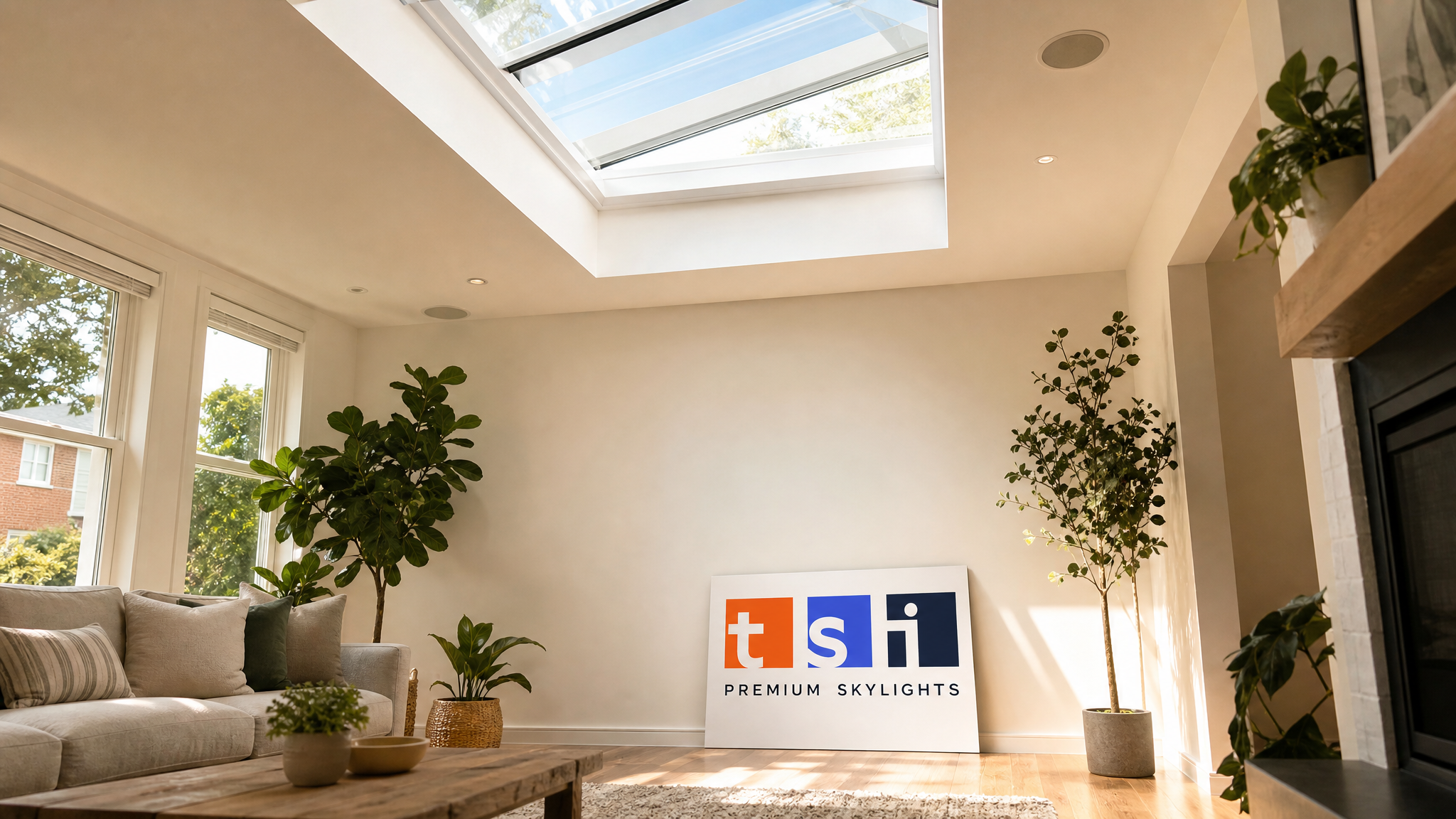
Understanding South Facing Skylight Heat Gain Toronto Homeowners Need to Manage
Solar heat gain through a skylight is measured by the Solar Heat Gain Coefficient (SHGC). A coefficient of 1.0 would mean all solar radiation passes through the glazing; a coefficient of 0.20 means only 20 percent of that energy enters the room. For south-facing orientations in Toronto’s climate, the general guidance from Natural Resources Canada and ENERGY STAR Canada is to target an SHGC no higher than 0.35 to 0.40 when paired with interior shading, or as low as 0.20 to 0.25 if the skylight is in a room with no supplemental shading and limited cross-ventilation.
The reason south-facing units demand tighter control than east or west-facing skylights is the angle of incidence. During Toronto’s summer solstice, the sun reaches an altitude of approximately 71 degrees at solar noon. At that steep angle, it strikes a horizontal or near-horizontal skylight almost perpendicularly, maximising the amount of radiation that passes through the glass. An east-facing unit catches lower-angle morning sun; a west-facing unit catches afternoon sun at a shallower angle by mid-summer; but a south-facing skylight is in the solar “bulls-eye” for the longest portion of the day across all the warmest months.
Beyond thermal discomfort, uncontrolled south facing skylight heat gain Toronto homeowners experience also accelerates UV degradation of interior furnishings. Hardwood floors, fabric upholstery, artwork, and painted surfaces all fade faster when exposed to unfiltered direct sunlight. The right glass coating filters ultraviolet radiation at the source — typically blocking 99 percent of UV energy — without noticeably reducing visible light transmission, so rooms remain bright without the bleaching effect.
Visible Transmittance (VT) is the companion metric to SHGC. A spectrally selective low-e coating allows a manufacturer to achieve a low SHGC (blocking the near-infrared heat component of sunlight) while maintaining a relatively high VT (letting visible light through). This is the combination every south-facing installation should target: an SHGC in the 0.20–0.35 range paired with a VT of 0.45 or above, giving you a room that feels bright and airy without the greenhouse effect.
| Glazing Specification | SHGC | Visible Transmittance | Recommended South-Facing Use | Approximate Premium Over Standard Double-Pane |
|---|---|---|---|---|
| Standard double-pane clear | 0.76 | 0.81 | Not recommended for south-facing in Toronto | — |
| Basic low-e double-pane | 0.40 | 0.60 | Acceptable with interior shading | +$80–$120 per unit |
| Spectrally selective low-e double-pane | 0.27 | 0.52 | Good standalone performance | +$150–$220 per unit |
| Spectrally selective low-e triple-pane | 0.20 | 0.44 | Best for south-facing in high-use rooms | +$280–$420 per unit |
| Electrochromic (smart) glass | 0.09–0.36 (variable) | 0.03–0.48 (variable) | Premium option, controllable via app | +$900–$1,800 per unit |
Low-E Coatings: Hard-Coat vs. Soft-Coat for South-Facing Installations
Low-emissivity coatings reduce the amount of infrared energy that radiates through the glass, but not all low-e coatings are created equal. The two broad categories are hard-coat (pyrolytic) low-e and soft-coat (sputter-deposited) low-e, and understanding the difference matters enormously when specifying a south-facing skylight.
Hard-coat low-e is baked onto the glass surface during the float-glass manufacturing process. It is extremely durable, resistant to moisture, and can be used on any surface of the glazing unit — including the innermost face of a single pane exposed to room air. Its downside is a relatively modest SHGC reduction: hard-coat low-e typically achieves an SHGC of 0.40 to 0.55, which is better than clear glass but still too high for unshaded south-facing applications in Toronto’s summer climate.
Soft-coat low-e, applied via a vacuum-deposition (magnetron sputtering) process, achieves significantly lower SHGC values — often 0.20 to 0.30 — because the coating can be engineered with multiple silver layers that selectively block near-infrared wavelengths. The trade-off is that soft-coat must be sealed inside an insulating glass unit (IGU) to protect it from moisture and oxidation. For skylights, this is standard practice anyway, so soft-coat low-e is universally preferred for south-facing installations in Ontario.
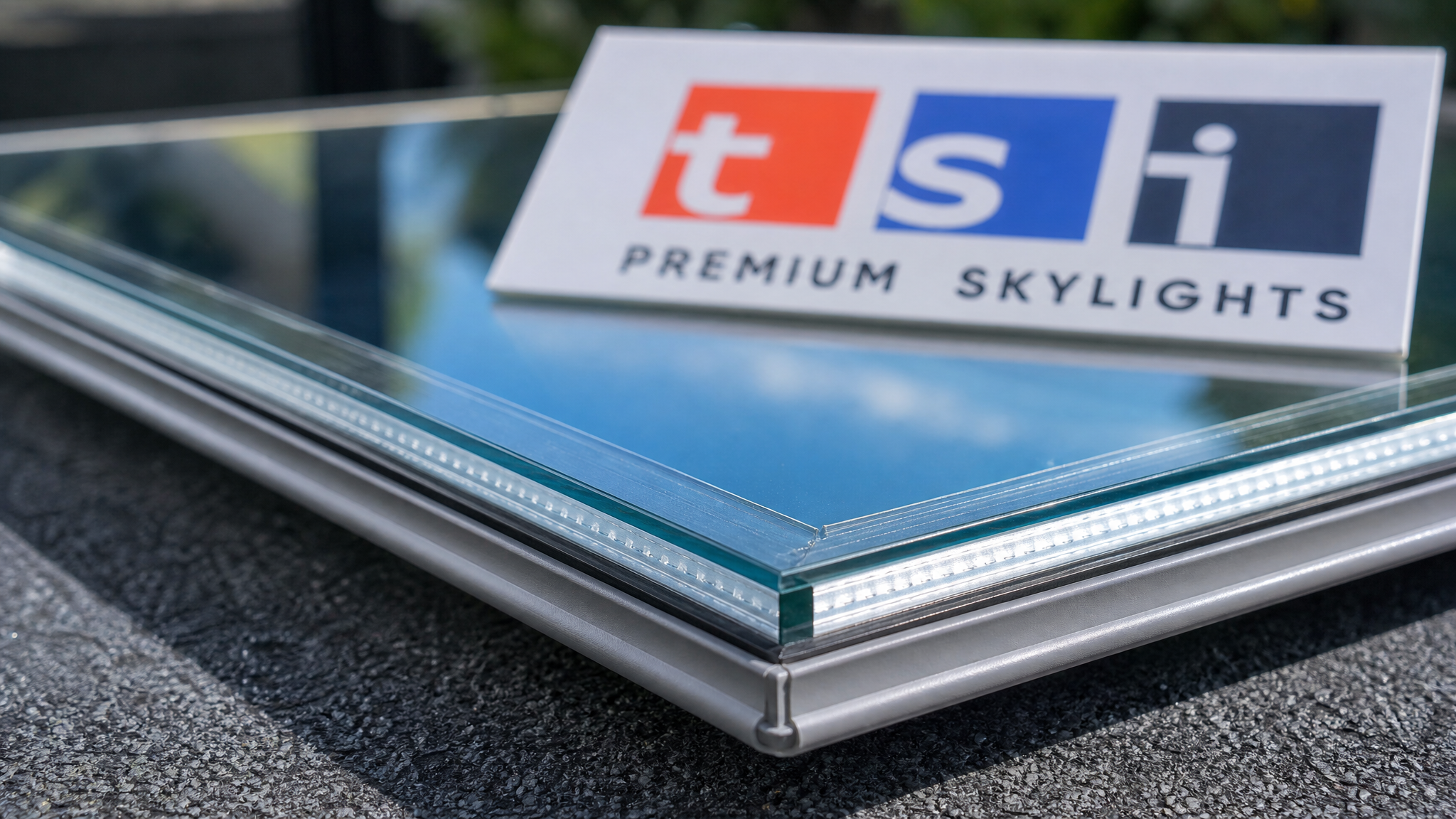
Modern spectrally selective soft-coat low-e coatings (sometimes marketed under brand names like Solarban, ClimaGuard Solar, or Velux’s own proprietary laminate) push the SHGC as low as 0.18 while keeping VT above 0.40. When paired with argon or krypton gas fill between panes, they also improve the centre-of-glass U-value — meaning the same unit that manages summer heat gain also reduces winter heat loss, making it a genuinely year-round performance upgrade rather than a trade-off.
Argon and Krypton Gas Fill: Worth the Upgrade for South-Facing Skylights?
Gas fills replace the air between the panes in an IGU with a denser, less thermally conductive gas. Argon is the most common and cost-effective upgrade; krypton is more thermally efficient but significantly more expensive and typically reserved for triple-pane units where the narrower cavity spacing benefits from its superior conductivity ratio.
For south-facing skylights in Toronto, the primary performance driver is the glass coating specification — the SHGC — rather than the gas fill. However, argon fill does contribute to a better overall U-value, which reduces heat loss on winter nights and reduces condensation risk on the inner glass surface in early spring and late autumn. The incremental cost of argon over air is modest — typically $25 to $60 per unit — and virtually every reputable skylight manufacturer includes it as a standard feature in their mid-range and premium product lines.
Krypton fill becomes worthwhile specifically in triple-pane configurations where the two gas cavities are narrower than 10 mm. In Toronto’s climate, a spectrally selective low-e triple-pane skylight with krypton fill can achieve a centre-of-glass U-value below 0.60 W/m²·K (roughly equivalent to U-0.10 in imperial units), which is exceptional insulating performance for an overhead glazed opening. If you are investing in a high-end south-facing skylight for a main living area in Oakville, Burlington, or Richmond Hill, the triple-pane krypton option is worth pricing out — the energy modelling typically shows a 7- to 12-year payback on the premium through combined heating and cooling savings.
Shade Solutions That Work With South-Facing Skylight Heat Gain Toronto Conditions
Even the best glass specification benefits from interior shading during peak summer hours. For south facing skylight heat gain Toronto management, the shade product you choose matters as much as the glazing beneath it — because a poorly designed shade can trap heat between itself and the glass, creating a hot pocket that radiates into the room and makes the comfort problem worse rather than better.
The three most effective shade categories for south-facing skylights in the GTA are cellular (honeycomb) shades, room-darkening roller shades, and venetian-style blind systems. Each has different performance characteristics and aesthetic applications.
Cellular shades work by trapping a layer of air between the shade fabric and the glass surface, creating an insulating buffer. For south-facing applications, this is valuable because it reduces the radiant heat that reaches the room even when the shade is in the raised position. Top-down cellular shades for skylights are specifically designed with channels that allow warm air to escape at the skylight frame rather than re-circulating into the room. Our light filtering skylight shades in cellular configurations filter UV radiation while preserving soft, diffused daylight — the ideal solution for south-facing skylights in living rooms, dining areas, and home offices where you want natural light without glare or heat.
Room-darkening shades are the right choice for south-facing skylights in bedrooms, home theatres, or any space where complete light and heat control is needed during peak hours. Our room darkening skylight shades use a multi-layer blackout fabric with heat-reflective backing that deflects solar radiation back through the glass before it can enter the room. In independent testing, quality room-darkening skylight shades reduce solar heat gain through the combined glazing-and-shade assembly by an additional 55 to 75 percent compared to the glass alone — a significant cooling-load reduction in Toronto’s summer climate.
Venetian-style skylight blinds offer the greatest degree of adjustability. By tilting the aluminium or fabric slats, you can modulate the angle of incoming light — blocking direct beam radiation while still allowing diffuse daylight — and then fully raise the blind to maximise light transmission on overcast days. Our venetian shades for skylights are available in motorised versions compatible with smart-home systems, allowing you to programme automatic adjustment based on time of day or temperature sensor input. For south-facing skylights in Toronto where the solar angle changes significantly between June and September, motorised venetian blinds that auto-adjust to track the sun’s position represent the most sophisticated heat management solution available in 2026.
| Shade Type | Estimated Heat Reduction vs. Unshaded Glass | Daylight Maintained | Best Room Application | Price Range (Installed, per Skylight) |
|---|---|---|---|---|
| Light filtering cellular | 30–45% | Diffuse, soft | Living rooms, kitchens, offices | $280–$480 |
| Room-darkening roller | 55–70% | Minimal to none | Bedrooms, home theatres | $320–$540 |
| Aluminium venetian (manual) | 40–60% (adjustable) | Adjustable beam/diffuse | Kitchens, dining, living rooms | $350–$580 |
| Fabric venetian (motorised) | 45–65% (adjustable) | Adjustable | Open-plan spaces, smart homes | $680–$1,100 |
| Room-darkening (motorised) | 65–75% | None when closed | Bedrooms, nurseries | $720–$1,200 |
Ventilating vs. Fixed Skylights for South-Facing Heat Management
One of the most effective — and underutilised — strategies for managing south facing skylight heat gain Toronto homes accumulate is ventilation. A fixed skylight, no matter how well-specified its glass coating, can only manage heat passively through the glazing itself. A venting skylight, by contrast, allows the hot air that naturally rises to the ceiling level to escape through the opening, pulling cooler air in from lower windows and doors in a process called the stack effect.
On a typical Toronto summer afternoon, the air near a south-facing ceiling may be 4 to 8 degrees warmer than the air at head height. Opening a venting skylight — even just 5 to 10 centimetres — can exhaust that hot-layer air in minutes. When combined with an open window on the shaded north or east side of the house, this creates a reliable passive cooling circuit that reduces air-conditioning demand during the 20 to 30 days per year when temperatures are warm but not extreme enough to justify running central AC at full capacity.
Our solar-powered fresh air skylights are particularly well-suited to south-facing applications because the photovoltaic cell that powers the motor is energised precisely when the sun is strongest — the same conditions when ventilation is most needed. The motorised sash opens and closes automatically via a rain sensor that also triggers closure if a summer shower arrives, and the system operates entirely off-grid, with no electrical wiring required through the roof structure. For homeowners in Mississauga, Vaughan, and Brampton looking to manage south facing skylight heat gain Toronto summers create without increasing their electrical load, solar-powered venting skylights are the most elegant solution available.
If you prefer a hard-wired solution with more precise control — including smart-home integration and programmable schedules — our electric fresh air skylights offer the same ventilation benefits with an expanded feature set. Both venting categories are available in the low-e, spectrally selective glazing packages discussed above, so you are not trading heat-gain performance for ventilation capability.
For spaces where a full venting skylight is not feasible — perhaps because of a complex roof structure, a tight rafter bay, or budget constraints — sun tunnel skylights provide a complementary light-delivery solution for adjacent areas without adding to the south-facing heat gain challenge. Sun tunnels terminate in a diffuser that scatters light evenly across a room with minimal solar heat contribution, making them an excellent pairing strategy: a venting skylight with full glazing in the main south-facing position, and sun tunnels distributing light into adjoining hallways or north-facing rooms.
Installation Considerations for South-Facing Skylights on Toronto Roofs
South-facing skylights are installed on both sloped (pitched) and flat roof systems across the GTA, and the installation requirements differ meaningfully between the two.
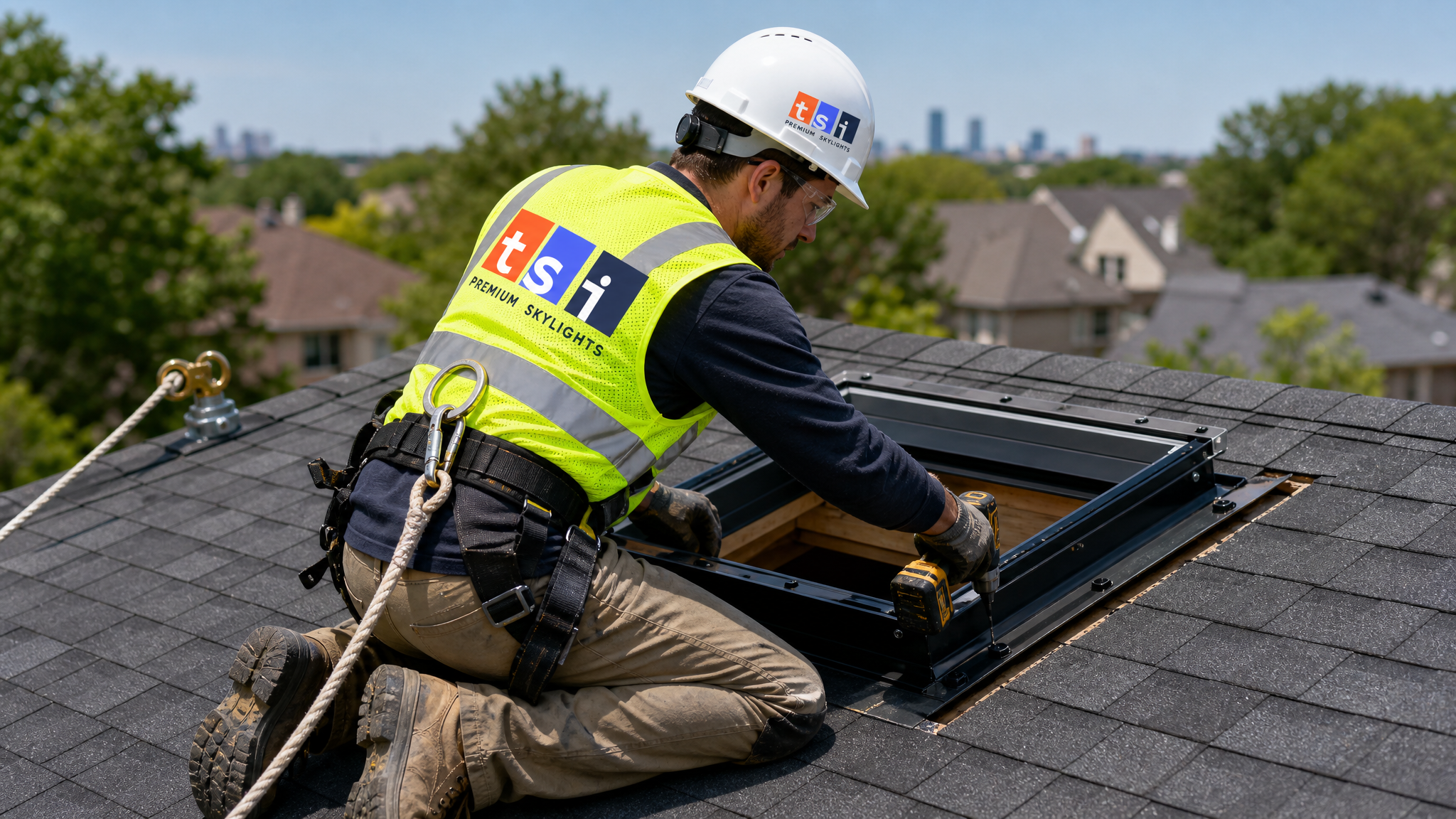
On a pitched roof — the most common configuration in Toronto’s residential neighbourhoods from Leslieville to Etobicoke — a south-facing skylight installation requires precise flashing integration with the existing shingle or tile system. The uphill (north) side of the skylight is the highest-risk zone for water infiltration, because any water that runs down the roof surface must be diverted around the frame. A properly installed step-flashing and counter-flashing assembly with a saddle (cricket) behind the skylight — mandatory for units wider than 750 mm under Ontario Building Code — creates a positive-drainage path around the frame. We examine the roofing substrate condition, the existing shingle life expectancy, and the structural rafter spacing before finalising any new skylight installation on a pitched surface.
On a flat or low-slope roof — very common in Toronto’s mid-century bungalows and modern additions in Oakville and Burlington — south-facing skylights are typically installed using a curb-mount system with a raised frame (minimum 150 mm above the membrane surface) to prevent ponding water from entering the frame. Our flat roof skylights are engineered specifically for low-slope applications, with integrated curb systems and EPDM or TPO-compatible flashing details that work with the membranes most commonly found on GTA flat roofs.
In both cases, the structural opening must be properly headed and trimmed to transfer roof loads around the new aperture. For spans wider than one rafter bay, we install doubled or LVL headers to carry the load, and we obtain the required building permit from the City of Toronto or the relevant municipal authority before breaking any sheathing. Permit timelines in the GTA range from 3 to 10 business days for residential skylight installations, which is an important planning consideration if you are targeting a specific date for the summer window.
Cost and Payback Analysis for South-Facing Skylight Upgrades in Toronto
One of the most common questions we receive from homeowners across the GTA is whether specifying a higher-performance glazing package for a south-facing skylight is worth the premium over a basic unit. The answer depends on the room, the existing HVAC load, and the planned service life of the installation — but the general payback analysis is encouraging.
A standard south-facing skylight with clear double-pane glass (SHGC 0.76) in a 12 m² living room in Toronto can add an estimated 450 to 600 kWh of cooling load per summer to the air-conditioning system, depending on the unit’s size and the shading from adjacent roof overhangs. At Ontario’s blended residential electricity rate of approximately $0.165 per kWh, that represents $74 to $99 in additional summer cooling costs annually — and the number grows as Toronto summers continue to warm.
Upgrading to a spectrally selective low-e double-pane unit (SHGC 0.27) reduces that solar contribution by approximately 65 percent, saving $48 to $64 per year in cooling costs. The glazing premium for a standard residential skylight (roughly 550 × 780 mm) is $150 to $220 over a basic unit, yielding a payback period of 3 to 4.5 years on cooling savings alone — before accounting for the UV protection value to furnishings and the winter heating-loss reduction.
Adding motorised room-darkening shades to the upgraded glazing increases the upfront cost by $700 to $1,200 but adds a further 65 to 75 percent reduction in peak-hour solar gain, with the potential to reduce total summer cooling load by 85 to 90 percent compared to an unshaded clear-glass skylight. The combined payback stretches to 10 to 15 years on energy savings alone, but the comfort, UV protection, sleep quality (for bedroom applications), and home-value benefits consistently lead clients to rate the investment as justified.
For skylight replacement projects — where a homeowner is upgrading an older unit that has lost its gas fill or developed seal failure — the calculation is even more favourable because the structural opening already exists and the installation cost is lower. We frequently see 15- to 20-year-old skylights in Toronto homes with degraded glazing where the replacement pays back in 5 to 7 years on the combined energy savings and comfort improvement.
| Scenario | Glazing Spec | Shading | Estimated Summer Cooling Saving (Annual) | Upfront Premium | Simple Payback |
|---|---|---|---|---|---|
| Base case upgrade (new build) | Spectrally selective low-e DP | None | $48–$64 | $170 | 3–4 years |
| Upgrade + light filtering shade | Spectrally selective low-e DP | Cellular light filtering | $72–$95 | $450 | 5–6 years |
| Full performance package | Spectrally selective low-e TP | Motorised room-darkening | $88–$115 | $1,380 | 12–15 years |
| Replacement (existing opening) | Spectrally selective low-e DP | Venetian manual | $78–$100 | $680 | 7–9 years |
| Solar venting + spectrally selective | Spectrally selective low-e DP | Passive ventilation | $95–$130 | $920 | 7–10 years |
Summer 2026 Promotions and Installation Windows
June and July represent the peak installation season for south-facing skylight projects in Toronto, and with good reason: contractors can work safely in dry conditions, roofing membranes and adhesives cure reliably at summer temperatures, and homeowners are most motivated by the immediate comfort benefit of managing south facing skylight heat gain Toronto summers deliver. Our installation teams are currently booking into late July for new installations and mid-July for replacement projects, so if you are considering a south-facing skylight upgrade for your home in the GTA this season, now is the time to get on the schedule.
Toronto Skylight Installers is an authorised installer and warranty partner for Velux, the market-leading skylight manufacturer in North America. All new Velux units installed by our team carry a 10-year manufacturer’s warranty on the product and our own 5-year workmanship warranty on the installation — a combination that ensures your investment is protected through the initial years of operation when any defect in glass, seal, or flashing would most likely manifest. We are also familiar with the Canada Greener Homes Grant requirements and can assist clients in assembling the documentation needed to claim incentives on qualifying high-efficiency glazing upgrades. Contact our office for current programme details, as grant availability changes and we track updates from Natural Resources Canada on a monthly basis.
What is the best SHGC rating to manage south facing skylight heat gain Toronto summers produce?
How much hotter does a south-facing skylight make a room compared to a north-facing one?
Are solar-powered venting skylights effective for reducing south facing skylight heat gain Toronto homes experience?
What type of skylight shade works best on a south-facing skylight in a Toronto bedroom?
Does a south-facing skylight require a building permit in Toronto in 2026?
How do I know if my existing south-facing skylight is causing excess heat gain and should be replaced?
Schedule Your South Facing Skylight Consultation Today
Getting south facing skylight heat gain Toronto homes right is a matter of the correct glass specification, the right shading accessory, and precise installation by a team that understands Ontario’s climate and building code. Toronto Skylight Installers brings all three together — we source the highest-performing glazing units available in 2026, stock the full range of cellular, room-darkening, and venetian shade accessories, and our installation teams hold Velux Master Installer certification with extensive experience on both pitched and flat roofs across the Greater Toronto Area.
Call us today at (416) 365-7557 or request a free consultation to get started.
Toronto Skylight Installers proudly serves Toronto, Mississauga, Markham, Vaughan, Brampton, and Oakville.