

Installing two skylights over a kitchen island Toronto homeowners are embracing is one of the most transformative upgrades you can make to your home in 2026. A kitchen island is already the social and functional centrepiece of your cooking space — but without adequate overhead natural light, even the most beautifully designed island can feel dim and uninspiring during food preparation, entertaining, and family gatherings. This comprehensive guide walks you through every consideration: layout and spacing, skylight sizing, product selection, solar heat gain management for Toronto summers, structural requirements, and what to expect from professional installation. Whether you are in Toronto, Mississauga, Markham, Vaughan, Oakville, or Burlington, our team at Toronto Skylight Installers delivers expert results that homeowners talk about for years.
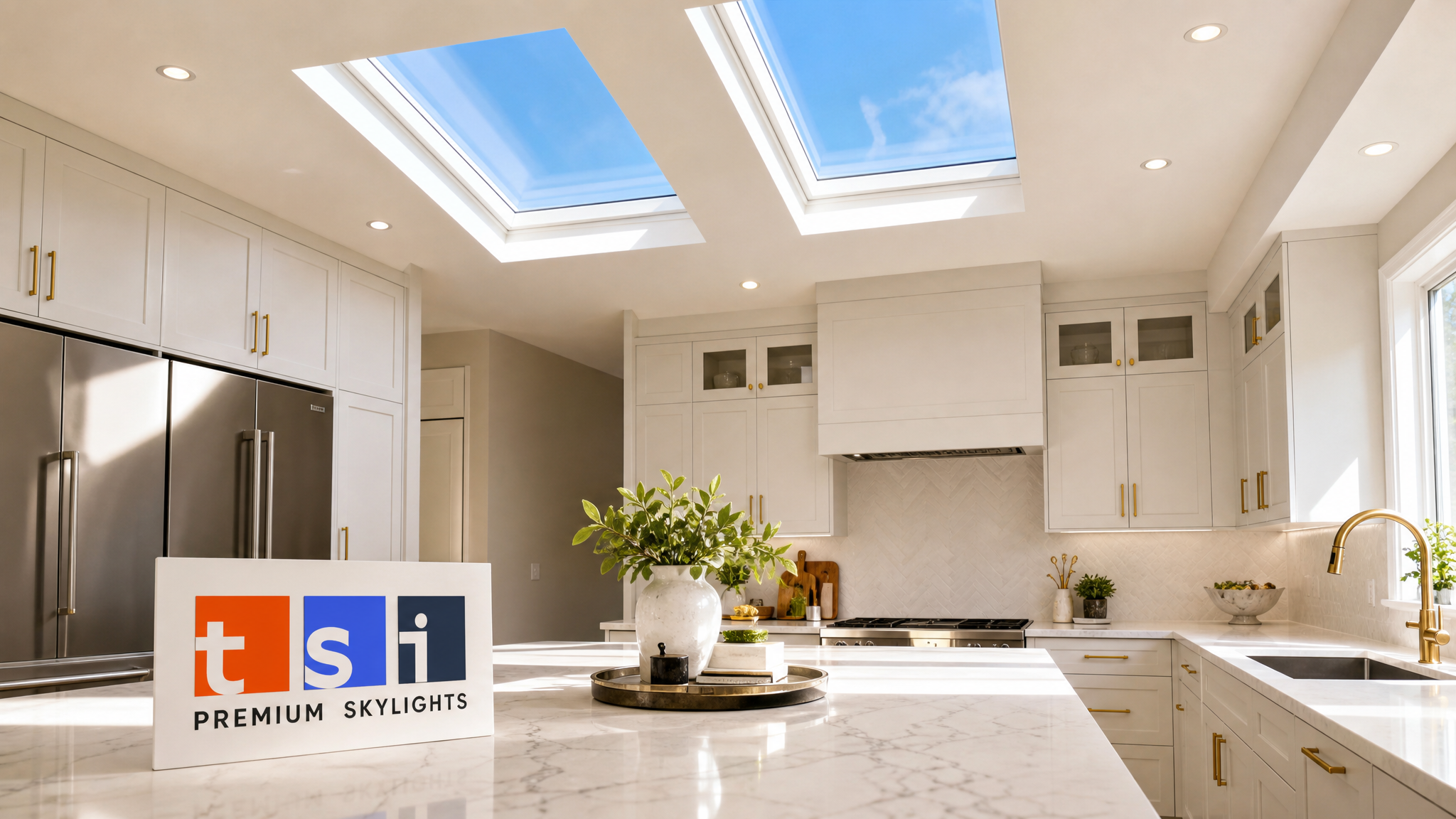
The demand for two skylights kitchen island Toronto projects has grown significantly through 2025 and into 2026. GTA homeowners are spending more time cooking at home, hosting in their kitchens, and looking for ways to reduce artificial lighting costs while improving the quality of their living environments. A single skylight above a long island often creates uneven light — one end bright, the other shadowed. Two skylights positioned symmetrically above the island eliminate that problem entirely, flooding the full prep surface with balanced, even daylight that shifts beautifully through the long summer hours of June and July.
Why Two Skylights Over a Kitchen Island Toronto Homes Benefit Most
A single overhead skylight placed at the midpoint of your island might seem sufficient on paper, but in practice the light coverage depends heavily on your ceiling height, island length, and the shaft angle used to bring light from the roof plane down to the living space. For islands longer than 1.5 metres — which is the case for most modern open-concept GTA kitchens — a single unit leaves the ends of the island noticeably darker than the centre.
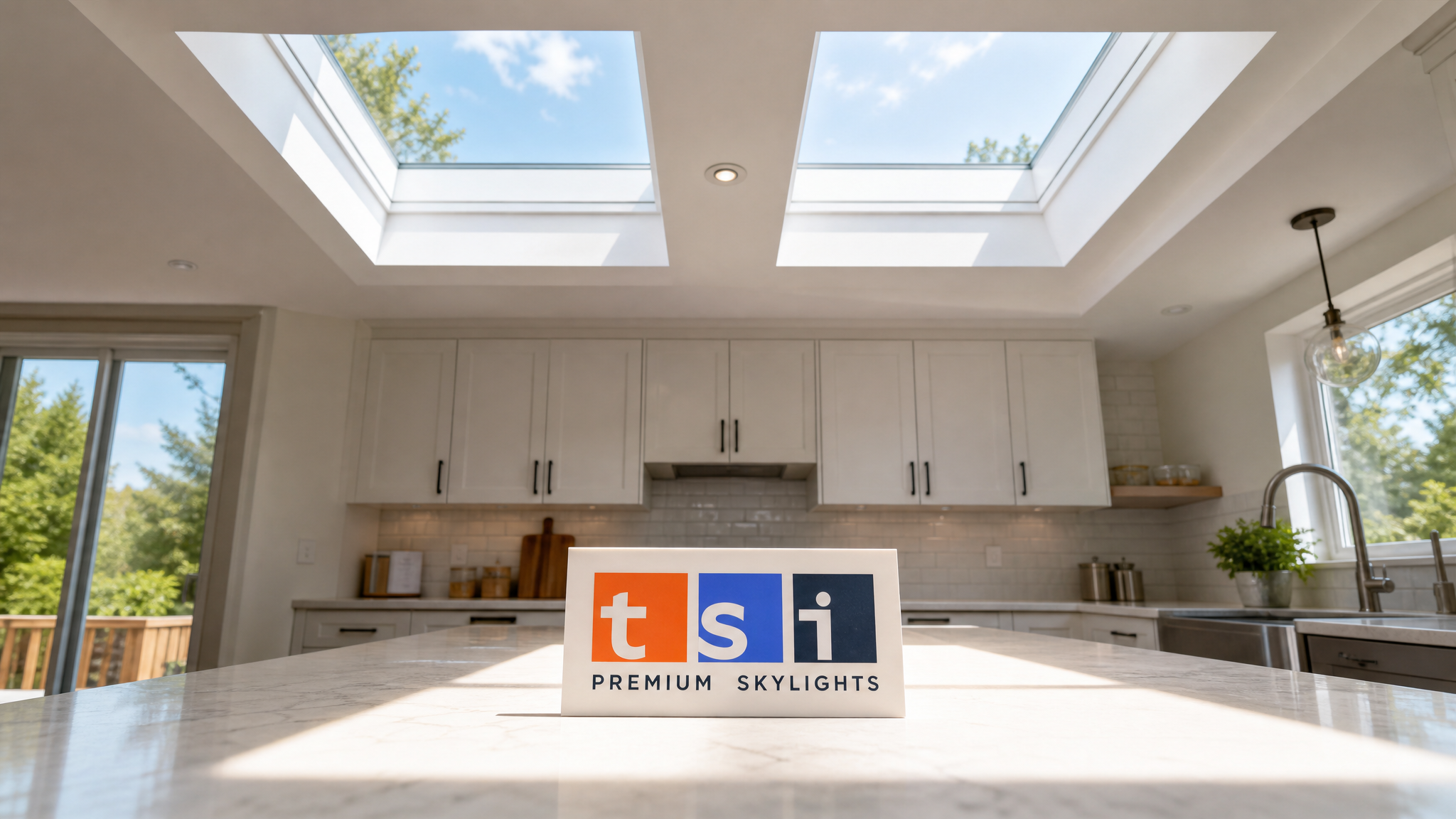
Choosing two skylights for your kitchen island Toronto project addresses that imbalance directly. When two units are spaced one-third of the island length in from each end, the overlapping light cones meet at the centre and create genuinely even illumination across the entire prep surface. Chefs and home cooks notice the difference immediately — colour rendering of food improves, shadows from your own body no longer block your working area, and the kitchen feels larger and more inviting. For entertaining, two skylights create a natural spotlight effect that elevates every dinner party.
There is also a practical energy argument. In summer, maximising daylight hours means fewer hours of overhead LED fixtures running on full brightness. Toronto sees approximately 15 hours of daylight around the June solstice, and a well-positioned pair of VELUX skylights can eliminate the need for task lighting over the island from sunrise through late afternoon. The annual energy savings are consistent, and the comfort gain from cooking under natural light rather than artificial task lighting is immediate and lasting.
| Skylight Configuration | Island Coverage | Light Evenness | Best For |
|---|---|---|---|
| Single skylight, centred | 60–70% of island length | Bright centre, dim ends | Islands under 1.2 m |
| Two skylights, symmetrically spaced | 95–100% of island length | Even across full surface | Islands 1.5 m and longer |
| Three skylights in a row | 100%+ | Exceptionally bright | Very long islands or galley kitchens |
| Two skylights, offset (different roof plane) | 70–85% | Moderate, directional | Split-level or complex roof geometry |
| Sun tunnel pair | 50–65% | Moderate, diffused | Deep ceiling shafts, budget installs |
Choosing the Right Skylight Type for Your Kitchen Island
Not every skylight product is equally suited to a kitchen environment. Kitchens generate steam, grease vapour, and temperature differentials that affect both the product choice and the installation method. When planning two skylights over a kitchen island in Toronto, you have three main product categories to consider: fixed skylights, solar-powered fresh air skylights, and electric fresh air skylights.
Fixed skylights are the most common choice for kitchen island installations. They admit maximum light with no moving parts, reducing long-term maintenance concerns. Fixed units are sealed permanently and are not intended to open for ventilation, which makes them simpler to install and generally more affordable. For kitchens with excellent range hood ventilation, a pair of fixed skylights above the island is often the ideal solution — all the light, none of the complexity.
Many Toronto homeowners upgrading their kitchens in 2026 are choosing solar-powered fresh air skylights or electric fresh air skylights for at least one of the two units above the island. An openable unit positioned above an island gives you the option to flush summer cooking odours directly out through the roof — a meaningful quality-of-life upgrade. The second unit can remain fixed, giving you the blend of simplicity and functionality that suits most kitchen environments.
Glazing matters enormously for a summer kitchen installation. Standard double-pane Low-E glass cuts the majority of ultraviolet radiation while admitting visible light. VELUX’s LoE3 glazing goes further, reducing solar heat gain by approximately 60% compared to clear glass — a critical consideration for south- or west-facing kitchen skylights in a Toronto June, when afternoon sun intensity peaks. Without appropriate glazing, two skylights over a kitchen island Toronto installations can create uncomfortable heat buildup in an already warm cooking environment.
| Skylight Product | Opens for Ventilation | Solar Heat Gain Coefficient | Best Use in Kitchen |
|---|---|---|---|
| VELUX Fixed (FCM) | No | 0.26–0.30 (LoE3 glass) | Primary light source, budget-friendly pair |
| VELUX Solar Fresh Air (VSS) | Yes — solar powered | 0.26 (LoE3 glass) | One of the pair for passive ventilation |
| VELUX Electric Fresh Air (VCS) | Yes — electric motor | 0.26 (LoE3 glass) | Premium option, integrates with smart home |
| VELUX Sun Tunnel (TGR/TGX) | No | N/A (diffused light) | Supplemental light in tight shaft situations |
| Generic curb-mount fixed | No | 0.35–0.55 (basic glass) | Budget alternative, limited warranty |
Sizing and Spacing Two Skylights Above a Kitchen Island in Toronto
Getting the sizing and spacing right is the most technically demanding part of any two skylights kitchen island Toronto project. The general rule used by experienced installers is that each skylight’s visible opening should equal approximately 5–10% of the floor area it is serving. For a kitchen island that occupies a 1-metre by 2.5-metre footprint, each of the two skylights should have a glazed area of roughly 0.13 to 0.25 square metres — which corresponds to a VELUX unit in the 460 × 610 mm to 780 × 980 mm size range.
Spacing is determined by three factors: the island length, the ceiling height, and the shaft angle. For a ceiling height of 2.4 metres (standard in most GTA homes), a light cone from a standard fixed skylight spreads approximately 0.8 to 1.0 metres by the time it reaches the island surface. Two skylights placed 80 cm in from each end of a 2.4-metre island will produce overlapping light cones that meet near the centre — resulting in truly even illumination. On higher ceilings of 2.7 or 3.0 metres, the cones spread further and the skylights can be positioned slightly closer to the ends.
The shaft — the framed tunnel that channels light from the roof opening down through the insulation layer and ceiling — has a major effect on light quality and spread. A straight shaft preserves the sharpest patch of light and the highest overall brightness. An angled shaft can direct light toward a specific part of the island, useful when structural constraints prevent positioning the roof opening directly above the island. Splayed shafts — widened at the ceiling opening — spread light more broadly and reduce the harsh bright-spot effect that straight shafts can create. For most two skylights kitchen island Toronto installations, our team recommends straight or lightly splayed shafts for maximum brightness.
Structural and Roof Considerations for Toronto Homes
Before any two skylights kitchen island Toronto installation can proceed, a structural assessment of both the roof framing and the ceiling assembly is required. Most GTA homes built after 1980 use engineered roof trusses, and cutting through a truss chord without proper engineering support creates serious structural risk. When the two skylight positions fall between existing rafters or trusses, the installation is straightforward. When they fall on a structural member, a header must be engineered and installed to redirect the load — adding cost but not complexity for an experienced team.
Insulation depth matters too. Toronto’s Ontario Building Code requires R-50 or better in attic assemblies in new construction, and most well-maintained GTA homes have between R-40 and R-60 of blown or batted insulation above the kitchen ceiling. The shaft must be framed through this insulation layer and insulated on all four sides to prevent condensation — a critical detail in Toronto’s winters. A poorly insulated shaft will produce condensation on the skylight glass and frame throughout the cold months, potentially causing water damage to the ceiling and cabinetry below.
Roof pitch affects product selection and flashing method. VELUX fixed and fresh air skylights are rated for installation on pitches from 15° to 75°. Flat or very low-slope kitchen extensions — common in Toronto’s postwar bungalows with rear kitchen additions — require a different product line and installation method. For these situations, a curb-mount installation with a higher-profile flashing system is standard, and our skylight installation team carries the full range of VELUX flashing kits to handle every roof geometry in the GTA.
Summer heat gain is the top concern for south- and west-facing kitchens in the GTA. Our new skylight installation consultants always evaluate roof orientation before recommending a product. South-facing installations benefit most from LoE3 glazing and optional room darkening shades or light filtering shades that can be deployed during the hottest afternoon hours without fully blocking the view of the sky. North-facing kitchens receive steady indirect light with minimal heat gain and require little to no shade management.
The Installation Process: What to Expect
A professional two skylights kitchen island Toronto installation typically spans one to two days for a standard GTA home with accessible attic space and a straightforward roof structure. The sequence our team follows ensures minimal disruption to your kitchen and a clean, professional result.
Interior work begins first: ceiling penetrations are marked based on the design layout, framing locations confirmed with a stud finder and inspection camera, and ceiling openings carefully cut. Headers are installed if required. The shaft framing is built up from the ceiling to the roof deck using dimensional lumber, then insulated and vapour-sealed on all four sides.
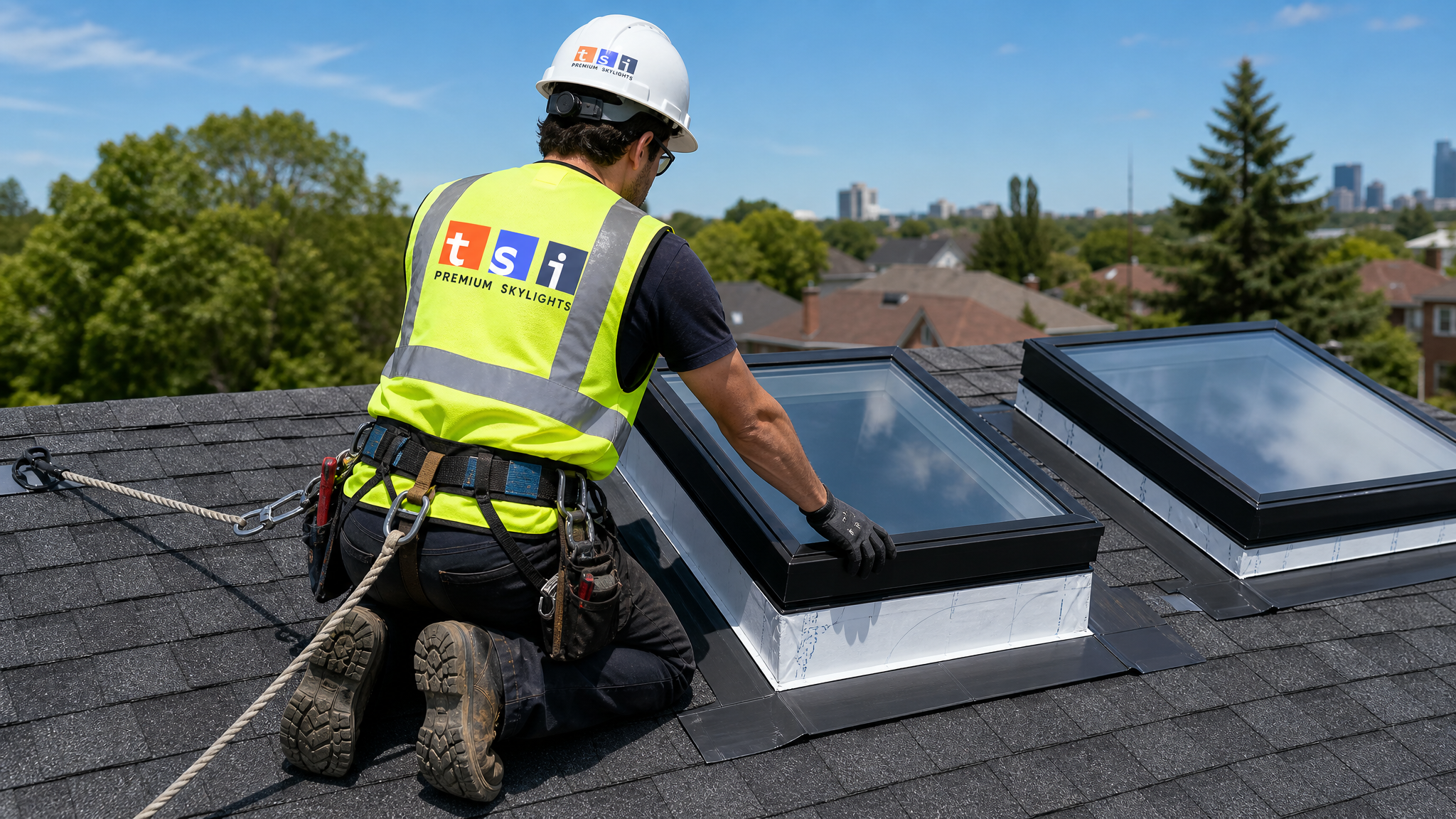
Roof work follows: shingles are carefully removed around each penetration location and set aside for reinstallation. Roof deck openings are cut sized precisely to the VELUX frame dimensions. VELUX’s self-flashing system is installed in layers following the manufacturer sequence — base flashing, step flashing integrated with existing shingles, and the sill and head flashing pans. The glazing units are then installed in the frames, seals verified, and motorised components wired if selected.
Interior shaft finishing — drywall, taping, and priming — completes the job. Shade hardware is installed if the homeowner has selected shades. A final inspection confirms both units operate correctly and all seals are complete. Throughout the process we protect your kitchen countertops, cabinetry, and flooring with drop cloths and temporary covers, and clean the work area completely before leaving.
Cost, Timeline, and Return on Investment
The investment for a professionally executed two skylights kitchen island Toronto project in 2026 depends on product selection, roof complexity, and shaft length. The table below provides representative ranges for GTA homeowners based on recent project data across Toronto, Mississauga, Markham, Vaughan, Oakville, and Burlington.
| Project Scope | Product Pair | Estimated Cost (CAD) | Installation Time |
|---|---|---|---|
| Two fixed skylights, standard shaft | 2× VELUX FCM 460×610 | $3,800 – $5,200 | 1 day |
| Two fixed skylights, larger size + shades | 2× VELUX FCM 780×980 + light filter shades | $5,500 – $7,500 | 1–2 days |
| One fixed + one solar fresh air | VELUX FCM + VSS, matched size | $6,200 – $8,400 | 2 days |
| Two electric fresh air skylights | 2× VELUX VCS with rain sensors | $8,500 – $12,000 | 2 days |
| Complex roof (truss header required) | Any pair + engineering | Add $800 – $2,000 | Add 1 day |
Return on investment for two skylights over a kitchen island Toronto properties comes from multiple directions. Appraisers in the GTA consistently note that skylight installations in kitchens and primary living areas increase assessed home value. A professional installation by Toronto Skylight Installers using VELUX products — which carry a 10-year product warranty and 20-year No-Leak guarantee — adds a durable, documentable improvement that buyers recognise. Energy savings from reduced artificial lighting are consistent, and the comfort gain from cooking under natural light rather than artificial task lighting is immediate and lasting.
For homeowners who have existing skylights that are more than 15–20 years old, a skylight replacement at the same time as a new island installation can be a smart opportunity to standardise the kitchen overhead to a single product generation — matching frames, matching glass tint, and matching operation across all units.
How many skylights do I need over a kitchen island in Toronto?
Will two kitchen island skylights make my Toronto home too hot in summer?
How far apart should two skylights be positioned above a kitchen island?
Do I need a permit for two skylights over a kitchen island in Toronto?
Should I choose fixed or openable skylights for a kitchen island?
How long does it take to install two skylights over a kitchen island in Toronto?
Schedule Your Two Skylights Kitchen Island Toronto Consultation Today
There is no better time to invest in two skylights over your kitchen island than the long, bright days of a Toronto summer. With 15 hours of daylight available in June and July, you will feel the difference immediately — a kitchen that was once dependent on overhead LEDs becomes a naturally lit, comfortable, genuinely enjoyable space for cooking, hosting, and everyday family life. Toronto Skylight Installers has completed hundreds of skylight projects across Toronto, Mississauga, Markham, Vaughan, Oakville, and Burlington, and our team brings the product knowledge, structural expertise, and installation craftsmanship to make your kitchen transformation seamless from the first consultation to the final cleanup.
Call us today at (416) 365-7557 or request a free consultation to get started. We will visit your home, evaluate your island layout and roof geometry, recommend the ideal pair of skylights and shading products for your orientation and budget, and provide a detailed written quote with no obligation. Our installations are backed by VELUX’s No-Leak warranty and our own workmanship guarantee.
Toronto Skylight Installers proudly serves Toronto, Mississauga, Markham, Vaughan, Oakville, Burlington, and surrounding GTA communities.