

The question of velux sun tunnel vs skylight low slope roof compatibility comes up constantly for Toronto homeowners — and understandably so. Low-slope roofs are common across the GTA, from Mississauga bungalows to Vaughan mid-century ranches, and both VELUX sun tunnels and traditional skylights can work beautifully on them. But they are not interchangeable products. Choosing the wrong one for your roof geometry, room type, and summer daylighting goals can mean years of frustration instead of years of glowing, natural light. This guide breaks down everything you need to know in 2026, including structural requirements, cost comparisons, summer performance, and the specific VELUX product lines that are rated for low-slope installations.
Summer is the best season to address daylighting upgrades. Toronto’s long June days deliver up to 15 hours of usable sunlight, making this the optimal window for installation — flashing cures faster, sealants bond properly in warm temperatures, and you can immediately enjoy the results through the summer months. Whether you are weighing the velux sun tunnel vs skylight low slope roof decision for a kitchen addition, a dark hallway, or a converted flat-roof extension, understanding the fundamentals before calling a contractor will save you time and money.
At Toronto Skylight Installers, we handle both product categories across the full GTA, and we see both options installed well — and poorly — every season. This article draws on that hands-on experience to give you a clear, unbiased comparison so you can make the right call for your specific home.
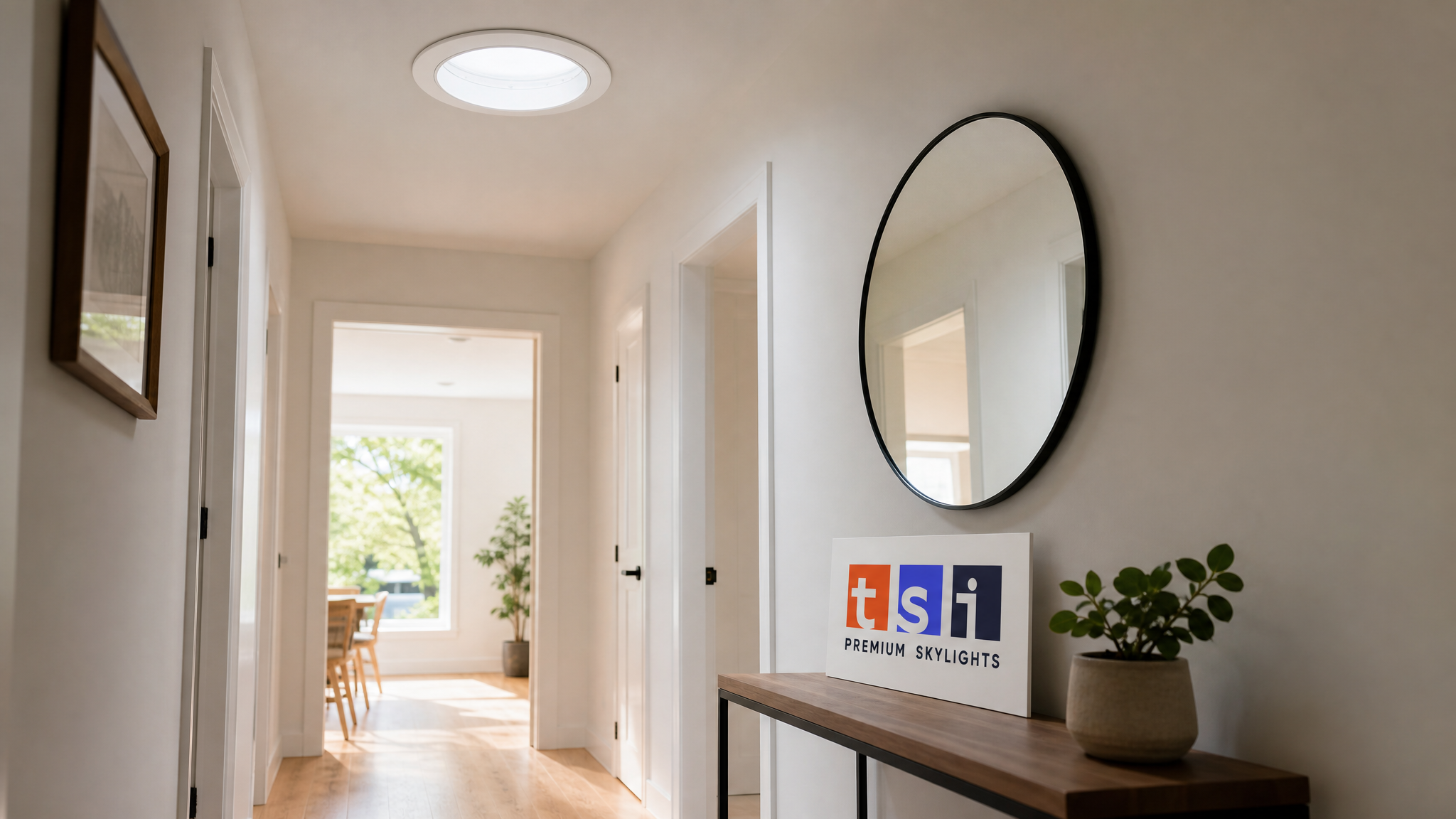
Understanding the velux sun tunnel vs skylight low slope roof Distinction
Before diving into product specifics, it helps to be precise about terminology. A sun tunnel (also called a tubular daylighting device or TDD) is a small-diameter reflective tube — typically 10 inches or 14 inches — that runs from a dome on the roof surface down through attic space and ceiling joists, terminating in a diffuser lens on your ceiling. A skylight is a glazed opening in the roof structure itself: a full pane of glass or acrylic that sits directly above the room, with no tube in between.
On a low-slope roof — generally defined as a pitch between 0° and 15° (or roughly a 0/12 to 3/12 slope) — both products are viable, but each has design requirements that differ from steep-slope applications. VELUX specifically rates its sun tunnel line (the TCR and TGR series) for roofs as low as 0° pitch. Their traditional skylight line, by contrast, requires a minimum pitch of 15° for most models — meaning a true flat or near-flat roof needs either a special curb mount kit or a sun tunnel instead.
This distinction is the core of the velux sun tunnel vs skylight low slope roof debate. A home with a genuine flat roof (0° pitch) has fewer skylight options than one with a gentle 3/12 pitch. Understanding where your roof falls on that spectrum — and what flashing kit or curb mount is needed — shapes every subsequent decision about product, cost, and installation timeline.
VELUX Product Lines Approved for Low-Slope Roofs
VELUX produces several product families, and not all of them are rated for low-slope applications. Here is a breakdown of the relevant lines for Toronto homeowners dealing with flat or gently pitched roofs.
Sun Tunnels (TCR / TGR / TWF series): The TCR (rigid tube) and TGR (flexible tube) lines are rated for pitches from 0° to 60°, making them the go-to solution for true flat roofs. The dome sits proud of the roof surface with a built-in water diverter system. The TWF series is specifically designed for flat roofs and uses a raised curb and dome assembly that handles Toronto’s summer rain events without leaking.
Fixed Skylights (FS series): Standard FS models require a minimum 15° pitch. However, VELUX offers a flat-roof accessory kit that allows FS units to be installed on roofs with 0° to 15° pitch using a pre-formed curb. This is a popular option for flat-roof extensions where homeowners want the full visual impact of a fixed skylight rather than a tube.
Venting Skylights (VS / CVP / GGU / GPU series): These require the same flat-roof curb accessory for sub-15° pitches. The solar-powered venting options are particularly well-suited to summer use because they open automatically when interior temperatures rise — a genuine comfort upgrade for Toronto’s humid June and July periods. You can explore the solar-powered fresh air skylight line to see what is available in this category.
Flat Roof Skylights (CVP / CFP series): VELUX’s dedicated flat-roof skylight line, the CFP and CVP, are designed from the ground up for 0° to 15° pitches. They include an integrated curb, proprietary flashing, and a raised dome that sheds water even in heavy summer downpours. These are the premium option for anyone who wants a true skylight on a genuinely flat roof without adapting a pitched-roof product. See the full range on our flat roof skylights page.
| VELUX Product | Minimum Pitch | Maximum Pitch | Low-Slope Kit Required | Venting Option |
|---|---|---|---|---|
| TCR / TGR Sun Tunnel | 0° | 60° | No (built-in) | No |
| TWF Flat-Roof Sun Tunnel | 0° | 15° | No (purpose-built) | No |
| CFP / CVP Flat Roof Skylight | 0° | 15° | No (purpose-built) | Yes (CVP) |
| FS Fixed Skylight + Flat Kit | 0° (with kit) | 90° | Yes | No |
| VS / GGU Venting + Flat Kit | 0° (with kit) | 90° | Yes | Yes |
| GPU Solar Venting + Flat Kit | 0° (with kit) | 90° | Yes | Yes (solar) |
Light Output, Room Suitability, and Summer Performance
One of the most practical differences in the velux sun tunnel vs skylight low slope roof comparison is how each product performs in real rooms during Toronto’s bright summer months.
Sun tunnels deliver a concentrated beam of daylight from a relatively small ceiling aperture — the diffuser lens on a 14-inch tunnel covers about 150 to 200 square feet of usable light spread. The light quality is soft and diffused, similar to a north-facing window on a clear day. Sun tunnels are excellent for hallways, closets, bathrooms, stairwells, and any space where you need ambient daylight without glare or direct sun patches. They work brilliantly in spaces where a structural opening is impractical because the tube can angle around joists, ductwork, and insulation runs.
Skylights, by contrast, deliver a far larger light volume. A single 22-by-46-inch skylight unit (a common VELUX FS M06 size) can flood 300 to 400 square feet with bright, direct or diffused daylight depending on shading. Skylights also bring a visual connection to the sky — clouds, blue sky, treetops — that a sun tunnel cannot replicate. For living rooms, kitchens, master bedrooms, and open-plan spaces, this visual openness is often the deciding factor.
In summer, heat gain is a legitimate concern for both products on Toronto roofs. VELUX glazing comes in three glass options: clear (highest light, highest heat gain), lightly tinted, and their LoE³ 336 coating (which blocks over 60% of solar heat while passing most visible light). On a south-facing low-slope roof in June, the LoE³ coating is strongly recommended for any skylight unit to prevent your living space from overheating by midday. Sun tunnels, because of their smaller aperture and diffuser lens, naturally moderate heat gain — making them more forgiving on south-facing orientations.
If heat control is a concern but you still want a venting skylight, the electric fresh air skylight can be programmed to open during Toronto’s cool summer mornings and close before midday heat peaks — a smart approach for flat-roof rooms that are prone to heat accumulation.
Installation Complexity on Low-Slope Toronto Roofs
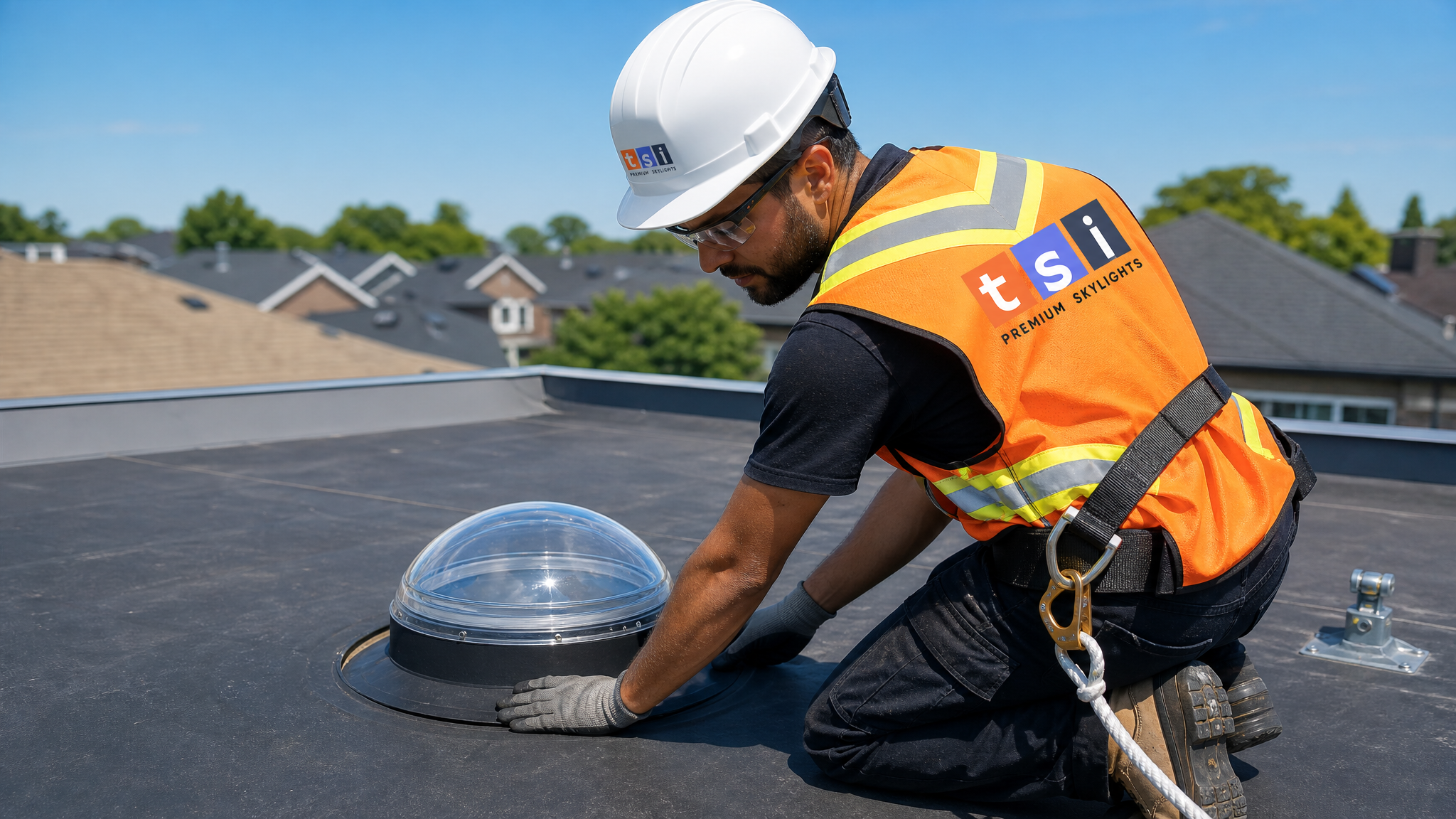
Installation difficulty is a major factor in the velux sun tunnel vs skylight low slope roof cost equation. Low-slope roofs introduce waterproofing challenges that steep-slope roofs avoid — water does not run off quickly, so any penetration must be sealed with multi-layer flashing systems that handle standing water and summer rain events.
Sun tunnel installation on a low-slope roof typically takes four to six hours for a single unit. The process involves cutting a small circular opening in the roof deck, installing the raised dome and self-flashing collar (which sits above the roofline to prevent water ingress), running the reflective tube through attic space, and fitting the ceiling diffuser. On roofs with EPDM rubber membrane or TPO membrane — common in Toronto’s flat-roof neighbourhoods — the installer integrates the flashing collar into the membrane using compatible adhesive and lap sealant. The small footprint of a sun tunnel makes this integration relatively straightforward compared to a full skylight opening.
Skylight installation on a low-slope roof is more involved. A full structural opening must be framed — doubled-up rafters or joists on each side, a proper header above, and sometimes a light shaft if attic space exists between the roof deck and the ceiling plane. The curb-mounted flat-roof flashing system (whether VELUX proprietary or a custom built-up curb) must then be integrated into the roofing membrane. On older Toronto homes with aged EPDM or built-up roofing (BUR), this is often the most delicate part of the job: disturbing existing membrane without triggering leaks in adjacent sections. A well-executed skylight installation on a flat roof typically takes one to two full days depending on framing complexity.
Key installation factors on GTA low-slope roofs:
- Membrane type (EPDM, TPO, modified bitumen, built-up tar-and-gravel) dictates flashing method
- Attic depth affects whether a light shaft is needed for a skylight
- Structural span between joists or rafters determines header sizing
- Roof age — membranes over 15 years old may need partial replacement in the work area
- Drain locations must be checked to ensure the new curb or dome does not block flow paths
Summer is the optimal season for this work in Toronto. Warm ambient temperatures (typically 20°C–30°C in June) allow EPDM adhesives and lap sealants to cure within hours rather than days. Flashing sealants that require 15°C minimum cure temperatures are difficult to apply reliably in shoulder-season months, making June through August the strongest installation window for flat-roof penetration work.
Cost Comparison: Sun Tunnel vs Skylight on a Low-Slope Roof in 2026
Cost is invariably a central consideration in the velux sun tunnel vs skylight low slope roof decision. The ranges below reflect typical GTA contractor pricing in 2026 for supply and installation on an existing low-slope roof. Custom framing, membrane replacement, or electrical work for motorised units will increase the total.
| Product / Scenario | Supply Cost (CAD) | Installation Labour | Total Typical Range | Installation Time |
|---|---|---|---|---|
| VELUX 10″ Sun Tunnel (TCR/TGR), existing low-slope roof | $450 – $650 | $400 – $600 | $850 – $1,250 | 4–6 hrs |
| VELUX 14″ Sun Tunnel (TCR/TGR), existing low-slope roof | $550 – $800 | $450 – $650 | $1,000 – $1,450 | 4–6 hrs |
| VELUX CFP Fixed Flat-Roof Skylight (medium, e.g. M04) | $900 – $1,400 | $800 – $1,200 | $1,700 – $2,600 | 1 day |
| VELUX CVP Venting Flat-Roof Skylight (medium) | $1,200 – $1,900 | $900 – $1,400 | $2,100 – $3,300 | 1–1.5 days |
| VELUX FS Fixed + Curb Kit, low-slope adapted | $800 – $1,300 | $900 – $1,400 | $1,700 – $2,700 | 1–1.5 days |
| VELUX GPU Solar Venting + Flat Curb, with shades | $1,800 – $2,800 | $1,000 – $1,600 | $2,800 – $4,400 | 1.5–2 days |
As the table illustrates, a sun tunnel on a low-slope roof is the most cost-effective path to natural light — often half the cost of an equivalent skylight installation. However, cost is not the only metric. A sun tunnel cannot replicate the visual sky view, the ventilation function, or the dramatic spatial effect of a full skylight. For many Toronto homeowners, particularly those renovating open-plan kitchens or master suites, the additional investment in a skylight pays off in daily quality of life and resale value.
It is also worth noting that Toronto Hydro and Enbridge occasionally offer rebates for solar-powered venting skylights under energy efficiency programmes — worth verifying before purchase. The federal Canada Greener Homes Grant may also apply if the installation is part of a broader energy upgrade. Ask your installer about current programme availability.
Structural Considerations Specific to Toronto Homes
Toronto’s housing stock spans a wide range of construction eras, and structural conditions vary accordingly. Pre-1970s bungalows in North York, Etobicoke, and Scarborough often have low-slope shed roofs or flat-roof rear additions with narrow rafter bays (12 to 16 inches on-centre) and minimal attic clearance. Post-1990s townhouses in Mississauga, Brampton, and Vaughan frequently have flat-roof garages or covered porch structures that homeowners want to light from above.
For sun tunnels, the structural impact is minimal — a 14-inch circular penetration between joists or rafters, with no header required if you select a bay that does not require cutting a structural member. This makes sun tunnels suitable for virtually any low-slope roof without a structural assessment.
For skylights, the opening size determines structural intervention. A standard 22-by-46-inch skylight opening will require cutting through at least one rafter or joist in most 16-inch on-centre framing configurations, triggering a header and trimmer installation. On flat-roof extensions with engineered I-joist framing (common in GTA additions built after 2000), cuts must be designed by a structural engineer — an additional cost that should be factored into the project budget. If you are planning a new skylight installation on an existing flat-roof structure, request a framing assessment as part of the initial quote.
Insulation is another GTA-specific concern. Ontario Building Code requires continuous insulation above roof decks on flat roofs in the Toronto climate zone — typically R-20 or higher. Any skylight installation must maintain thermal continuity at the curb by using a thermally broken curb frame. VELUX’s proprietary EKW flat-roof curb meets Ontario requirements, but budget builds using site-built wooden curbs can create thermal bridges that show up as frost or condensation rings around the skylight in early spring — a sign of compromised insulation. This is not an issue with sun tunnels, whose small tube diameter has minimal thermal footprint.
Shades, Accessories, and Summer Light Control
One advantage of full skylights over sun tunnels is the ability to add interior shading. VELUX manufactures a comprehensive accessory line — venetian, light-filtering, and room-darkening shades — that clip into the skylight frame without tools. On a south-facing flat roof in Toronto, where June sun can be intense by 10 a.m., shading is not optional — it is essential for comfort.
The venetian shades are the most popular choice for living and kitchen areas, as they allow directional light control — angled slats can redirect summer sunlight toward the ceiling as a wash of indirect light rather than a direct beam on work surfaces. For bedrooms, the room darkening skylight shades provide total blackout at the skylight plane, which is highly useful in a Toronto summer where sunrise comes before 6 a.m. and early morning light through an east-facing skylight would otherwise disrupt sleep.
Sun tunnels, by their nature, do not accommodate shading accessories in the same way. The ceiling diffuser lens can be replaced with a dimmable version (VELUX offers a manual damper kit), and some installers fit a twist-close damper in the tube to cut light entirely. But fine-grained light control — the kind a venetian blind provides — is not available for sun tunnel installations. If nuanced light control is important to your daily routine, this difference weighs in favour of a skylight with compatible shades.
For light filtering shades, the semi-translucent fabric allows daylight to pass while eliminating direct sun glare — a popular middle ground for kitchen skylights where bright work lighting is wanted but specular reflections on countertops are not. These shades fit all standard VELUX fixed and venting skylight frames.
Making the Final Decision: A Summary Comparison
The velux sun tunnel vs skylight low slope roof question ultimately comes down to four factors: your roof geometry, your room type, your budget, and your goals. The table below summarises the key decision variables to help you arrive at a confident choice before calling a contractor.
| Factor | Sun Tunnel Wins | Skylight Wins | Notes for Low-Slope Roofs |
|---|---|---|---|
| True flat roof (0° pitch) | Yes — natively rated | Needs curb kit or CFP series | Sun tunnel is simpler on genuine flat roofs |
| Small, dark rooms (hallway, bath) | Yes — ideal application | Overkill unless room is large | 10″ tube adequate for most small spaces |
| Open-plan living/kitchen | Supplements only | Yes — primary daylighting | Multiple sun tunnels can approximate one large skylight |
| Ventilation / fresh air | No | Yes — venting models | Critical advantage of skylight in summer |
| Budget under $1,500 | Yes | Rarely achievable | Sun tunnel is the low-cost path |
| Minimal structural impact | Yes | Header framing required | Key on older Toronto homes with small rafter bays |
| Interior shading control | Limited | Full range of VELUX shades | Important on south-facing Toronto roofs in summer |
| Resale value impact | Moderate | High | Full skylights are stronger selling features |
| Installation time | Half-day | Full day or more | Sun tunnel minimises disruption |
For many Toronto homeowners, the answer is not either/or — it is both. A hallway, bathroom, and stairwell served by sun tunnels, and a kitchen or master suite served by a proper flat-roof skylight. This combined approach maximises daylighting across the home while keeping structural interventions to the places where the investment pays off most visibly. Our team at Toronto Skylight Installers regularly designs mixed installations of this type for GTA clients, and the results are consistently among the most satisfying projects we complete.
If you are leaning toward a full skylight replacement on an existing flat-roof home, our skylight replacement page outlines the process for swapping out aged units. And if there is ever an urgent leak around an existing skylight or sun tunnel dome, our emergency skylight repairs team is available across the GTA with same-day response.
What is the key difference when comparing velux sun tunnel vs skylight low slope roof installations?
Can a VELUX sun tunnel be installed on a completely flat roof in Toronto?
How much does it cost to install a VELUX sun tunnel vs skylight on a low-slope roof in the GTA?
Which is better for a Toronto summer: a sun tunnel or a venting skylight on a flat roof?
Does a velux sun tunnel vs skylight low slope roof installation require a building permit in Toronto?
How long does a VELUX sun tunnel or skylight installation take on a flat Toronto roof?
Schedule Your velux sun tunnel Consultation Today
Whether you have settled on a sun tunnel for a dark hallway or a full flat-roof skylight for your kitchen addition, Toronto Skylight Installers has the product knowledge and installation expertise to get it right the first time. We stock VELUX’s full line — including the flat-roof specific CFP, CVP, TCR, and TGR series — and our certified installers work on EPDM, TPO, modified bitumen, and tar-and-gravel roofs across the GTA every week of the summer season.
Call us today at (416) 365-7557 or request a free consultation to get started.
Toronto Skylight Installers proudly serves Toronto, Mississauga, Markham, Vaughan, Brampton, and Oakville with expert VELUX sun tunnel and skylight installations on all roof types.